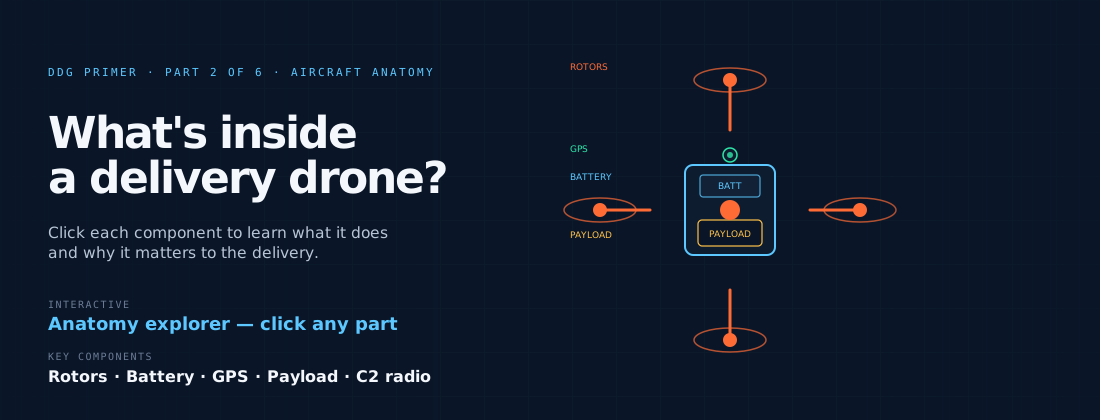
What’s inside a delivery drone: the key components explained
A commercial delivery drone is not a scaled-up toy and not a miniature aircraft. It is a purpose-built system designed around a specific problem: carrying a package of up to a few kilograms from a hub to a delivery address, autonomously, reliably, and in a wide range of weather conditions. Every component reflects a trade-off between capability, weight, cost, and reliability.
Propulsion: rotors, wings, or both
The most visible element of any drone is its propulsion system. The choice of propulsion determines almost everything else about the aircraft’s capabilities and limitations.
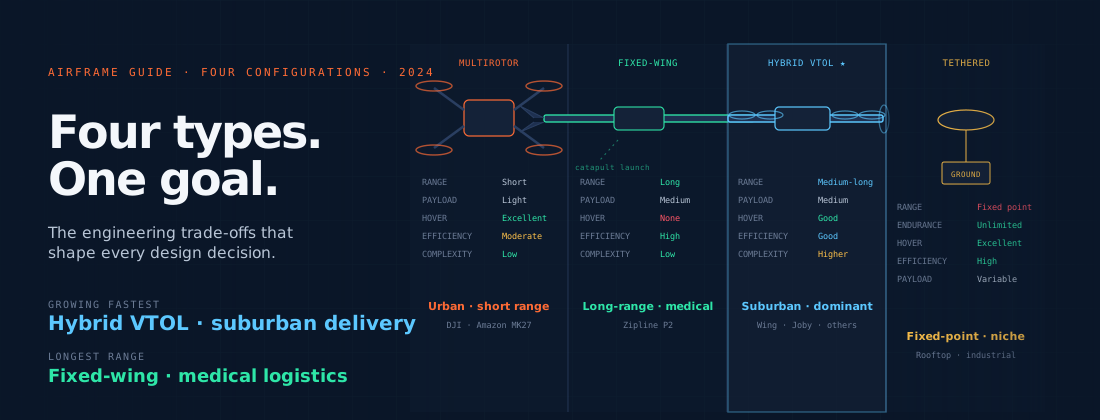
Multirotors — aircraft with four, six, or eight rotors arranged symmetrically — are the configuration most people picture when they think of a drone. They take off and land vertically, hover precisely, and can operate in confined spaces. Their weakness is efficiency: hovering requires a lot of power, which limits range and payload.
Fixed-wing aircraft — conventional aeroplanes — are far more efficient in cruise because their wings generate lift without the rotor spinning at high power. The trade-off is that they need space to take off and land, or a launch mechanism of some kind, and cannot hover over a delivery point.
Hybrid VTOL aircraft — the configuration used by Wing, Wingcopter, and others — combine vertical take-off rotors with fixed wings for cruise flight. They take off and land like a multirotor and fly like an aeroplane. The engineering is more complex, but the capability profile is better suited to many delivery applications than either pure configuration.
The battery: why range is still limited
Commercial delivery drones run on lithium-polymer or lithium-ion battery packs. The energy density of current battery technology — how much energy can be stored per kilogram of battery — is the primary constraint on range and payload for electric aircraft.
A heavier battery extends range but also adds weight that the rotors must lift, which consumes more power, which reduces the efficiency gain. The relationship between battery size and useful range is not linear. This is why small improvements in battery energy density — measured in watt-hours per kilogram — translate directly into meaningful increases in delivery range, and why battery technology development is one of the most closely watched areas in the industry.
Navigation: how the drone knows where it is
Commercial delivery drones use a combination of GPS, inertial measurement units, and barometric altimeters to know their position in three dimensions. GPS provides global positioning accurate to within a few metres. The IMU — a combination of accelerometers and gyroscopes — provides rapid position updates between GPS fixes and maintains stability during manoeuvres. The barometric altimeter provides altitude reference.
For precision delivery — lowering a package to within centimetres of a specific point — additional sensors are used. Downward-facing cameras and optical flow sensors allow the aircraft to hold position precisely even when GPS accuracy is insufficient.
Detect and avoid: sharing the sky safely
One of the most technically demanding requirements for commercial drone delivery is the ability to detect and avoid other aircraft. A drone flying Beyond Visual Line of Sight — beyond where the pilot can see it — must be able to identify potential collision risks and take evasive action without human input.
Current detect-and-avoid systems use radar, cameras, and acoustic sensors to identify other aircraft and distinguish them from birds, buildings, and other objects. The performance standards that aviation authorities require for autonomous DAA are among the most demanding technical requirements in the regulatory framework — and one of the main constraints on expanding commercial BVLOS operations.
The delivery mechanism: how the package gets from the aircraft to the ground
Different operators use different mechanisms to transfer the package from the aircraft to the customer. Wing uses a winch that lowers the package on a thin line from a hovering aircraft, placing it within a small target zone without the aircraft landing. Zipline uses a guided drop from a fixed-wing aircraft at cruise altitude — the package descends in a padded container. Some operators land the aircraft at a dedicated pad near the delivery point.
The choice of delivery mechanism has major consequences for the proportion of addresses that can be served (some gardens are too small or too obstructed for a winch delivery), the range of products that can be carried (drop delivery rules out fragile or liquid items), and the noise impact on surrounding residents.