AirMap: the USS platform that has been at the centre of UTM development since the beginning
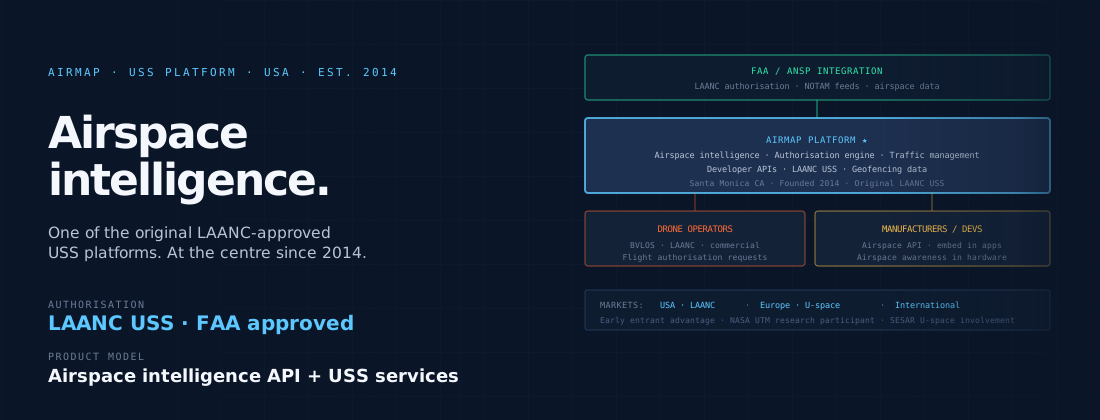
AirMap was founded in Santa Monica, California in 2014. In the years that followed, the company positioned itself at the centre of a problem that the drone industry was beginning to confront: how commercial unmanned aircraft operations could be managed in shared airspace at scale. The UTM category that AirMap helped define — the digital infrastructure for coordinating commercial drone operations — was not yet named when the company was founded. By the time LAANC became operational in the United States, AirMap was among its founding approved suppliers.
LAANC and the US market
LAANC — the Low Altitude Authorization and Notification Capability — is the FAA’s system for providing automated, near-real-time airspace authorisation to drone operators in controlled airspace around airports. Before LAANC, a drone operator needing to fly in Class B, C, D, or E airspace had to submit a manual waiver request that could take weeks to process. LAANC reduced this to near-instantaneous authorisation for operations within pre-defined parameters.
AirMap was among the first USS platforms to achieve LAANC approval, giving it access to the largest commercial drone market in the world through the most significant digital airspace management framework the FAA had created. The LAANC network processes a large volume of authorisation requests and provides the data infrastructure through which a significant proportion of commercial US drone operations are legally authorised.
International expansion and U-space engagement
AirMap has pursued international expansion beyond the US LAANC framework, engaging with UTM and U-space development processes in European and Asian markets. The company has participated in SESAR Joint Undertaking projects developing the U-space framework in Europe, and has developed relationships with aviation authorities in markets where UTM frameworks are being built.
The challenge of international expansion for a USS platform is that each jurisdiction requires separate regulatory engagement and, in the case of EU member states under the U-space framework, separate national certification. AirMap’s international development has therefore required substantial investment in regulatory relationships across multiple jurisdictions — an investment that reflects the company’s view that the long-term UTM market is global rather than US-centric.
Airspace intelligence as a product
Beyond the authorisation and traffic management functions of UTM, AirMap has developed airspace intelligence as a product category: the aggregation, processing, and presentation of airspace data — NOTAM feeds, TFR data, weather, regulatory boundaries — in formats that drone operators, manufacturers, and software developers can use. This airspace intelligence layer has commercial value independent of the authorisation function: a drone manufacturer whose app can show pilots where they can legally fly is providing a safety function that also reduces the manufacturer’s liability exposure.
The developer platform that AirMap has built around this airspace intelligence — providing APIs that allow drone manufacturers and software developers to embed airspace awareness in their own products — represents a different commercial model from the direct USS-to-operator relationship. It positions AirMap as infrastructure for the drone ecosystem rather than a direct service provider to operators, which provides a broader addressable market but also more diffuse revenue relationships.
The competitive position
AirMap operates in a USS market that has multiple established participants — Altitude Angel, Unifly, and others in Europe; additional competitors in Asian markets. The structural dynamics of this market, as analysed elsewhere on DDG, favour consolidation over time. AirMap’s position as one of the earliest entrants, with LAANC approval and relationships across multiple regulatory jurisdictions, represents a meaningful incumbent advantage that later entrants cannot easily replicate. Whether that advantage is sufficient to sustain AirMap’s position through the consolidation phase that the UTM market is likely to undergo is one of the central questions for the company’s long-term trajectory.