How noise shapes community acceptance — and how operators are responding
Regulatory authorisation for drone delivery establishes the legal permission to operate. Community acceptance determines whether that operation remains politically sustainable over time. The two are related but not identical: an operation can be legally authorised and communally opposed, a combination that creates pressure for regulatory revision and operational constraint. Among the factors that drive community opposition to drone delivery, noise is consistently the most prominent.
Why delivery drones are noisy
The acoustic footprint of a multirotor delivery drone is determined primarily by the interaction between the rotating blades and the air. The fundamental frequency of the noise generated by a rotor is determined by the blade passage frequency — the number of times a blade passes a given point per second, determined by the number of blades and the rotational speed. Multirotors typically generate noise in the 80 to 100 Hz range for the fundamental frequency, with harmonics extending to several kilohertz.
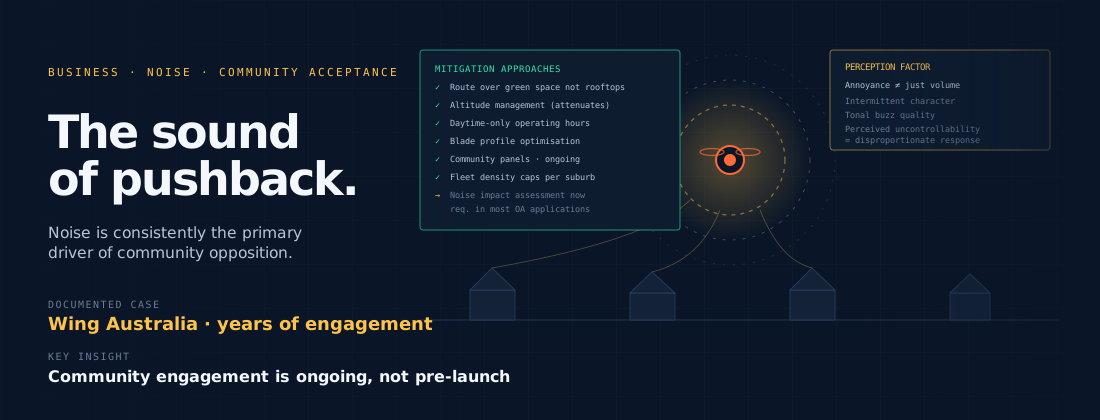
The perceptual quality of this noise — how annoying it is relative to its absolute level — is a significant factor in community response. The combination of a high-pitched buzzing character, intermittent occurrence (as the aircraft passes overhead), and association with a source perceived as unnecessary creates an annoyance response that can be disproportionate to the absolute noise level. Studies of community response to aircraft noise have consistently found that the perceived controllability of the noise source — whether the affected person feels they have any say in whether the noise occurs — is a significant predictor of annoyance, and drone delivery operations are perceived as particularly uncontrollable from the community’s perspective.
Wing’s Australian experience
Wing’s Australian operations have generated the most publicly documented body of evidence on community response to drone delivery noise, partly because the operations have run for several years and partly because the company has been required to engage with community concerns as part of its ongoing regulatory relationship with CASA.
Wing has publicly acknowledged that noise was a significant concern raised by residents in its Canberra operational area. The company made modifications to its operational procedures — adjusting routing to avoid flying directly over houses where alternatives existed, constraining operating hours to daytime periods, and working with aircraft designers on rotor configurations that reduce the tonal character of the noise. Wing has also described conducting surveys of residents in its operational areas and adjusting operations in response to the findings.
The Australian experience demonstrates that community noise concerns, while real and significant, are manageable through operational design and genuine engagement — but that they require sustained attention rather than a one-time resolution. An operator that treats community engagement as a pre-launch activity rather than an ongoing operational function is likely to face recurring friction.
Design approaches to noise reduction
Aircraft designers have pursued several approaches to reducing the noise footprint of delivery drones. Rotor blade profile optimisation — modifying the shape, pitch distribution, and tip geometry of rotor blades — can reduce the intensity of the tonal noise components that make drone noise particularly annoying. Increasing the number of blades reduces the amplitude of individual blade vortex interactions. Reducing rotor disc loading — the thrust per unit area of the rotor disc — typically reduces noise but requires either larger rotors or more of them, with corresponding weight implications.
The noise-efficiency trade-off is a genuine constraint: the rotor configurations that produce the least noise are generally not those that produce the best aerodynamic efficiency. Design teams must balance noise, efficiency, weight, and reliability, with the optimal balance depending on the specific operational context.
Operational noise mitigation
Beyond aircraft design, operational approaches to noise mitigation include routing optimisation (avoiding flying directly over residences where alternatives exist), altitude management (higher altitude attenuates noise at ground level, with the trade-off of increased energy cost), timing restrictions (avoiding operations during periods of peak outdoor residential activity), and fleet density management (avoiding high concentrations of simultaneous flights over the same neighbourhood).
The effectiveness of operational noise mitigation depends on how the operation is designed from the outset. An operator that has planned routes without considering noise impact will find it more difficult to retrofit noise mitigation than one that incorporates noise modelling into initial route design. The regulatory trend in most jurisdictions is toward requiring noise impact assessment as part of operational authorisation applications — making noise consideration part of the design process rather than an afterthought.