Ten things a decade of commercial drone delivery has demonstrated
This article represents DDG’s editorial analysis drawing on publicly available information about commercial drone delivery operations over the period since the first sustained commercial services launched. It is analytical rather than a factual account of specific events.
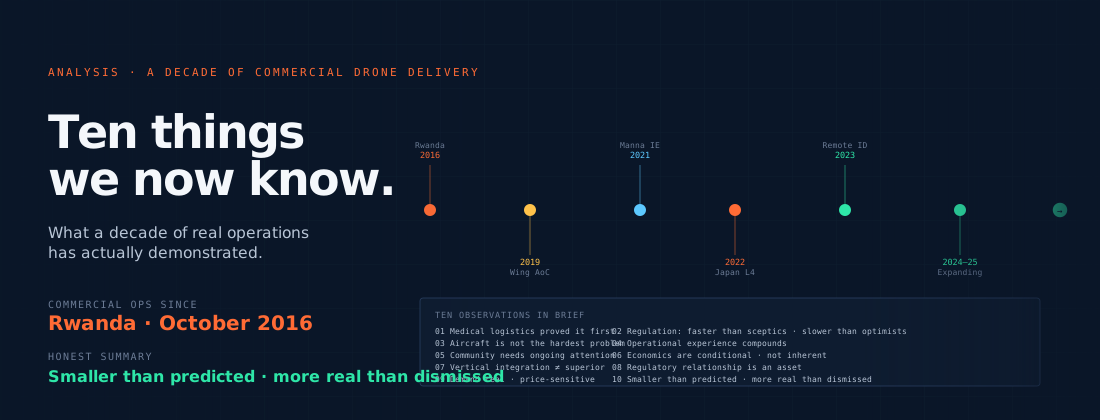
When Zipline began delivering blood products to health facilities in Rwanda in 2016, commercial drone delivery was largely a concept supported by prototypes and optimistic timelines. In the years since, real operations have produced real evidence. The industry that exists today looks different from the industry that was predicted — in ways that are instructive for understanding where it is going.
1. Medical logistics proved the concept where retail could not
The operations that achieved commercial sustainability earliest were medical logistics operations in markets where the alternative to drone delivery was slow, unreliable, or absent. Rwanda, Ghana, the Swiss hospital network: these markets shared the characteristic that the time value of the delivery was measurable in clinical outcomes. The economics worked because the premium justified by the service was real and the alternative was genuinely inferior. Retail delivery in markets with functioning same-day road logistics has proven harder to make economically viable at current scale.
2. Regulation moves faster than the sceptics predicted and slower than the optimists hoped
The early years of commercial drone delivery were accompanied by predictions that ranged from regulatory blockage that would prevent commercial operations indefinitely to imminent full-scale deployment in major cities. The reality has been neither. BVLOS authorisations have been granted. Rules-based frameworks have developed. Operations over populated areas have been permitted in multiple jurisdictions. This is faster than sceptics expected. It has also taken longer and been more incremental than optimists projected.
3. The aircraft is not the hardest problem
A decade of industry development has produced capable, reliable delivery aircraft from multiple manufacturers. The engineering challenge of building a drone that can carry a meaningful payload over a meaningful distance reliably is essentially solved at current operational scales. The harder problems have proven to be regulatory authorisation, community acceptance, logistics integration, and hub economics — none of which is primarily an aircraft engineering problem.
4. Operational experience compounds
The operators who have been flying the longest have accumulated something that money cannot quickly buy: operational data. Wing’s years of Australian operations provide a dataset on real-world failure modes, weather impacts, and community response that is directly useful for regulatory engagement, operational improvement, and expansion planning. Zipline’s African operations provide similarly compounded experience. The value of operational time cannot be shortcut by investment.
5. Community acceptance requires sustained investment
Every operator that has conducted sustained residential delivery operations has encountered community opposition to noise, privacy concerns, or both. Every operator that has managed to continue operating has done so through sustained community engagement — not a pre-launch consultation but an ongoing process of listening, responding, and adjusting operations. Operations that treated community acceptance as a regulatory checkbox rather than an operational function have faced recurring friction.
6. The economics are real but highly conditional
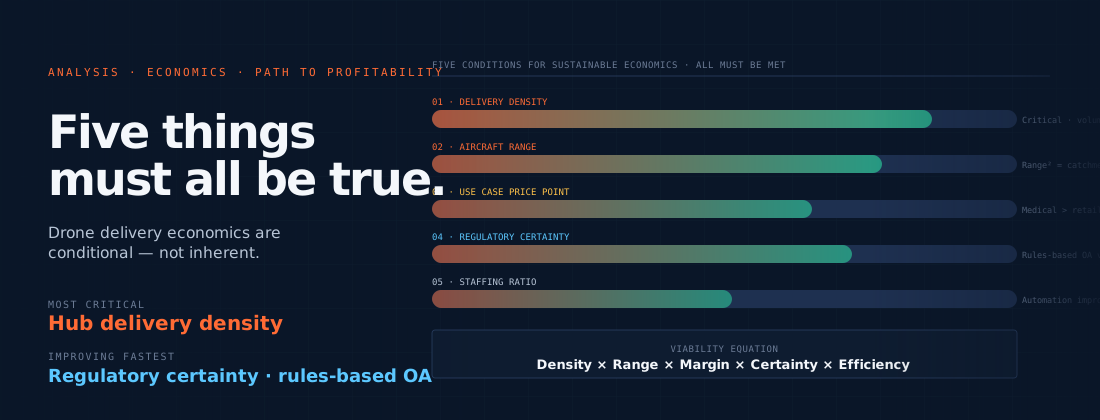
Drone delivery can be economically viable. It is not automatically economically viable. The conditions under which the economics work — sufficient delivery density, appropriate use case, regulatory certainty, operational maturity — must all be met simultaneously. Operations that have met those conditions have continued and expanded. Operations that have not have contracted or exited.
7. Vertical integration is not obviously superior to specialisation
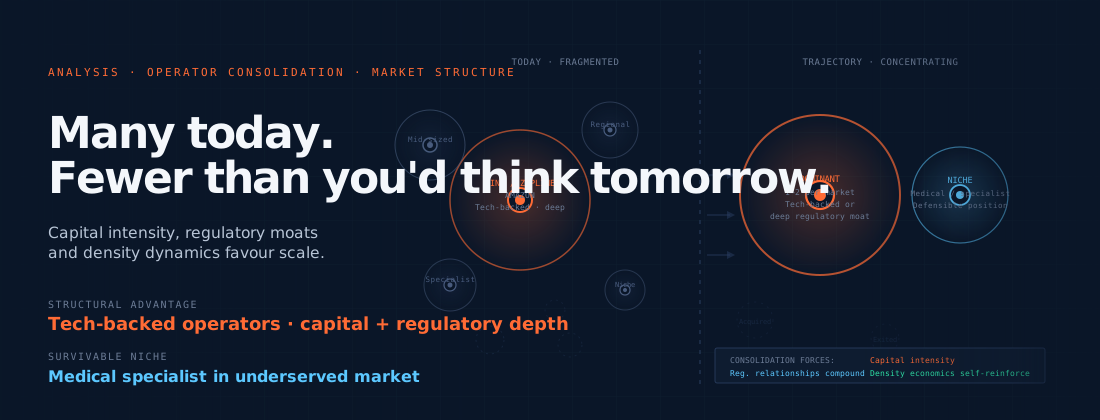
The industry contains both highly vertically integrated operators — who build their own aircraft, develop their own software, and operate their own USS — and highly specialised ones, who buy aircraft, license software, and use third-party airspace services. Neither model has demonstrated clear superiority. Vertical integration provides control and potential cost advantage at scale; specialisation provides flexibility and faster time to market. The right balance depends on the specific market and the operator’s competitive position.
8. The regulatory relationship is an asset
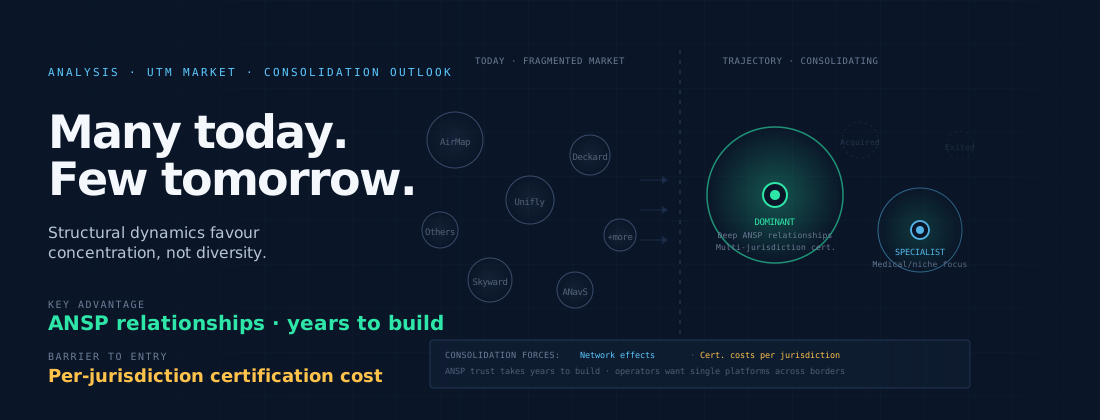
The operators that have achieved the most regulatory progress are not necessarily those with the best aircraft. They are those that have invested most systematically in building regulatory relationships — engaging early, sharing operational data transparently, participating in standard-setting processes, and treating regulators as partners in safety rather than obstacles to progress. The regulatory relationship is an asset that, like operational experience, compounds over time and cannot be quickly acquired by new entrants.
9. Consumer demand is real but price-sensitive
Where commercial delivery services have operated, customers have used them and, in documented cases, expressed high satisfaction. The demand for faster delivery than road alternatives can provide is real. It is also price-sensitive: the premium that residential customers will pay for drone delivery over road delivery is not unlimited, and pricing that makes the economics work for the operator may not match the premium that customers will sustain over time. Finding the sustainable price point has been one of the persistent commercial challenges of the sector.
10. The industry is smaller than predicted and more real than dismissed
A decade ago, projections for drone delivery in 2025 ranged from dystopian saturation to irrelevance. The reality is neither. Commercial drone delivery exists, works, and is growing — but it is a specific, relatively narrow industry serving defined use cases in a limited number of markets, not the ubiquitous transformation of logistics that the most optimistic projections described. Understanding it accurately — as a real but bounded industry with specific economic and regulatory conditions for success — is more useful than either the hype or the dismissal.