How packages reach the ground: comparing winch, drop and landing delivery mechanisms
Drone delivery discussions focus heavily on aircraft — range, payload, airframe configuration. The delivery mechanism receives less attention but determines as much of the operational design as the aircraft itself. How the package reaches the ground from a hovering or passing aircraft is not a detail to be solved after the aircraft is chosen: it shapes what aircraft configurations are viable, what locations can be served, what payloads can be carried, and how quickly the hub can cycle aircraft for the next delivery.
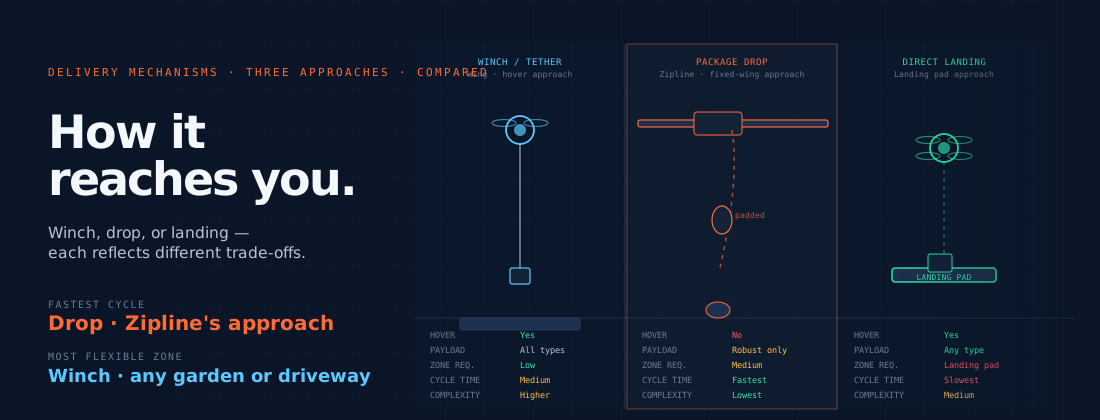
Three delivery mechanisms dominate current commercial operations: winch lowering, package drop, and direct landing. Each reflects a different set of engineering trade-offs and suits different operational contexts.
Winch lowering
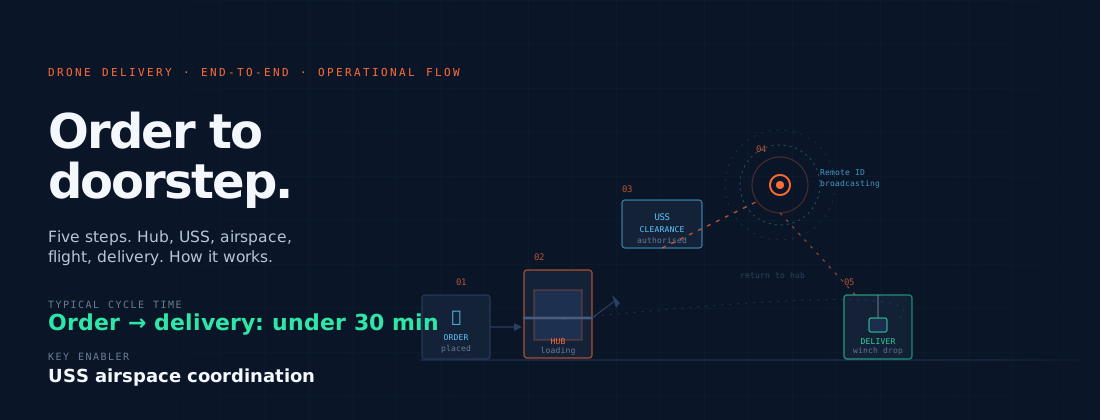
The winch mechanism — used most publicly by Wing — involves the aircraft hovering above the delivery zone at a fixed altitude and lowering the package on a tether until it reaches the ground. The package detaches from the tether at ground level, and the tether is retrieved as the aircraft returns to base. The aircraft never lands at the delivery address.
The primary advantage of winch delivery is the flexibility of the delivery zone. Because the aircraft is hovering rather than landing, it does not require a prepared surface: a garden, a driveway, or a patch of clear ground of sufficient size is adequate. The delivery zone can be any outdoor residential space with sufficient clearance above and around it — a much wider category of eligible addresses than those with suitable landing surfaces.
The mechanism also provides precise placement: the tether allows the package to be lowered to a specific location within the delivery zone, giving customers predictable placement and avoiding the scattering that drop delivery produces.
The limitations of winch delivery are primarily operational. The mechanism adds mechanical complexity — a motor, a tether, a release mechanism, a sensor system to detect ground contact — that creates additional maintenance requirements and potential failure modes. Wind affects the tether during lowering, causing the package to swing: in significant crosswinds, precise placement becomes difficult and the aircraft must work against the wind to maintain position, consuming battery energy. The hover time required for the lowering and retrieval sequence is also energy-intensive and adds to the delivery cycle time compared with faster mechanisms.
Package drop
The drop mechanism — used by Zipline and others — involves the aircraft releasing the package from a defined altitude in a padded container designed to absorb the impact of landing. In Zipline’s implementation, the aircraft does not hover: it passes over the delivery zone at cruise speed and releases the package, which glides or falls to the delivery area in a padded tube.
The operational advantages of drop delivery are speed and simplicity. The aircraft does not need to hover — which is energy-intensive for fixed-wing designs — and the delivery sequence adds minimal time to the flight. For fixed-wing aircraft that cannot hover at all, drop delivery is the only viable mechanism without a significant altitude change.
The cycle time advantage is substantial. A drop delivery adds seconds to a flight rather than the minutes required for a winch sequence. For a hub operating at high frequency, this difference compounds: a hub completing 100 deliveries per day saves significant accumulated time and battery energy through drop delivery compared with winch.
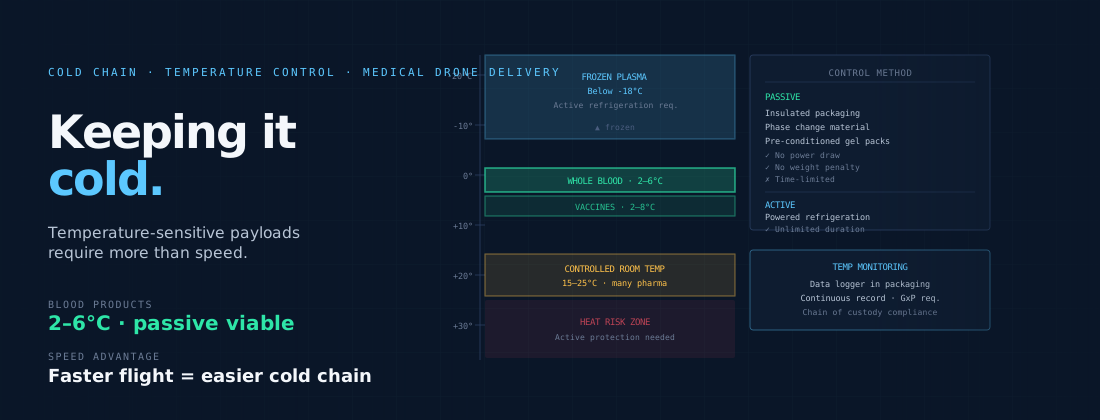
The limitations are payload-related. Drop delivery imposes significant constraints on what can be carried. Fragile items — electronics, glass containers, certain medical products — cannot tolerate the impact of a drop landing even with sophisticated packaging. Liquid containers that might spill, items requiring upright orientation, and anything where packaging integrity is critical after delivery are generally not suitable for drop mechanisms. The mechanism is well-suited to blood products in their specific packaging, pharmaceuticals in robust containers, and small durable goods — but narrows the category of deliverable items compared with winch or landing mechanisms.
The delivery zone also requires more clearance than winch delivery: the package arrives at speed and needs space to land without hitting obstacles. This limits drop delivery in environments with high obstacle density.
Direct landing
Landing delivery involves the aircraft flying to the delivery location and landing, either on a prepared pad or a suitable natural surface, releasing the package, and departing. The aircraft physically reaches the ground at the customer’s location.
The advantage of landing delivery is that it imposes the fewest constraints on payload. Any item that can be carried in the aircraft’s payload bay and tolerate the aircraft’s flight dynamics can be delivered: fragile items, liquids, temperature-sensitive products, large or irregularly shaped packages. The landing also allows for more reliable placement and, in principle, for customer interaction at the delivery point.
The limitations are operational. Landing delivery requires a suitable landing surface at every delivery address — flat, clear of obstacles, with adequate approach and departure paths. In residential environments, suitable surfaces exist (driveways, flat garden areas) but exclude a proportion of addresses that lack them. Urban environments with limited outdoor space create significant challenges for landing delivery.
The delivery cycle time is also the longest of the three mechanisms: approach to landing, weight-on-wheels confirmation, payload release, departure, all take time. For operations with tight hub cycle time requirements, this is a meaningful constraint.
Choosing a mechanism
The appropriate delivery mechanism depends on the use case more than any single performance factor. Medical logistics operations — particularly blood products and laboratory samples — have used drop delivery successfully because the payloads are robust, the time advantage is valuable, and the delivery zones (hospital helipads and designated receiving areas) provide suitable clearance. Retail and consumer delivery, where the payload category is diverse and includes fragile items, tends toward winch delivery for its flexibility. High-volume operations with a well-defined, durable payload category may favour drop delivery for its speed advantage.
Some operators have developed hybrid systems that combine elements of different mechanisms or design their aircraft and payload bays to support multiple delivery modes depending on the payload type. The diversity of mechanisms in current commercial use reflects a sector that has not yet converged on a single solution — which in turn reflects the diversity of the use cases it is trying to serve.