The Amazon effect: how Prime Air’s trajectory shapes expectations for the whole sector
This article is DDG’s analytical assessment of Amazon Prime Air’s influence on the commercial drone delivery sector. It is based on publicly available information about Amazon’s drone delivery programme and the broader sector’s development.
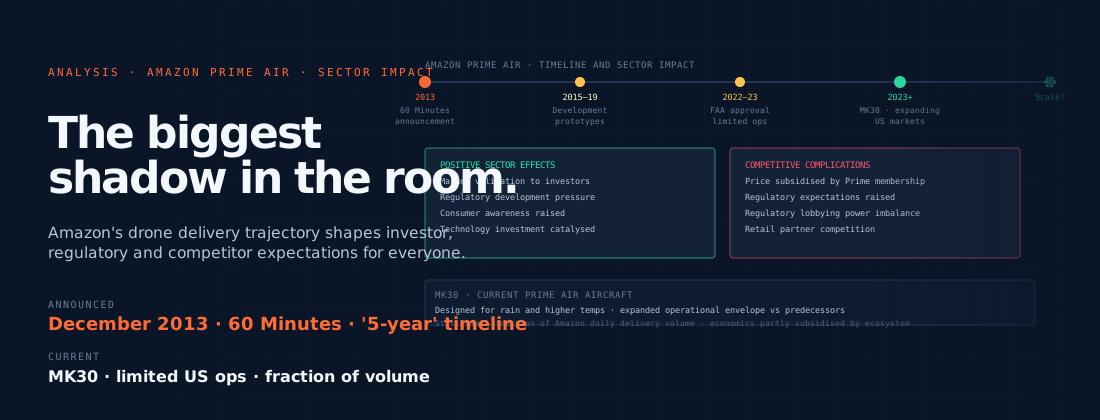
Jeff Bezos announced Amazon’s drone delivery ambitions on 60 Minutes in December 2013, framing autonomous drone delivery as something Amazon expected to achieve within five years. More than a decade later, Prime Air is operational — but the operational scale and timeline are very different from what the 2013 announcement implied. The gap between the initial promise and the operational reality is not unique to Amazon, but Amazon’s size and media prominence mean that its trajectory has had effects on the entire sector that other operators’ trajectories have not.
How the announcement shaped investment and expectations
The 2013 announcement, and subsequent high-profile coverage of Prime Air development, created a public expectation that drone delivery would be widely available to consumers within a few years. This expectation — combined with Amazon’s track record of delivering on ambitious logistics commitments — attracted investment into the drone delivery sector that might not have materialised as quickly or at as large a scale without it.
The investment attracted by the drone delivery sector’s implied Amazon-backed future has funded real development. Wing, Zipline, Flytrex, DroneUp, and other operators have all benefited from an investor community that was primed to see drone delivery as an imminent large-scale opportunity rather than a speculative long-term technology bet. The Prime Air announcement, whatever its accuracy as a delivery timeline, catalysed a sector that has produced real operational capability.
The regulatory dynamic
Amazon’s engagement with the FAA on drone delivery regulation has been both significant and complicated. The company’s scale, its legal and regulatory resources, and its commercial urgency have made it a forceful advocate for regulatory development that enables commercial drone delivery. Amazon’s participation in FAA rulemaking discussions, its public comments on proposed regulations, and its advocacy for specific technical standards have all shaped the regulatory development process.
At the same time, the FAA’s recognition that Amazon — with its scale, its customer base, and its logistics infrastructure — represents a categorically different kind of commercial drone operator from the smaller operators that have achieved earlier operational successes has created regulatory dynamics that are not always straightforwardly positive for the sector. The concern that regulations designed around Amazon’s eventual scale might be more stringent than those needed for the operators currently achieving commercial viability has been raised by smaller operators in regulatory discussions.
The MK30 and the current state of Prime Air
Amazon’s current delivery drone, the MK30, represents a substantially more developed system than the early Prime Air prototypes that preceded it. The MK30 has been designed for operations in rain and at higher temperatures than previous versions, expanding the operational envelope. It has been deployed in specific markets in the United States, delivering packages to residential addresses from Amazon fulfilment sites within the operational radius.
The operational scale of Prime Air remains limited relative to Amazon’s overall delivery volume — a tiny fraction of Amazon’s daily package deliveries come by drone. The path from current limited deployment to the scale at which Prime Air becomes a meaningful component of Amazon’s logistics network runs through the same regulatory development, operational scaling, and community acceptance challenges that all operators face — just with Amazon’s resources applied to them.
The sector impact of Amazon’s presence
Amazon’s presence in the drone delivery sector has ambiguous effects on other operators. On one hand, it validates the market to investors and customers, creates regulatory pressure for framework development, and demonstrates the operational seriousness of the technology. On the other hand, it creates competitive dynamics that smaller operators struggle to match: Amazon can subsidise Prime Air delivery as a customer retention tool for Prime membership, making the economics of delivery pricing disconnected from the true cost of the service.
The operators best insulated from Amazon’s competitive pressure are those serving use cases that Amazon does not — particularly medical logistics, which Amazon’s retail delivery infrastructure is not designed to serve. The operators most exposed are those competing directly for the same retail delivery customers in markets where Prime Air is or becomes available.
The Amazon effect on the sector is ultimately the Amazon effect on everything it enters: the presence of a well-capitalised, operationally sophisticated, customer-relationship-advantaged competitor that competes on terms that the broader market cannot match. For drone delivery, as for e-commerce, logistics, cloud computing, and other sectors, Amazon’s entry changes the competitive dynamics for every other participant — not always to their disadvantage, but always in ways they must account for.