The autonomy gap: what it will take for commercial drones to fly without a remote pilot
This article represents DDG’s editorial analysis of where the industry stands and the direction it is likely to develop, based on publicly available regulatory and technical information. Forward-looking assessments reflect our interpretation of current trends and should not be treated as predictions of specific outcomes or timelines.
Every jurisdiction that currently permits commercial BVLOS drone delivery — the United States, Australia, Japan, Ireland, Rwanda, and others — requires that a qualified remote pilot in command be contactable and accountable for each flight. The pilot may not be able to see the aircraft. They may be monitoring dozens of simultaneous flights from a ground control station. But they are there, and their presence is a regulatory requirement.
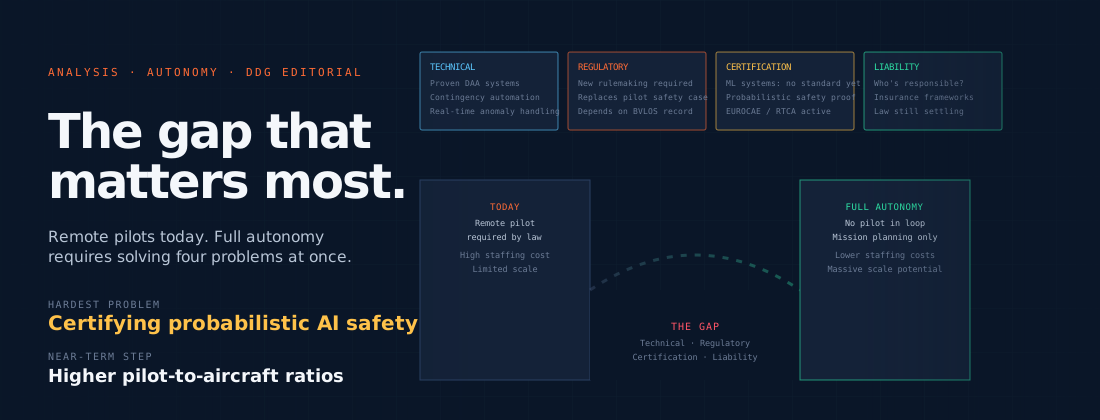
Removing that requirement — allowing commercial delivery drones to operate with no human in the loop beyond the mission planning phase — is the change that would most significantly alter the economics of drone delivery. It is also the change that requires the most work to achieve, across four distinct dimensions that must all be addressed simultaneously.
The technical dimension
Autonomous flight in the sense of executing a pre-planned route without real-time pilot input is already present in most commercial delivery systems. What is missing is the capability to handle unexpected situations — airspace conflicts, system anomalies, unusual weather, landing zone obstructions — without human intervention.
Detect and avoid systems that can identify and respond to non-cooperative traffic (aircraft without transponders, birds, other obstacles) without human input remain a significant technical challenge. Current DAA systems in commercial use typically flag conflicts for human resolution rather than resolving them autonomously. The gap between detecting a potential conflict and responding to it appropriately without human judgement is substantial, particularly in complex or ambiguous situations.
The contingency management problem is similarly demanding. A human remote pilot who observes an anomaly — a battery draining faster than expected, an unusual vibration, a GPS uncertainty — can apply judgement about the appropriate response. Automated systems must either handle every potential anomaly through pre-programmed logic or escalate to human oversight. The range of anomalies an aircraft can encounter in real-world operations is broad enough that pre-programmed responses are inherently incomplete, and the escalation to human oversight is precisely what autonomy is trying to eliminate.
The regulatory dimension
Current BVLOS rules in most jurisdictions were written with a remote pilot as an assumed component of the safety case. The remote pilot’s judgement is implicitly part of the risk mitigation for many of the scenarios the rules are designed to address. Removing the remote pilot from the safety case requires rewriting or supplementing those rules to specify what alternative mitigations are acceptable.
This is not a minor amendment to existing rules. It requires a rulemaking process that defines the performance standards autonomous systems must meet, the certification pathway for demonstrating they meet them, and the operational framework within which autonomous operations are permitted. In most major jurisdictions, that rulemaking has not started.
The logical sequencing of regulatory development suggests that the BVLOS framework must be proven at scale before the autonomy framework is developed on top of it. Regulators who have not yet processed the safety record of BVLOS operations with remote pilots in the loop are unlikely to be prepared to assess the safety case for operations without them. This sequencing makes the regulatory timeline for autonomy dependent on the pace at which the BVLOS framework matures — which adds time regardless of the state of the technical solutions.
The certification dimension
Certifying an autonomous system for use in civil airspace involves demonstrating, to a regulatory authority’s satisfaction, that the system meets defined safety performance standards. For software-based autonomous decision-making — particularly the machine learning systems that underpin current DAA and contingency management approaches — the certification methodology is not yet established in most jurisdictions.
Aviation certification bodies have historically required deterministic systems: given input X, the system produces output Y, always. Machine learning systems are probabilistic rather than deterministic: they produce output Y most of the time, with some probability distribution over other outcomes. Developing certification frameworks for probabilistic safety-critical systems is an active area of work in aviation standards bodies, but it has not yet produced widely adopted standards for autonomous UAS.
The liability dimension
When a remote-pilot-in-command is required, the liability framework for an incident is relatively clear: the operator is responsible, and within the operator’s organisation, the remote pilot in command has a defined accountability. When no human is in the loop during flight, the liability framework becomes more complex. Product liability, operator liability, software developer liability — the distribution of responsibility in the event of an autonomous system failure affecting a third party is an area of law that is not yet settled in most jurisdictions.
Insurance markets, which have developed products for piloted BVLOS operations by building on aviation insurance frameworks, face a similar challenge in pricing autonomous operations. The actuarial data for autonomous commercial drone operations simply does not yet exist at meaningful scale.
The trajectory
None of these four dimensions is individually insurmountable. Each is being actively worked on, by operators, manufacturers, regulators, standards bodies, and legal scholars. The challenge is that all four must be resolved sufficiently, simultaneously, before autonomous commercial operations at meaningful scale become possible.
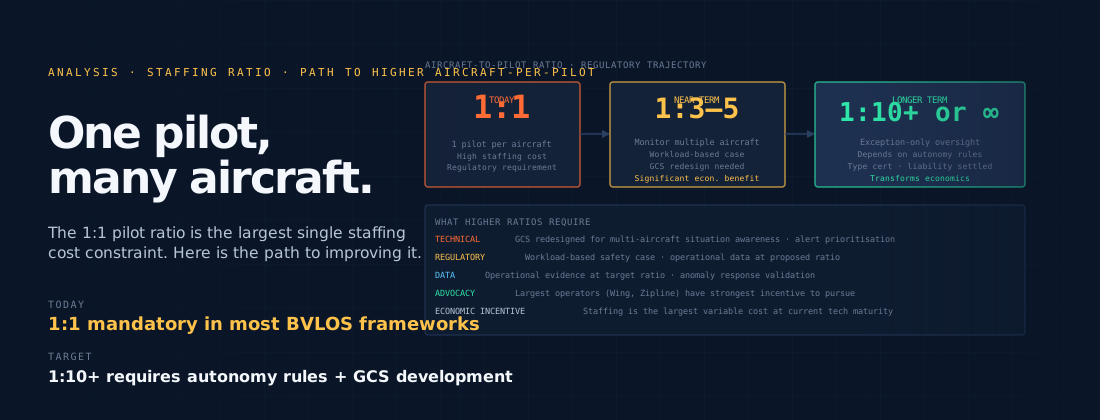
The most plausible path to operational autonomy runs through graduated steps rather than a single transition. Reduced remote pilot ratios — one pilot monitoring many more aircraft than current rules allow — represent an intermediate position that requires less from each of the four dimensions than full autonomy while delivering significant economic benefit. The path from current ratios to higher ones, and from those to full autonomy, is where the technical, regulatory, certification and liability work is most usefully focused.
The operators whose economics most depend on resolving the autonomy question are building the case for the next regulatory step from the moment the current rules take effect. The pace at which that case develops will determine more about the industry’s trajectory than almost any technical development in the aircraft itself.