The minimum viable hub: what delivery density numbers actually determine drone delivery economics
This article is DDG’s analytical assessment of drone delivery hub economics, based on publicly available information about operational costs, pricing, and market structure. Specific numbers used are illustrative of the structural relationships involved; actual operator economics vary and are largely commercially sensitive.
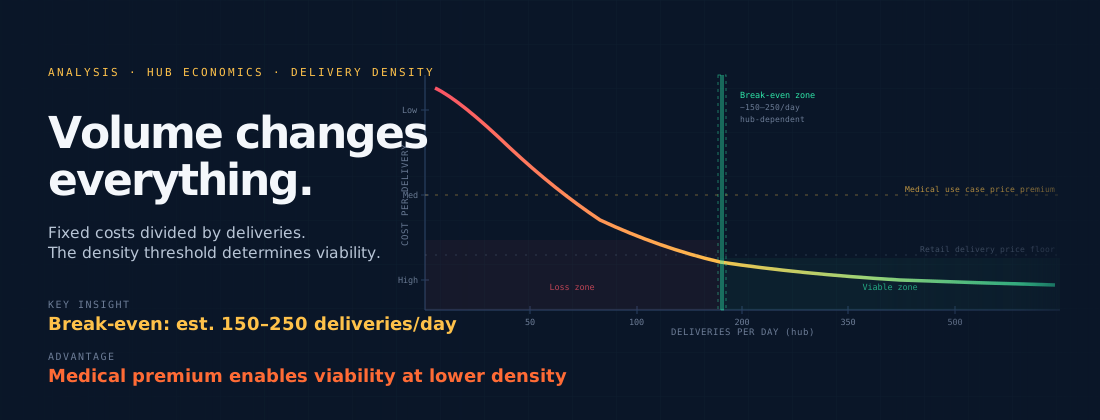
The most important number in drone delivery economics is not the cost of the aircraft, the range, or the payload capacity. It is the number of deliveries the hub makes per day. Everything else — the fixed cost of the hub, the staffing, the maintenance overhead, the regulatory compliance cost — is divided by that number. At low delivery volumes, the cost per delivery is not commercially viable. At high delivery volumes, it is. The threshold between the two determines which markets and use cases can sustain commercial drone delivery operations.
The fixed cost structure
A commercial drone delivery hub carries costs that are largely fixed regardless of delivery volume. The hub facility — whether owned, leased, or co-located with a retail partner — has a fixed cost. The minimum staffing required to run the operation safely — remote pilots, package handlers, maintenance technicians — has a floor that does not scale proportionally with delivery volume below a certain threshold. The regulatory compliance overhead — the cost of maintaining the operational authorisation, safety management system, and related documentation — is largely fixed. The aircraft fleet, once purchased or leased, has a fixed cost.
Layering these costs produces a hub cost structure that looks like a fixed base plus a variable component that scales with volume. The fixed base is substantial relative to the variable component at current technology maturity. A hub delivering 20 packages per day has almost the same fixed cost base as one delivering 200, but ten times the cost per delivery. The economics of drone delivery are therefore acutely sensitive to delivery volume in a way that road delivery — which has a more linear cost structure — is not.
What break-even looks like
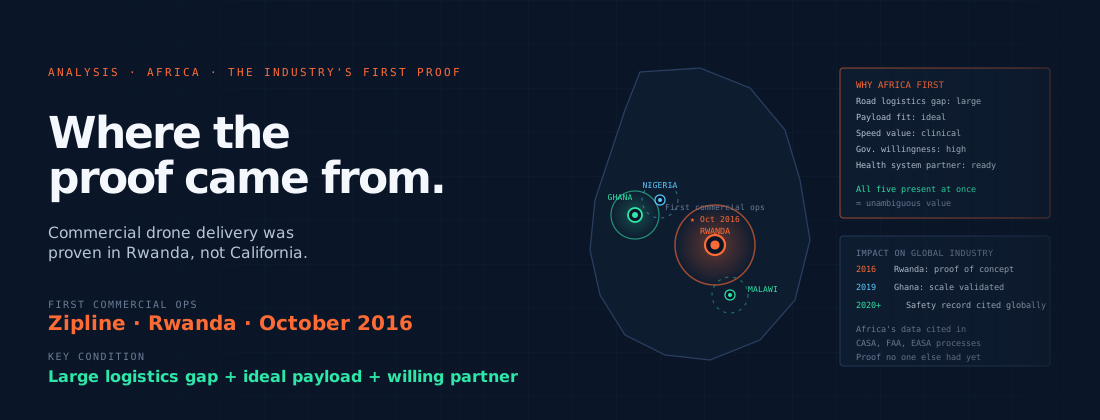
The break-even delivery volume — the number of deliveries per day at which the hub covers its costs — depends on the specific cost structure of the operation, the pricing it can achieve, and the retail or healthcare partner economics that determine the revenue per delivery. These variables differ significantly across markets and use cases, which is why the economics of medical drone delivery in Rwanda are so different from those of retail drone delivery in suburban Virginia.
Operators that have discussed their economics publicly have generally described break-even in terms of hundreds of deliveries per day from a single hub — not tens. The gap between current operational volumes at early-stage hubs and the volume required for positive unit economics is one of the central challenges of the industry’s development phase. The investment thesis for most funded operators involves accepting this gap during the period when volume is being built, in the expectation that the unit economics at scale are attractive enough to justify the investment.
Catchment area and the geometry of density
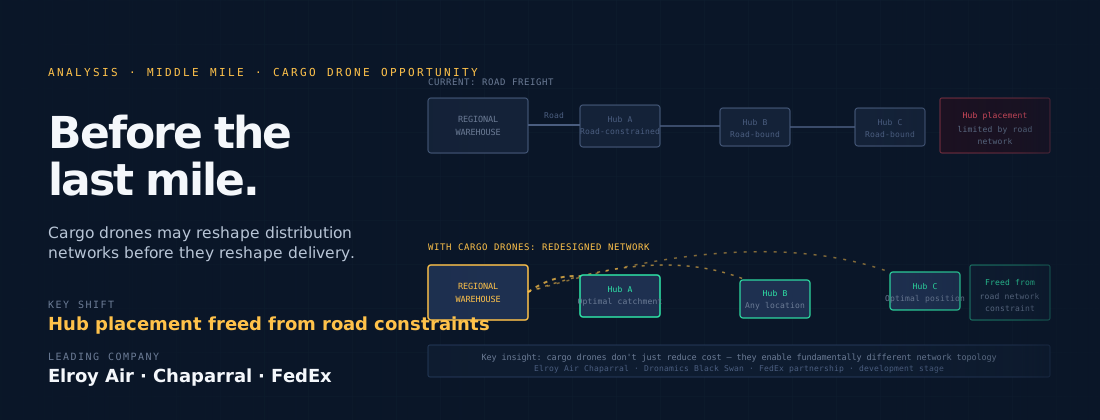
The delivery volume a hub can achieve is constrained by the catchment area it can serve — the geographic circle around the hub within which delivery is operationally possible. The density of deliverable addresses within that circle, and the proportion of those addresses that choose drone delivery, determines the maximum daily delivery volume the hub can reach.
This is why aircraft range has such outsized importance in drone delivery economics. A range improvement of 50 per cent does not increase the catchment area by 50 per cent — it increases it by 125 per cent, because catchment area scales with the square of the range. A hub that gains meaningful range capability through aircraft improvement can serve dramatically more addresses with no change in its fixed cost base, fundamentally changing its break-even volume calculation.
The use case premium and its impact on density requirements
The minimum viable delivery density is not fixed — it depends on the revenue per delivery. A medical logistics use case where the delivery premium is large can sustain profitable operations at lower delivery volumes than a consumer retail use case where the premium is modest. This is the structural reason why medical logistics has achieved commercial sustainability at smaller scale than consumer retail: the unit economics are better at the same delivery volume.
As the industry matures and retail drone delivery scales to higher volumes, the density threshold for viable retail operations will fall — both because volume increases and because operational improvements reduce fixed costs per delivery. The operators that survive the current low-volume phase to reach that threshold will find economics that are materially more attractive than what the industry’s early critics assumed would be the permanent state of affairs.