Africa as the proving ground: why drone delivery scaled where conventional logistics struggled most
This article is DDG’s analytical assessment of why African markets have been central to the development of commercial drone delivery, based on publicly available information about operations and the conditions that enabled them.
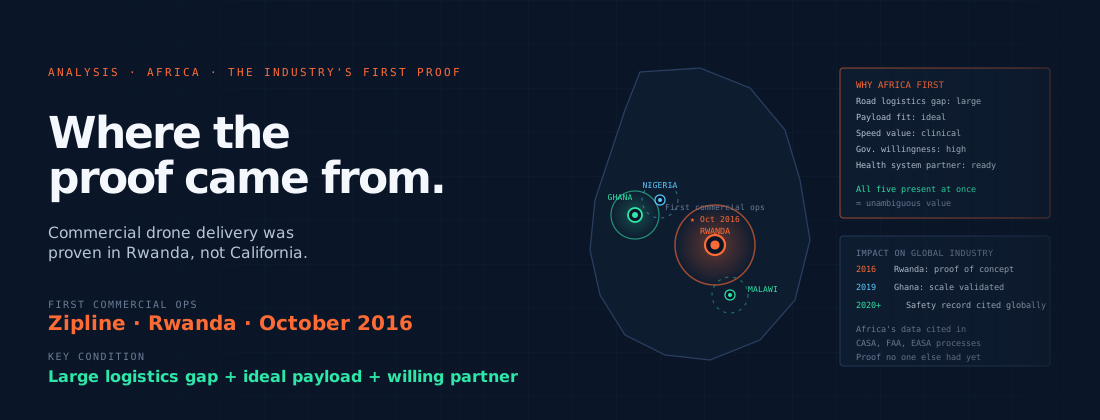
Zipline began delivering blood products to health facilities in Rwanda in October 2016. By any reasonable definition, that operation — real commercial flights, genuine medical payloads, sustained delivery to health facilities that depended on the service — was the beginning of the commercial drone delivery industry. Not in Silicon Valley. Not in Singapore. In Kigali.
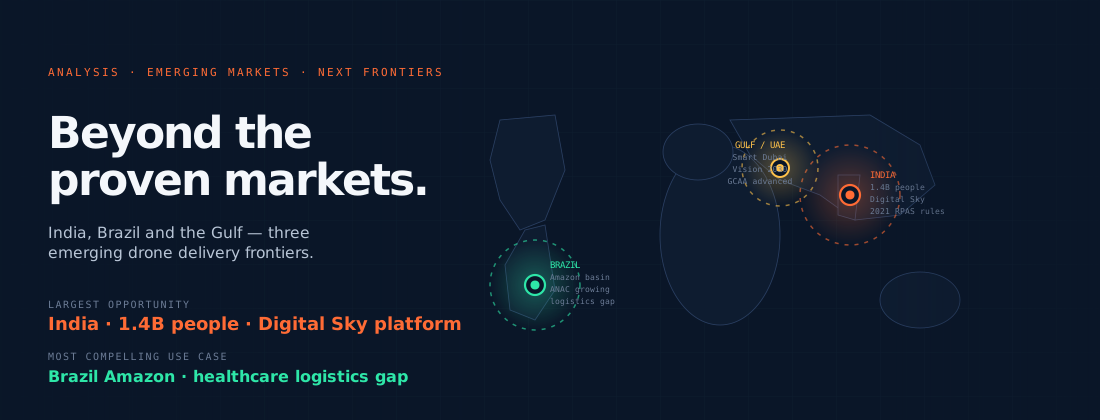
The subsequent development of commercial drone delivery in Ghana, in Malawi, in Nigeria, and in other African markets is not a curiosity or a footnote to the industry’s history. It is the core data point from which the industry’s proof of concept derives. Understanding why African markets enabled this development matters for understanding the industry’s trajectory more broadly.
The ground logistics gap
The fundamental condition that makes drone delivery most valuable is a meaningful gap between what drone delivery can achieve and what the available alternative can achieve. In Rwanda in 2016, that gap was large and consequential. The available alternative for delivering blood products to remote health facilities was a road network that was unreliable, slow, and often impassable during rainy season. The travel time from the national blood bank in Kigali to outlying health facilities could be measured in hours — and for blood products whose clinical use is urgent, hours matter in ways that can be quantified in patient outcomes.
In this environment, drone delivery’s speed advantage was not a marginal improvement over an adequate system. It was a step change in capability relative to an inadequate one. The gap between the performance of drone delivery and the performance of the alternative was large enough to justify the cost of the system and the investment in regulatory engagement — because the alternative’s failure had a measurable cost that the drone system reduced.
The regulatory context
Rwanda’s regulatory environment offered something that European and North American regulators were not yet prepared to offer in 2016: a government willing to engage pragmatically with a new technology that could deliver an immediate public health benefit, even in the absence of a fully developed regulatory framework for the activity. The Rwandan Civil Aviation Authority worked with Zipline to develop the authorisation framework for its operations, rather than requiring that a comprehensive regulatory framework exist before operations could begin.
This approach reflects a pattern that recurs across African drone deployment. Governments facing acute logistics challenges — health supply chains that fail to reach remote communities, emergency response capabilities that are geographically constrained — have often been prepared to engage with drone delivery as a solution before their aviation regulatory frameworks fully accommodate it, working with operators to develop bespoke authorisation frameworks that allow beneficial operations to proceed.
The medical logistics use case and its fit
Blood products are, as a payload category, close to ideal for drone delivery in the conditions that characterise many African health system logistics challenges. They are small and light — well within the payload capacity of first-generation delivery aircraft. They are time-sensitive — the reason they are being sent urgently. They are not fragile in the sense that excludes drop delivery. And their destination — health facilities — is an addressable, identifiable location with staff who can receive and log deliveries. The use case was, in technical terms, tractable with the technology that existed in 2016 in a way that many other delivery applications were not.
What the African experience means for the global industry
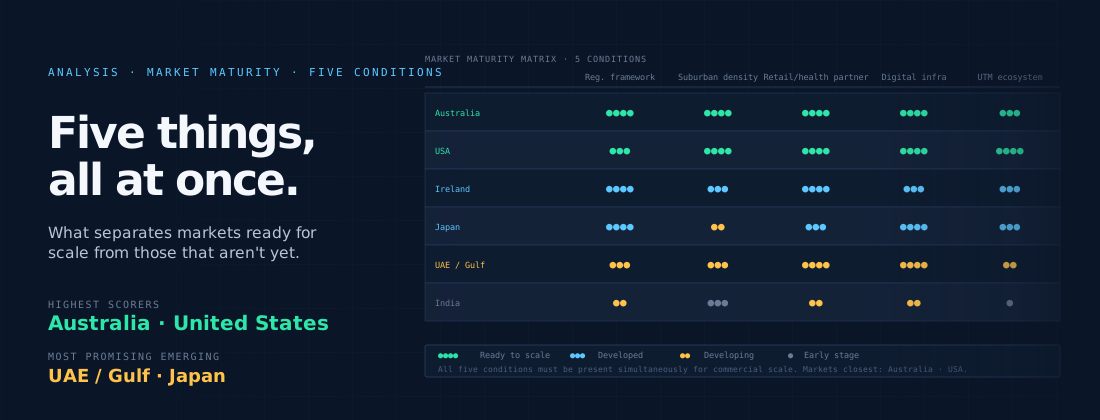
The proof of concept that African operations have provided is not perfectly transferable to other markets. The conditions that made drone delivery so immediately compelling in Rwanda — a large logistics gap, a tractable medical use case, a government partner willing to work through regulatory questions pragmatically — do not exist in the same form in suburban Australia or rural Ireland. The economics and the regulatory path in those markets are different.
What does transfer is the demonstration that drone delivery can be a real, operational, commercially sustained service rather than a perpetual prototype. The years of Zipline’s Rwandan operations provided the industry’s most important early evidence that the technology works, that it can be operated reliably, and that it can deliver clinical value in real health systems. That evidence base has been cited in regulatory discussions globally and has been part of the story that every operator tells when seeking authorisation for new operations in new markets. The African proving ground produced a proof of concept that the entire global industry has drawn on.