Beyond blood: the medical payloads that could follow if the delivery model proves out
This article represents DDG’s editorial analysis of trends in medical drone delivery and their potential implications. It is based on publicly available information about current operations, clinical research, and regulatory frameworks. Forward-looking assessments are analytical rather than predictive.
The medical logistics use case for drone delivery has been proven in specific, well-documented contexts: blood products to remote health facilities in Rwanda and Ghana, laboratory samples between Swiss hospital facilities, pharmaceutical deliveries to residential addresses in Ireland. These are real, operational, commercially sustained services. They are also, in the context of the full scope of medical logistics, a narrow slice.
The question of where the medical drone delivery application goes from here is worth examining carefully, because the answer has significant implications for the economics of the sector and for the regulatory path operators need to build.
What current operations have established
The operations that have reached sustained commercial scale share several characteristics. The payloads are relatively small — typically under two kilograms. The recipients are either health facilities with designated receiving infrastructure (hospital helipads, dedicated landing areas) or residential addresses with suitable outdoor delivery zones. The time-sensitivity of the payload is sufficient to justify a premium delivery mechanism. And the regulatory pathway, while demanding, has been achievable within existing frameworks for medical product transport.
These shared characteristics are not coincidental. They reflect the specific conditions under which the current generation of delivery aircraft, with their payload and range constraints, and the current regulatory frameworks, with their requirements for designated landing areas and cold chain documentation, make drone delivery viable.
The adjacent payload categories
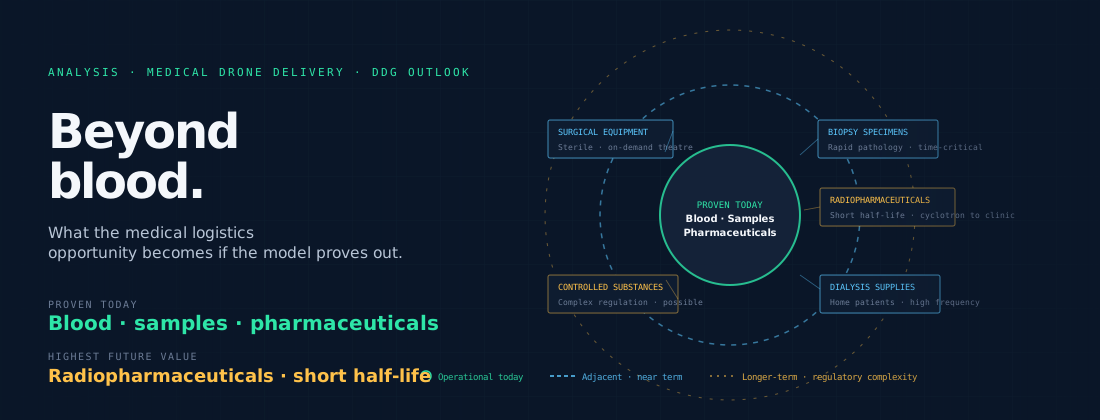
Several medical payload categories share the characteristics that have made blood and pharmaceuticals tractable, and could plausibly be served by systems similar to those already in operation.
Radiopharmaceuticals — radioactive tracers used in nuclear medicine imaging and therapy — are produced at cyclotrons with short half-lives, sometimes measured in hours or even minutes. The decay rate means that a pharmaceutical that leaves a production facility viable may be significantly degraded by the time it arrives at a hospital via conventional road transport. A drone delivery corridor between a cyclotron facility and a nuclear medicine department represents, in principle, a use case where the speed advantage of drone delivery has direct clinical value that road transport cannot provide.
Surgical biopsy specimens, collected during procedures and requiring rapid laboratory analysis, share the time-sensitivity that characterises the blood and sample use cases that are already operational. The difference is that specimens collected during surgery may require more complex chain-of-custody documentation and more careful handling than routine laboratory samples. The regulatory pathway exists — it is the same one that covers laboratory sample transport — but the operational design is more demanding.
Home dialysis supplies for patients receiving home haemodialysis represent a different profile: high frequency, predictable schedule, modest individual weight, significant aggregate volume. The drone delivery proposition here is not speed but reliable, frequent supply without the patient or a carer needing to travel to collect supplies. The economics depend on delivery frequency and whether the operational overhead of many small deliveries to a single patient is manageable — a question that the current residential delivery model is already designed to answer.
The regulatory pathway questions
Moving from blood products and standard pharmaceuticals to radioactive materials, to surgical specimens with chain-of-custody requirements, or to controlled substances requires engagement not just with aviation regulators but with the pharmaceutical and medical device regulatory frameworks that govern each payload type. In the United States, the FDA’s regulations covering drug transport apply regardless of the transport mechanism. In the EU, the equivalent pharmaceutical standards framework applies. These regulatory requirements add a compliance layer that is separate from the aviation authorisation process and that must be satisfied simultaneously.
Radiopharmaceuticals present a specific additional challenge: the transport of radioactive materials is regulated by nuclear regulatory authorities — the NRC in the United States, equivalent bodies elsewhere — as well as by transport and aviation authorities. A drone carrying a radioactive tracer is, simultaneously, an unmanned aircraft subject to aviation regulation and a radioactive material transport subject to nuclear regulation. The regulatory coordination required to address both is not insurmountable, but it is more complex than the coordination required for blood products.
The market size implication
The current medical drone delivery market is defined by what is currently operationally possible. The adjacent payload categories described above are not currently served at scale by any operator. If the drone delivery model proves out — achieving the safety record, operational efficiency and regulatory acceptance that makes it a standard rather than a novel option — the medical logistics market available to it is considerably larger than current operations suggest.
That expansion does not happen automatically. It requires deliberate regulatory engagement, purpose-built cold chain and chain-of-custody solutions for each payload type, and the kind of partnership with health system operators that Matternet’s Swiss Post relationship exemplifies. The operators best positioned to capture adjacent payload categories are those that have built the deepest regulatory and commercial relationships in the medical logistics sector — and that have the operational track record to make the safety case to the relevant authorities for each new payload category they wish to serve.