The path to profitability: what conditions must exist before drone delivery makes economic sense at scale
This article is DDG’s analytical assessment of the economics of drone delivery, based on publicly available information about operator models, regulatory frameworks, and cost structures. It does not represent financial advice and forward-looking observations are analytical rather than predictive.
The question of whether drone delivery is economically viable has been asked, and answered in contradictory ways, since the first commercial operations launched. The honest answer is that it depends — on the market, the use case, the regulatory environment, the operator’s capital structure, and the maturity of the operation. Understanding what it depends on is more useful than a generic assertion about the sector’s economics.
The fixed cost problem
Drone delivery operations carry a high fixed cost base relative to the variable cost of each delivery. The hub facility, the fleet, the maintenance infrastructure, the ground control station, the regulatory compliance overhead, and the minimum staffing required to keep the operation running are all largely fixed regardless of how many deliveries the operation makes. The delivery volume required to cover those fixed costs — the break-even delivery density — determines the minimum scale at which an operation can be economically sustainable.
The implication of a high fixed cost base is that the economics of drone delivery improve dramatically as volume increases, and are very poor at low volume. An operation delivering fifty packages per day from a hub that costs the same to run as one delivering five hundred is carrying ten times the cost per delivery. This relationship is not unique to drone delivery — it characterises hub-based logistics generally — but it is particularly acute in drone delivery because the fixed costs are high relative to the value of individual deliveries, and the early-stage volume ramp is slow.
The hub catchment area and why range matters disproportionately
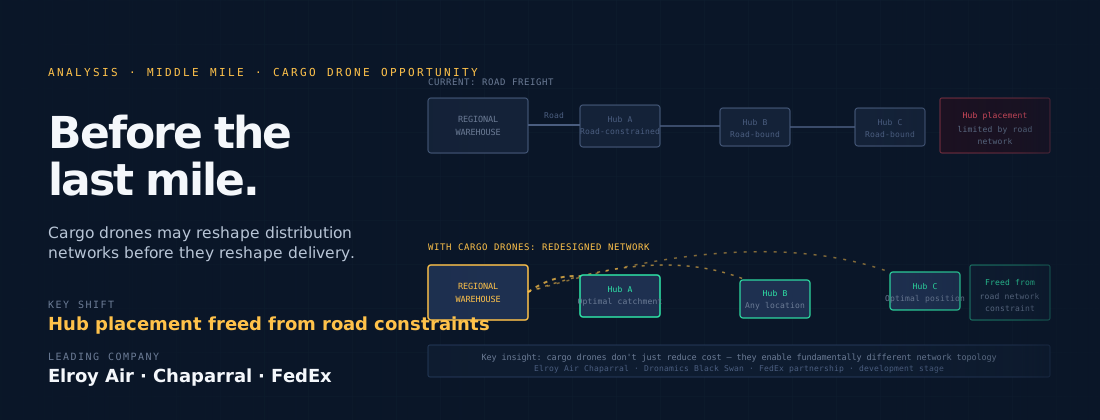
The catchment area of a delivery hub is the geographic area within which the hub can serve delivery addresses. It is determined primarily by the range of the delivery aircraft — specifically, by the round-trip range from the hub to the delivery address and back, with safety margins applied. For a hub with an aircraft capable of a ten-kilometre operational radius, the catchment area is approximately 314 square kilometres. For a hub with an aircraft capable of a fifteen-kilometre radius, the catchment area is approximately 707 square kilometres — more than twice as large, from a 50 per cent range improvement.
This geometric relationship between range and catchment area means that aircraft range improvements have a disproportionate impact on the addressable market per hub. An operator that improves its aircraft’s operational range by a third can more than double the population reachable from each hub, transforming the hub economics without changing the fixed cost base. This is one reason why range is the aircraft specification that operators and analysts watch most closely.
The use case and the price point
The revenue per delivery is the other side of the equation, and it depends heavily on the use case. The premium that a customer will pay for drone delivery over road courier delivery is determined by the value they place on the speed advantage. In markets where the alternative is a same-day or next-day road delivery, the speed premium for a ten-minute drone delivery is measurable but modest. In markets where the alternative is a multi-hour or multi-day wait — rural areas, medical logistics in time-critical scenarios — the premium is substantially larger.
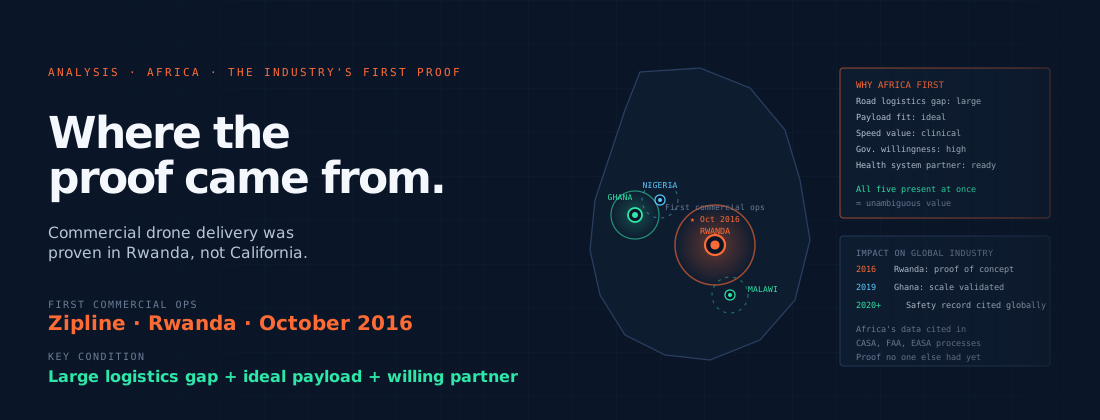
Medical logistics has consistently produced the strongest economics among early drone delivery use cases for this reason. The value of a blood product reaching a remote facility in twenty minutes rather than three hours can be measured in clinical outcomes. That value translates to the ability to price the service at a level that can sustain the operation. Consumer retail delivery, where the alternative delivery option is a same-day road courier, faces a much narrower margin.
The regulatory certainty factor
The investment required to establish a drone delivery hub — the facility, the equipment, the staff, the regulatory engagement costs — is substantial and not easily recovered if the operation is discontinued. Operators making that investment need confidence that the regulatory framework governing their operations will remain in place long enough for the investment to be amortised.
The shift from waiver-based BVLOS to rules-based operational authorisation frameworks — the direction of travel in the United States, Australia, Japan and elsewhere — directly improves the investment economics of drone delivery by providing greater regulatory certainty. An operator investing in hub infrastructure under a rules-based framework is making a different risk calculation than one investing under a waiver that expires and must be renewed. The former is infrastructure investment; the latter is, to a degree, a bet on regulatory continuity.
The staffing trajectory
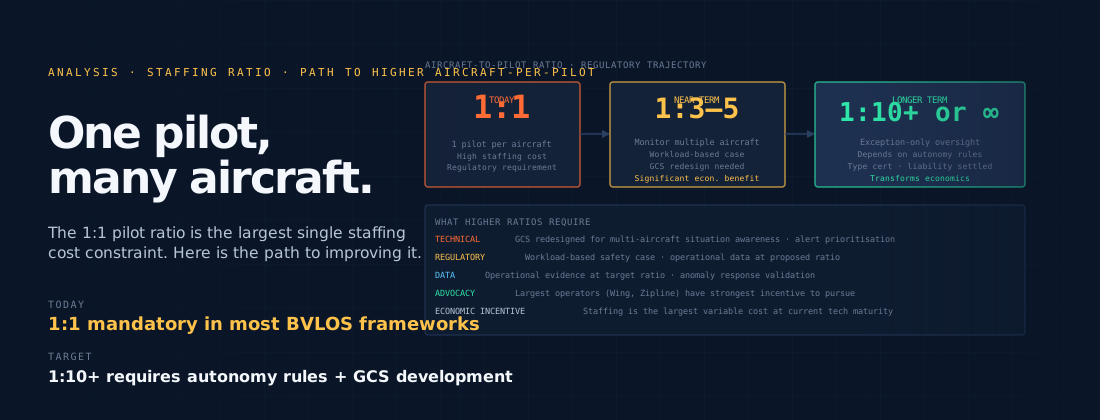
Current drone delivery operations are staff-intensive relative to their delivery volume. Remote pilots, package handlers, ground control station operators, maintenance technicians — the labour cost per delivery is high at current volumes and current technology levels. The economic trajectory of the sector depends partly on whether and how that ratio improves as the industry matures.
Higher aircraft-to-pilot ratios — permitted as autonomous capabilities develop and regulators allow reduced oversight requirements — would allow a given staffing level to support more deliveries. Hub automation — automated loading, battery swapping, and pre-flight checks — would reduce the package handling overhead. Both developments are technically plausible and are actively being pursued. Neither has yet materialised at the scale required to substantially change the staffing economics of any major operator.
The conditions for sustainable economics
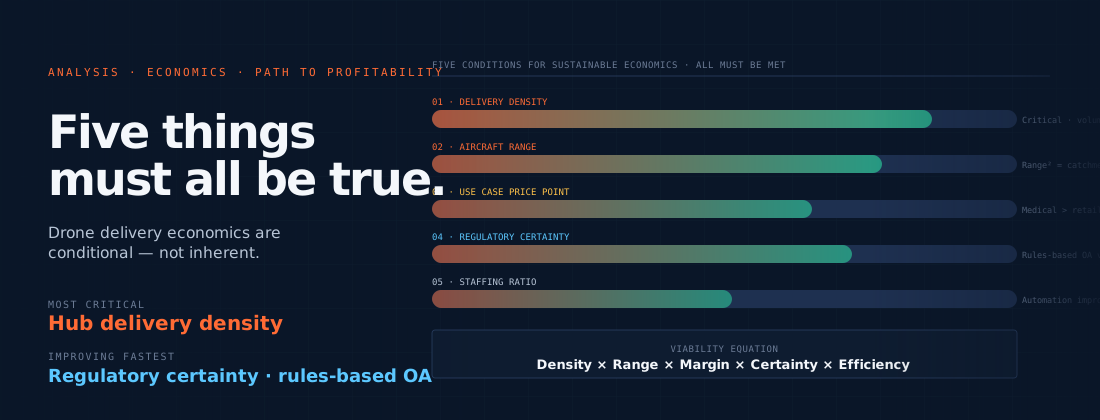
Putting these factors together, the conditions for economically sustainable drone delivery at scale are: sufficient delivery density in the hub catchment area to cover fixed costs; aircraft range adequate to serve that catchment area; a use case with a price point that covers variable costs and contributes to fixed cost recovery; a regulatory framework that provides sufficient certainty to justify the infrastructure investment; and operational maturity sufficient to achieve reasonable staffing efficiency. Meeting all five simultaneously is what makes drone delivery work economically. Each one is improvable; none can be skipped.