Drone delivery’s next frontiers: India, Brazil and the Gulf
This article is DDG’s analytical assessment of emerging drone delivery markets based on publicly available regulatory, market, and operational information. Forward-looking observations reflect our reading of current trajectories.
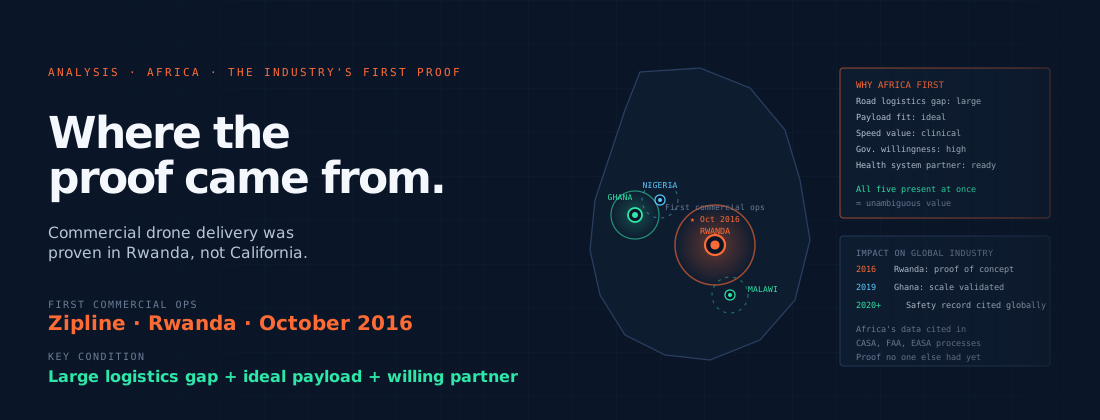
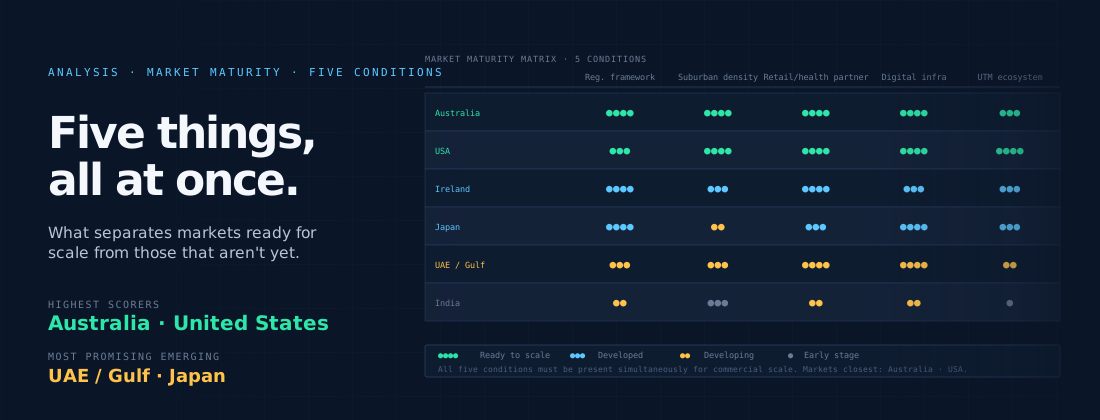
The operational track record of commercial drone delivery has been built primarily in a small set of markets: Australia, the United States, Ireland, Switzerland, and Rwanda and Ghana. These markets share characteristics — engaged regulators, willing retail or healthcare partners, and a combination of geographic and economic conditions that makes drone delivery viable. They are not, in the global context of commercial logistics, the largest or most economically significant markets. The question of where drone delivery goes beyond its current operational base is one of the most commercially significant in the sector.
India: scale, healthcare gaps and a maturing regulatory framework
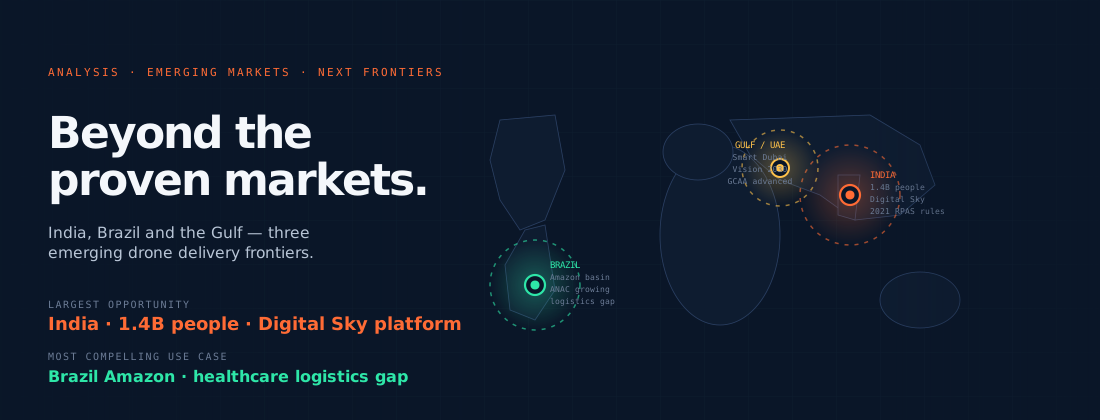
India presents a drone delivery opportunity that is large in almost every dimension. The country’s population of 1.4 billion, its geography of remote and semi-urban communities with inadequate healthcare logistics, its rapidly growing e-commerce market, and its government’s explicit policy support for drone development all point toward a significant market.
India’s regulatory framework for drones was substantially updated in 2021, when new RPAS rules replaced a more restrictive earlier framework. The updated rules established a categorisation system — Nano, Micro, Small, Medium, and Large — based on aircraft weight, with operational permissions tied to category. The Digital Sky Platform, developed by India’s Directorate General of Civil Aviation, provides the digital infrastructure for drone flight authorisation.
Several Indian companies and some international operators have conducted medical drone delivery trials in India, particularly in states with significant rural healthcare logistics challenges. Telangana, Manipur, and Arunachal Pradesh have been among the states where medical drone delivery trials have taken place, delivering vaccines, blood products, and pharmaceutical supplies to remote health facilities.
The barriers to scaling in India include regulatory uncertainty around BVLOS, the complexity of operating in Indian controlled airspace, and the commercial challenge of finding sustainable economics in a market where healthcare logistics budgets are constrained. The opportunity is genuine and large; the path to capturing it is demanding.
Brazil: Amazon basin logistics and a growing drone regulatory framework
Brazil’s geography is, in important respects, the most extreme version of the logistics problem that makes drone delivery compelling. The Amazon basin — a river-connected network of communities across an area larger than Western Europe, with road infrastructure that is sparse, seasonal, and frequently impassable — has logistics challenges that no conventional solution addresses well. The health logistics needs of Amazon basin communities, combined with the difficulty of serving them by conventional means, create a use case for medical drone delivery that is, if anything, more compelling than the African markets that first demonstrated the model’s value.
Brazil’s civil aviation authority — ANAC — has been developing its drone regulatory framework in dialogue with international developments, and has issued authorisations for commercial drone operations including some BVLOS trials. The regulatory path to large-scale commercial operations remains more complex than in the most progressive jurisdictions, but the direction of development is toward greater openness rather than restriction.
Brazilian e-commerce is also large and growing, with a domestic market that creates demand for faster delivery alternatives in urban and suburban markets. The economics of retail drone delivery in Brazilian cities face the same conditions as other markets — suburban geography suits current-generation aircraft better than dense urban environments — but the scale of the potential market makes the investment case compelling even if only a fraction of addresses are initially deliverable.
The Gulf: regulatory ambition and infrastructure investment
The Gulf Cooperation Council states — particularly the UAE and Saudi Arabia — have been among the most publicly ambitious in their statements about drone delivery development. Dubai’s Smart City initiative has included drone delivery as a stated priority, and the UAE’s General Civil Aviation Authority has developed regulatory frameworks for drone operations that are among the more permissive in the world for certain categories of operation.
The Gulf’s economic characteristics suit drone delivery infrastructure investment: high per-capita income creates willingness to pay for premium delivery services; the urban geography of Gulf cities — predominantly low-to-mid-rise suburban development in the newer residential areas — suits current-generation delivery drone operations; and government capital availability means that infrastructure development does not depend on commercial economics being immediately compelling.
Saudi Arabia’s Vision 2030 programme has explicitly identified drone delivery as a technology sector the kingdom wants to develop, creating both regulatory and financial incentives for operators to establish Gulf operations. Several major international operators have expressed interest in Gulf markets, and some have established pilot programme agreements with Gulf government entities.
The common thread
What India, Brazil, and the Gulf share — despite their very different economic and geographic profiles — is a combination of large unmet logistics need, government engagement with drone technology as a solution, and developing regulatory frameworks that are moving toward rather than away from commercial BVLOS operations. None of them has yet produced the kind of sustained commercial operations at scale that Australia, Ireland, and the US have demonstrated. All of them represent market opportunities that are larger than the markets currently being served.