The middle mile gap: why cargo drones may reshape distribution before they reshape delivery
This article is DDG’s analytical assessment of the middle-mile drone logistics opportunity. It is based on publicly available information about logistics economics, cargo drone development, and the distribution infrastructure of major logistics networks.
The drone delivery industry is almost entirely focused on the last mile: the movement of packages from local hubs to individual residential or commercial addresses. This is understandable — last-mile delivery is where the consumer-facing value is most visible, where the PR opportunity is greatest, and where the regulatory challenge of flying over residential areas has been the primary focus of regulators and operators alike.
The result of this focus is that a different application has received much less attention: the middle mile. Moving freight between regional distribution centres and the local hubs from which last-mile delivery operates is a logistics problem with characteristics that make it, in some respects, better suited to autonomous cargo drone operations than the last-mile residential problem that has dominated the industry’s development.
Why the middle mile has different economics
Middle-mile logistics between hub nodes has several characteristics that differ from last-mile residential delivery in ways that are relevant to drone operations.
The delivery points — distribution centres and hub facilities — are fixed, known, and designed for logistics operations. They have suitable landing infrastructure, trained staff to receive cargo, and operational processes that can accommodate autonomous vehicle arrivals. The residential address problem — diverse surfaces, variable clearances, community noise sensitivity — does not apply. An autonomous cargo drone flying between a distribution centre and a local delivery hub is operating between two purpose-built logistics facilities, not landing in someone’s garden.
The payloads are larger than residential delivery payloads, which changes the aircraft size and economics required. A cargo drone moving 50 to 150 kilograms between hub nodes is a different aircraft from one delivering a 1.5-kilogram retail package to a residential address — closer to the Elroy Air Chaparral category than to Wing’s delivery drone. The larger payload means fewer flights are required to move a given total freight volume, which affects the operational tempo and the economics of the hub-to-hub operation.
The routing flexibility argument
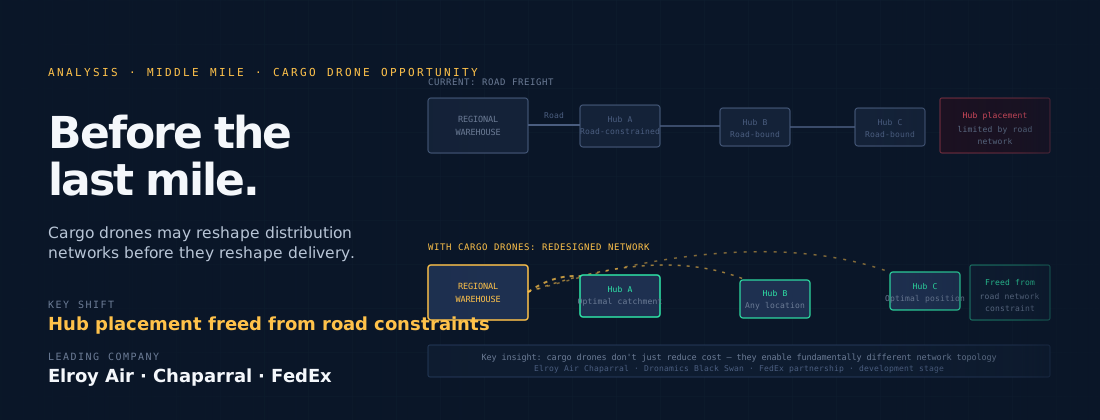
The most commercially interesting argument for middle-mile cargo drones is not just cost reduction on existing routes — it is the routing flexibility that autonomous cargo drones could enable. A logistics network designed around road transport has to place hubs in locations accessible by road, at intervals determined by road transport time and cost. A network with autonomous cargo drone middle-mile capability could place last-mile hubs in locations that serve the residential delivery catchment optimally, regardless of road access, and supply them by air from regional distribution centres.
This reframing — from cargo drones as a cheaper version of road transport to cargo drones as an enabler of fundamentally different network topology — is where the most significant long-term value may lie. A last-mile delivery network whose hub placement is constrained by road transport is a different and less efficient network than one whose hub placement is constrained only by the catchment area of the delivery drones themselves.
The regulatory path is different and in some respects easier
Middle-mile cargo drone operations between logistics facilities have a regulatory profile that differs from last-mile residential delivery in ways that are, in some respects, more favourable. The operations are between fixed, purpose-built facilities — not over dense residential areas. The payloads are commercial freight, not consumer packages subject to diverse retail partner requirements. The operational tempo is more predictable and less variable than residential delivery. And the safety case can be built around a defined, repeatable operation rather than the diverse and variable conditions of residential delivery.
The counterpoint is that cargo drones in the 50 to 500 kilogram payload range require type certification from aviation authorities — a more demanding process than the operational authorisation pathway for small parcel delivery drones. The type certification burden is the primary regulatory barrier to middle-mile cargo drone deployment, and it is a barrier that will take time to resolve regardless of the operational merits of the application.
The operators watching this space
Elroy Air, with its Chaparral platform and FedEx partnership, is the most publicly visible company developing specifically for the middle-mile application. Dronamics, with its longer-range Black Swan fixed-wing cargo drone, addresses a different point on the middle-mile spectrum — longer distances, larger payloads, connecting regional rather than local nodes. Both represent early-stage development of what could become a significant market segment if the type certification path can be navigated successfully.
The large logistics incumbents — FedEx, UPS, DHL, Amazon Logistics — are watching the middle-mile cargo drone space with a strategic interest that is at least as important as their investment in last-mile delivery drone programmes. Middle-mile autonomous air freight at scale would affect the economics of their networks more profoundly than last-mile residential delivery, precisely because the middle mile is a cost centre that existing technology addresses expensively.