How far can a delivery drone fly? Understanding range, payload and the trade-offs
When people ask how far a delivery drone can fly, they usually want a simple number. The honest answer is: it depends — on the aircraft, the payload weight, the battery state, the wind, the temperature, and what the operator defines as a safe operational limit. But behind that complexity is a set of relationships worth understanding, because they explain a great deal about where commercial drone delivery is viable and where it is not.
The basic constraint: battery energy divided by power demand
An electric delivery drone has a fixed amount of energy stored in its battery at the start of a flight. That energy is consumed by the motors at a rate that depends on how hard they are working. How hard the motors work depends on the total weight they are lifting (aircraft plus battery plus payload) and the aerodynamic efficiency of the aircraft.
This produces the fundamental range-payload trade-off: a heavier payload requires more power to carry, which drains the battery faster, which reduces the range. An empty aircraft can fly further than a loaded one. A small payload allows a longer flight than a large one.
Most commercial delivery drones are designed around a target payload of between one and three kilograms — the weight range that covers the majority of e-commerce parcels and food delivery orders — at a range that allows a meaningful delivery radius from a hub.
Why the delivery radius matters more than the range
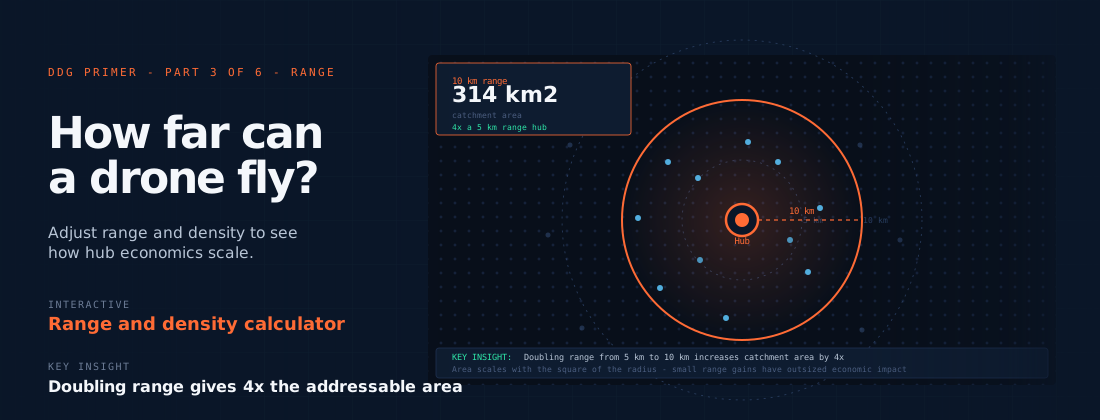
The range of a drone is typically quoted as a straight-line distance — how far it can fly from point A to point B. But what matters commercially is the delivery radius: the area around a hub that the drone can serve. And area scales with the square of the radius.
A drone with a range of five kilometres can serve addresses within five kilometres of its hub — an area of roughly 78 square kilometres. A drone with a range of ten kilometres can serve an area of roughly 314 square kilometres — four times larger, from doubling the range. This is why seemingly modest improvements in range — driven by better batteries, lighter aircraft, more efficient motors — translate into dramatic expansions of the addressable market for a hub operation.
The round-trip constraint
Commercial delivery operations require the aircraft to return to its hub after each delivery. This means the effective one-way delivery range is roughly half the total aircraft range — the other half is needed for the return journey.
Some operators reserve additional battery margin beyond the round-trip requirement for safety contingencies: if the aircraft needs to hold position, divert to an alternative landing point, or make an emergency return from mid-route, there must be sufficient battery remaining to do so. These safety margins — defined in the operator’s safety case — further reduce the effective delivery radius.
What current aircraft actually achieve
Wing’s delivery aircraft operates with a practical delivery radius of approximately ten kilometres from its hub facilities, carrying payloads of up to 1.5 kilograms. Zipline’s Platform 1 fixed-wing aircraft has a much longer range — capable of reaching facilities 100 kilometres or more from its launch points — because the fixed-wing configuration is far more efficient in cruise than a multirotor. The trade-off is that Zipline’s aircraft cannot hover, which limits the delivery mechanism to a guided drop.
The cargo drone sector — Dronamics, Elroy Air — operates at a fundamentally different scale: payloads of 50 to 350 kilograms over hundreds of kilometres. These aircraft are not last-mile delivery vehicles. They address the middle-mile problem: moving freight between distribution centres and local hubs, not between hubs and residential addresses.
What would change the picture
Two developments would most significantly expand the range capabilities of commercial delivery drones. The first is battery energy density: if lithium-ion batteries achieved twice their current energy density per kilogram, range would increase substantially without adding weight. The second is hydrogen fuel cells, which offer higher energy density than batteries and faster refuelling, and which several developers are investigating for longer-range delivery applications.
In the near term, the more impactful development may be hub network design rather than aircraft capability: placing hubs closer to residential catchment areas reduces the range each aircraft needs to cover, allowing smaller and cheaper aircraft to serve more addresses within the constraints of current battery technology.