Cold chain drone delivery: the temperature control challenge for medical and pharmaceutical payloads
The medical logistics case for drone delivery is compelling, and one of the reasons it is compelling is speed: drones can cover point-to-point distances faster than road vehicles that must navigate the road network. But speed alone does not solve the logistics problem for temperature-sensitive medical payloads. Blood products, vaccines, certain pharmaceuticals, and biological samples all have temperature requirements during transport — and maintaining those requirements in a small, lightweight aircraft that must also manage its weight and power budget carefully is a genuine engineering challenge.
What temperature sensitivity means in practice
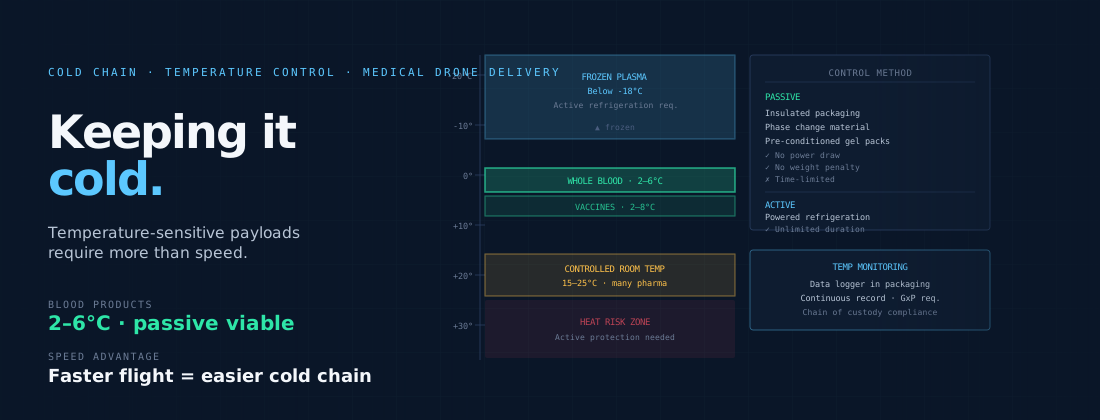
Different medical payloads have different temperature requirements, and those requirements are defined with precision in pharmaceutical and clinical guidelines. Whole blood for transfusion must typically be maintained between two and six degrees Celsius. Fresh frozen plasma requires storage below minus eighteen degrees Celsius and must be transported frozen. Many vaccines fall within a two to eight degree Celsius cold chain requirement. Some pharmaceutical products require controlled room temperature — between fifteen and twenty-five degrees Celsius — which in a drone context means protection from both cold and heat extremes.
The consequences of breaking the cold chain vary by product. Blood products outside their temperature range may be unsafe for transfusion. Vaccines exposed to temperatures outside the cold chain may lose effectiveness. Biological samples collected for laboratory analysis may degrade in ways that produce incorrect results. The clinical stakes of cold chain failure are high enough that regulatory frameworks in most jurisdictions define documentation requirements for temperature monitoring throughout the transport process — a chain of custody for temperature as well as for the physical product.
Passive temperature control
The simplest approach to temperature control in drone delivery is passive insulation — packaging the payload in thermally insulated containers with pre-conditioned phase change materials or gel packs that absorb or release heat to maintain the target temperature range. This approach adds no weight beyond the insulation and phase change material, requires no power, and is straightforward to implement.
The limitation of passive insulation is time. The thermal mass of the phase change material determines how long the target temperature range can be maintained. For a short delivery flight of five to fifteen minutes, passive insulation is typically adequate even for blood products and vaccines: the temperature rise inside a well-insulated container during a fifteen-minute flight at ambient temperatures of twenty to twenty-five degrees Celsius can be kept within acceptable limits with appropriate insulation design.
For longer flights — thirty minutes or more — or in extreme ambient temperatures, the passive insulation budget becomes tighter. Operators targeting longer-range medical delivery routes must either design the insulation system for the full worst-case flight duration in the most challenging ambient temperature conditions, or add active temperature control.
Active temperature control
Active temperature control uses powered refrigeration or heating elements within the payload compartment to maintain the target temperature regardless of ambient conditions and flight duration. This provides a more robust solution for longer flights and extreme temperatures but at the cost of weight — the refrigeration system, its power supply, and its controls all add to the aircraft’s all-up weight — and power, which is drawn from the same battery that powers the aircraft.
The weight and power budget trade-off is significant on small delivery aircraft. A refrigeration unit capable of maintaining two to six degrees Celsius for a one-litre payload compartment in a thirty-degree ambient environment might weigh several hundred grams and consume twenty to fifty watts during operation. On an aircraft with a total payload capacity of one to two kilograms and a battery providing perhaps one kilowatt-hour of usable energy, these are not trivial costs.
Some operators have approached this by designing the payload compartment separately from the aircraft, with the payload pod as a swappable module that includes its own thermal management. This allows the thermal system to be optimised for the payload type and pre-conditioned before loading, reducing the power draw during flight to that needed for maintenance rather than establishment of the target temperature.
Temperature monitoring and documentation
Maintaining temperature during transport is necessary but not sufficient in regulated medical environments. Documentation that the temperature was maintained — a continuous record of temperature throughout the transport process — is typically required for blood products and pharmaceutical shipments. This requires temperature logging capability in the payload packaging: a small data logger that records temperature at defined intervals and can be read out on receipt to verify compliance.
Drone delivery systems that aspire to serve regulated medical logistics markets must integrate temperature monitoring into their documentation chain. This means not just logging temperature during flight but incorporating the temperature record into the delivery documentation system, making it available to the receiving facility as part of the chain of custody documentation, and generating the reports required by regulatory frameworks for pharmaceutical and blood product transport.
Why speed helps
The most straightforward observation about cold chain management in drone delivery is that speed is itself a form of temperature management. A delivery that takes ten minutes is a delivery during which the thermal insulation needs to perform for ten minutes. A delivery that takes forty-five minutes by road may require performance over a period five times as long.
This is one of the genuine structural advantages of drone delivery for medical logistics: the speed that makes it attractive to health systems also makes the cold chain management problem more tractable. The engineering challenge of maintaining temperature for a fifteen-minute drone delivery is significantly easier than maintaining temperature for a forty-five-minute road delivery, even if the road vehicle has more weight and power budget available for thermal management.