Amazon Prime Air: a factual account of what is publicly known
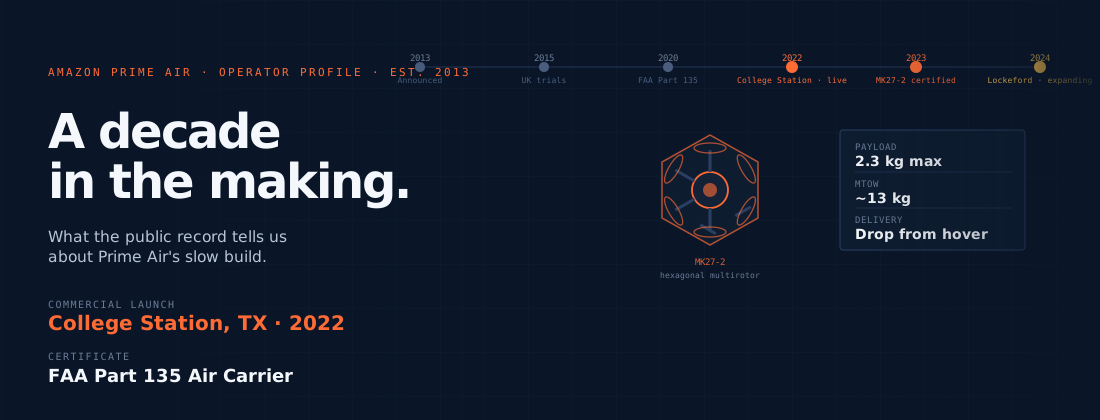
Amazon Prime Air has been in development since 2013, when Jeff Bezos first described the concept publicly on 60 Minutes. More than a decade later, it is a functioning commercial service in two US locations — though its development has proceeded considerably more slowly and with more complexity than Amazon’s early public statements implied.
The long development period
Amazon’s public statements about Prime Air in its early years suggested commercial availability “within four to five years” of the 2013 announcement. That timeline proved substantially optimistic. The programme went through multiple aircraft design iterations, significant regulatory engagement with aviation authorities in multiple countries, and several restructurings of the team working on it.
The gap between announcement and operation reflects not a failure of Amazon’s engineering capabilities but the genuine complexity of the regulatory and operational challenges involved in building a commercial drone delivery service. The FAA’s authorisation requirements, the engineering demands of a system that needs to be reliable enough to operate over residential areas at scale, and the operational infrastructure required to support delivery at meaningful volume all proved more demanding than the initial timelines assumed.
The aircraft
Amazon has developed multiple aircraft designs over the course of Prime Air’s development history. Its MK27-2 aircraft, which received FAA certification, is a hexagonal multirotor design. Amazon has publicly discussed developing aircraft with hybrid VTOL configurations in addition to its multirotor designs, reflecting the same range-versus-operational-simplicity trade-offs that all drone delivery operators face.
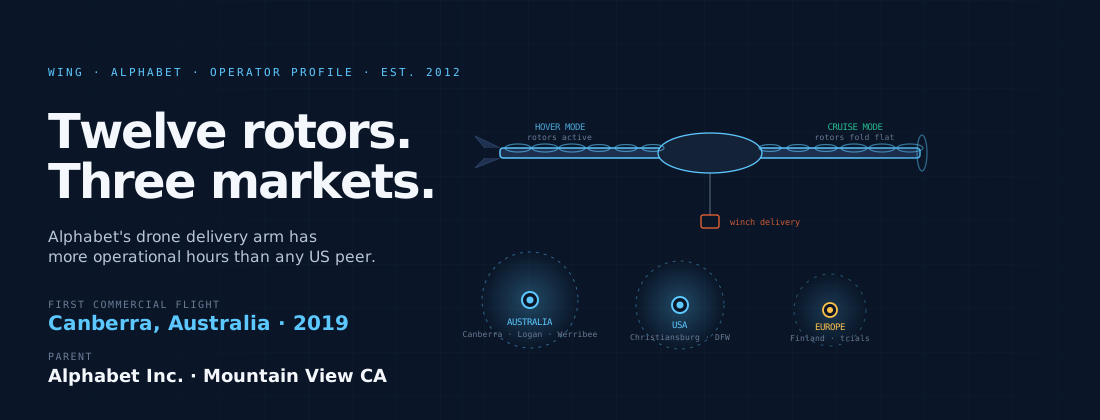
The delivery mechanism used by Prime Air’s current operational aircraft involves the aircraft hovering above the delivery location and releasing the package in a way that allows it to fall the remaining short distance to the ground — a different approach from the winch-based delivery used by Wing, with different requirements for the delivery location and different payload handling implications.
Commercial operations
Amazon launched commercial Prime Air delivery operations in College Station, Texas, and Lockeford, California. Both markets were chosen for operational characteristics — suburban geography, relatively uncluttered airspace, populations with high e-commerce adoption — that suited the capabilities and constraints of the current aircraft and operational model.
The College Station operation, near Texas A&M University, began delivering to customers in 2022. Lockeford, a small community in the San Joaquin Valley, began operations around the same time. Amazon has characterised both operations as commercial services rather than pilots, though the scale and geographic scope of delivery remain limited compared to the company’s eventual ambitions for the programme.
International operations
Amazon has also operated Prime Air testing and developmental operations in the United Kingdom, at a test facility in Cambridgeshire. Its UK operations have involved engagement with the Civil Aviation Authority and the broader UK regulatory environment. Amazon has not launched commercial delivery operations in the UK as of the most recent publicly available information.
What is not publicly known
Amazon does not publish operational statistics for Prime Air — delivery volumes, completion rates, fleet size, or economic performance are not disclosed. The company also does not publish detailed information about its development pipeline, regulatory strategy, or timeline for expansion to additional markets beyond what it announces at the time of specific milestones.
This opacity means that analysis of Prime Air’s progress relative to competitors, or assessments of when it might reach particular scale milestones, is necessarily speculative. What is publicly documented is that the service exists, operates commercially in two US markets, and has the backing of one of the world’s largest companies — a combination that makes it a significant presence in the sector regardless of what the current operational numbers look like.