The 5G question: how cellular network evolution changes drone delivery’s operating envelope
This article represents DDG’s analytical assessment of how 5G network development intersects with commercial drone delivery operations, based on publicly available technical and regulatory information.
The relationship between 5G networks and drone delivery is one of the most frequently invoked but least precisely described topics in discussions of the sector. “5G will enable drone delivery” is a statement that appears regularly in investor presentations, regulatory consultations, and industry analyses. The statement is true in some respects and misleading in others, and the distinction matters for understanding what 5G actually changes about the drone delivery landscape.
What 4G LTE already provides
Commercial drone delivery operations that are currently running — Wing in Australia, Manna in Ireland, Flytrex in North Carolina — use LTE (4G) cellular networks for command and control, telemetry, and operational coordination. LTE provides sufficient bandwidth and sufficient coverage to support these operations in the markets where they currently exist. The cellular infrastructure that enables current commercial operations is not 5G.
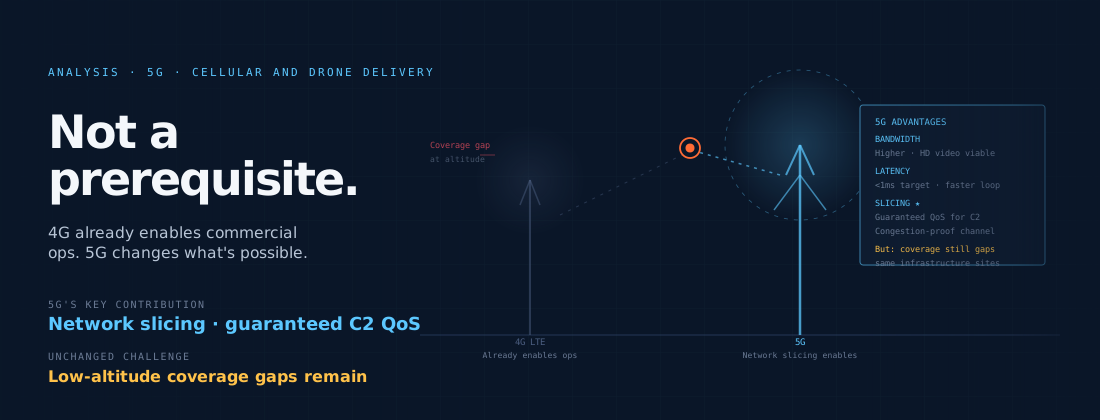
This is an important baseline observation. 5G is not a prerequisite for commercial drone delivery — it is a potential improvement to the cellular infrastructure that drone operations already use. Operations launched today on 4G networks will still work on 4G networks in markets where 5G is not yet deployed. The argument that drone delivery is waiting for 5G to be viable is not supported by the operational evidence.
What 5G adds
5G offers improvements over 4G in three dimensions that are relevant to drone delivery: bandwidth, latency, and network slicing.
Higher bandwidth allows more data to be transmitted simultaneously — relevant for drone operations that send high-resolution video alongside command and control data, or that manage large numbers of simultaneous flights from a single ground control station. Current C2 links carry relatively small data packets; bandwidth is not the primary bottleneck for most current operations. As operations scale and particularly if high-definition video feeds become standard in commercial operations, bandwidth becomes more relevant.
Lower latency — the delay between sending a command and the network delivering it — is more immediately relevant to drone control. 5G’s sub-millisecond latency targets, if achieved in deployed networks, represent a meaningful improvement over 4G’s typical 20 to 40 millisecond round-trip times. For real-time control applications, lower latency gives operators and autonomous systems faster feedback loops.
Network slicing is the 5G capability with the most significant potential impact on drone delivery operations. Network slicing allows a mobile network to be partitioned into logical sub-networks, each with guaranteed quality of service characteristics — defined bandwidth, latency, and reliability — allocated to specific application types. A network slice designated for drone delivery C2 could provide guaranteed delivery of control signals even when the shared network is congested, something that 4G networks cannot reliably provide.
The coverage challenge
The most significant limitation of cellular networks for drone delivery is not technology generation — it is coverage. Cellular networks are designed and optimised for ground-level coverage: base stations are positioned to serve users on the ground, and coverage at low altitude (below 120 metres) is often significantly patchy compared to coverage at ground level.
This coverage gap applies to both 4G and 5G networks. A 5G network built on the same site infrastructure as a 4G network will have the same coverage holes at low altitude, albeit potentially with better performance where coverage exists. Expanding low-altitude coverage for drone operations requires either additional base station deployments specifically targeting aerial coverage or the use of directional antennas on existing sites — neither of which is happening at scale as a result of consumer demand alone.
The regulatory enablement question
5G networks support capabilities — high-bandwidth data links, network slicing, edge computing for low-latency processing — that could underpin regulatory frameworks for higher-density autonomous drone operations. If regulators are prepared to grant operational authorisations that depend on guaranteed quality of service from the communications network, 5G’s network slicing capability provides a technical basis for those guarantees that 4G cannot reliably offer.
The relationship is therefore as much regulatory as technical: 5G enables new classes of regulatory framework for drone operations, which in turn enable new operational models. The pace at which that enablement translates into actual operational change depends on the pace of both 5G deployment and the regulatory frameworks that exploit it — neither of which is determined by technology alone.