Why drone delivery launches in suburbs first: the physics and planning logic
This article is DDG’s analytical assessment of the geographic logic of drone delivery deployment, based on publicly available information about operational characteristics and the environments in which commercial services have launched.
Drone delivery has launched commercially in suburban Canberra, suburban North Carolina, suburban Galway, suburban Zurich, suburban Logan and Werribee. It has not launched at scale in central London, central New York, or central Tokyo. This pattern is consistent enough across geographies, regulatory environments, and operators to require explanation. The explanation has multiple components, but they are consistent: suburban environments offer structural advantages over dense urban environments for current-generation delivery drones.
Vertical access to delivery zones
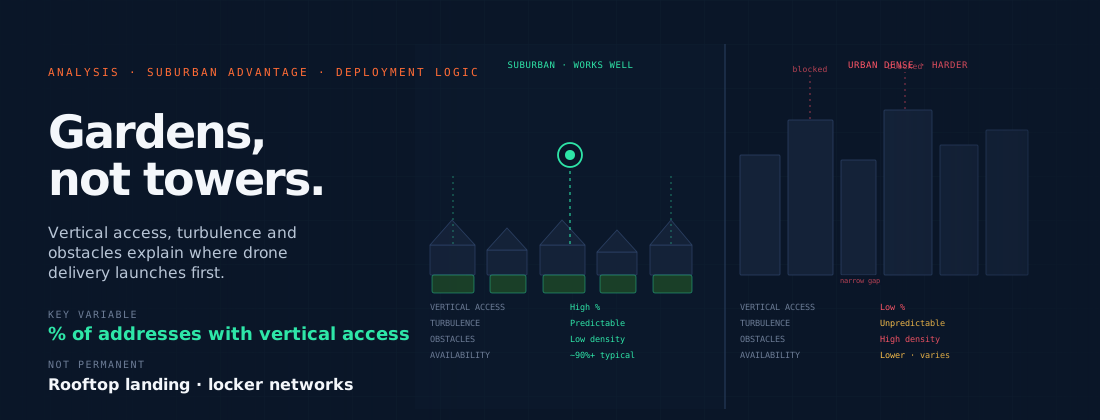
Winch delivery — the dominant mechanism for residential drone delivery — requires the aircraft to hover above the delivery zone and lower a package vertically to the ground. This requires unobstructed vertical airspace above the delivery location: no power lines, no tree canopy, no multi-storey buildings immediately adjacent. In a suburban environment with detached or semi-detached housing, gardens, and relatively low building heights, suitable delivery zones are common. In a dense urban environment with mid-rise and high-rise buildings, narrow streets, and overhead infrastructure, they are rare.
The calculation is simple: in a typical low-density suburban residential area, the proportion of addresses reachable by winch delivery is high. In a dense urban area, it is low. The hub’s addressable market — the number of deliveries it can physically make — is constrained not just by range but by the proportion of addresses within range that are physically deliverable. Urban density compresses that proportion significantly.
Obstacle and airspace complexity
Dense urban environments present a substantially more complex obstacle environment than suburban ones. Multi-storey buildings create airspace that requires routing around rather than over them. The turbulent airflow patterns generated by tall building complexes create flight quality challenges that compound the routing complexity. The density of manned aviation activity — helicopter routes, hospital helipads, aviation approaches to urban airports — is also typically higher over dense urban areas than suburban ones.
Each of these factors adds to the cost and complexity of urban operations: more detailed corridor mapping, more stringent DAA requirements, more complex regulatory engagement, higher demands on the aircraft’s navigation and obstacle avoidance systems. Current-generation aircraft, designed and certified for suburban operating conditions, face operational envelopes that are harder to fill in dense urban environments.
Low-altitude wind and turbulence
Drone delivery aircraft operate at low altitudes — typically 30 to 120 metres above ground level. At these altitudes, wind conditions are heavily influenced by the terrain and structures below. Suburban environments, with consistent low-rise building heights and open garden areas, produce relatively predictable low-altitude wind patterns. Dense urban environments, with highly variable building heights and complex building configurations, produce highly variable turbulence and channelling effects that are difficult to predict from hub-level weather data.
The operational consequence is that weather cancellations are more frequent in complex urban environments than suburban ones for aircraft with the same meteorological limits. An operation that achieves 90 per cent availability in suburban conditions may achieve substantially less in a dense urban centre — reducing the effective delivery volume and worsening the economics.
Population density, not population
A common misconception is that drone delivery requires low population. The opposite is true: the economics require high delivery density, which requires a high population within the catchment area. The relevant variable is not population density per se but the form that density takes — low-rise suburban density, where gardens and driveways provide delivery zones, supports drone delivery well. High-rise urban density, where many people live in buildings without private outdoor delivery zones, supports it poorly regardless of how many people are present.
This distinction matters for how the market develops. Cities with high populations spread across suburban-form development — much of the US sunbelt, Australian cities, many Middle Eastern urban areas — have large addressable markets for drone delivery. Dense European cities with high-rise residential construction have smaller addressable markets at current aircraft and delivery mechanism capabilities. This is not a permanent condition: building-integrated delivery infrastructure, rooftop landing zones, and delivery locker networks represent potential solutions, but they require infrastructure investment and regulatory frameworks that do not yet exist at scale.
The implication for urban delivery
The suburban advantage is not permanent. It reflects the capabilities of current-generation aircraft and delivery mechanisms, and the regulatory frameworks developed around them. As aircraft improve, as delivery mechanisms diversify, and as urban infrastructure develops to support drone delivery, the calculus will shift. The operators building operational experience and regulatory relationships in suburban markets today are best placed to expand into adjacent urban markets as the conditions for those markets improve.