What is BVLOS? The regulatory threshold reshaping commercial drone delivery
If there is one regulatory concept that defines the current state — and the near-term future — of commercial drone delivery, it is BVLOS: Beyond Visual Line of Sight flight. Understanding what it means, why it matters, and how different regulatory systems approach it is essential to understanding the industry.
What BVLOS means
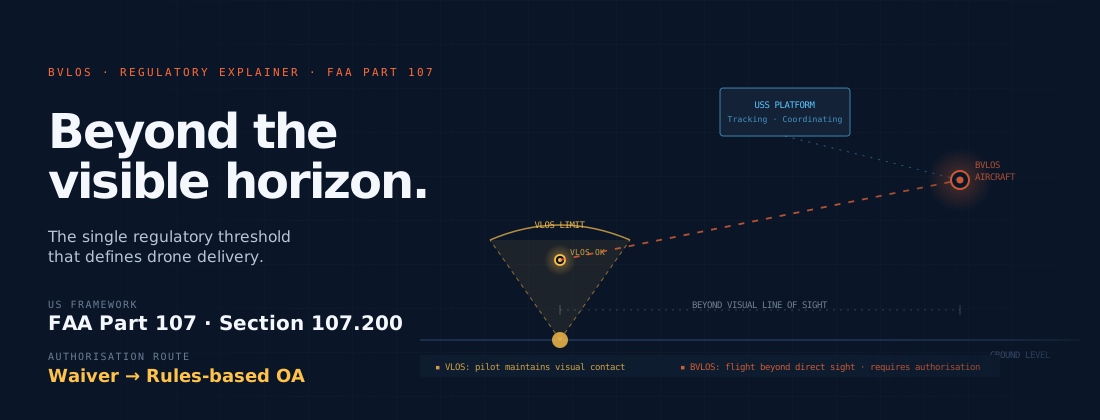
Visual Line of Sight flight, or VLOS, is the default operating condition for civilian unmanned aircraft in almost every regulatory jurisdiction in the world. Under VLOS rules, the remote pilot must maintain direct unaided visual contact with the aircraft at all times during flight. In practice, this limits operations to a radius of several hundred metres in good visibility conditions — useful for photography and inspection, but insufficient for delivery operations at any meaningful scale.
Beyond Visual Line of Sight flight, by contrast, allows the aircraft to operate beyond the range at which the remote pilot can see it directly. For drone delivery, this is not a preference but a necessity: a hub-based delivery operation serving a multi-kilometre radius around a distribution facility simply cannot function under VLOS constraints.
Why BVLOS has been the central regulatory challenge
The requirement to maintain visual contact with an aircraft is not arbitrary. It exists because visual observation is the most reliable mechanism for detecting and avoiding other aircraft and ground hazards in real time. A remote pilot who can see the aircraft can respond to unexpected obstacles — a manned aircraft entering the area, a bird strike, a sudden change in wind — in ways that automated systems have historically been less reliable at handling.
The challenge for regulators has been developing confidence that drone delivery systems can replicate that safety function through other means: radar-based detect-and-avoid systems, transponders, ground-based radar coverage, USS coordination, and the operational discipline of defined corridor flight. Building that confidence has taken time, and the frameworks that have emerged reflect a deliberate, evidence-based approach to expanding permissions as the safety record develops.
The US approach: from waivers to rules
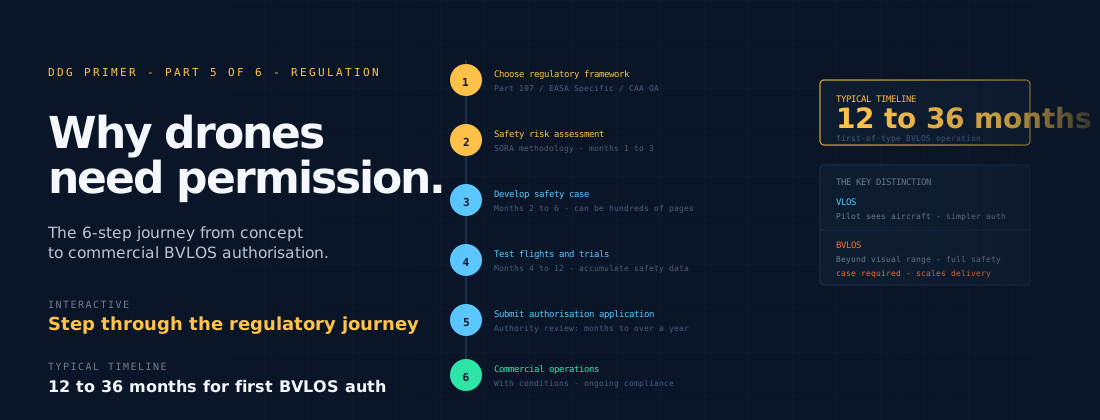
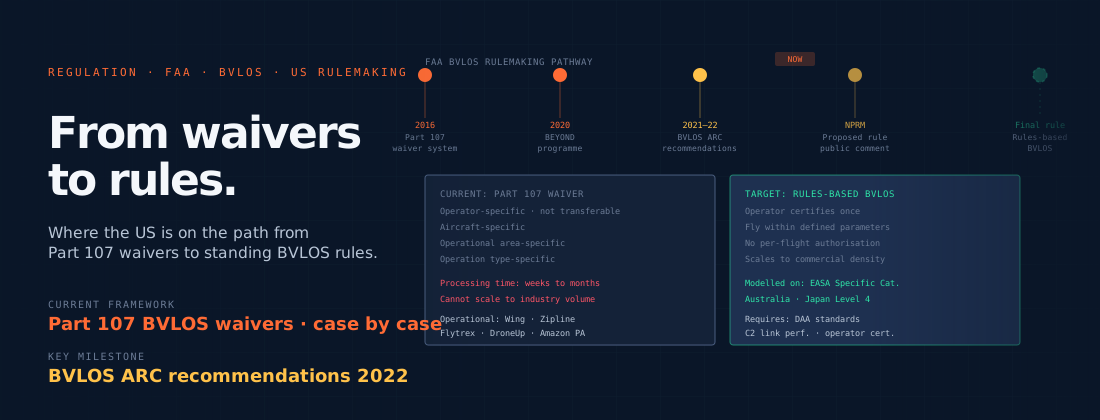
In the United States, the Federal Aviation Administration established the regulatory framework for small unmanned aircraft systems through Part 107, which took effect in August 2016. Part 107 established VLOS as the operating standard and created a waiver mechanism — under Section 107.200 — through which operators could apply for permission to conduct BVLOS operations on a case-by-case basis.
The waiver process required operators to demonstrate that their proposed BVLOS operation could be conducted safely without the protections that VLOS requirements provide. In practice, this meant detailed submissions covering aircraft airworthiness, detect-and-avoid capabilities, pilot qualification, corridor characteristics, and emergency procedures. Waivers, when granted, were specific to a named operator, a defined aircraft type, and a defined geographic corridor. They could not be transferred or applied to different operations without a new application.
For early-stage operators conducting research and demonstration flights, the waiver framework was workable. For operators attempting to build commercial delivery networks at scale, it created a compliance overhead that constrained growth significantly. Managing dozens or hundreds of individual waivers — each with its own renewal cycle, its own conditions, and its own geographic specificity — consumed engineering, legal and operational resources that could otherwise have gone into building services.
The FAA has been developing a rules-based framework to replace the waiver regime for routine BVLOS operations. This has involved extensive stakeholder consultation, safety analysis, and the development of performance-based standards that operators must meet to qualify for standing operating permissions rather than one-off waivers.
The European approach: U-space
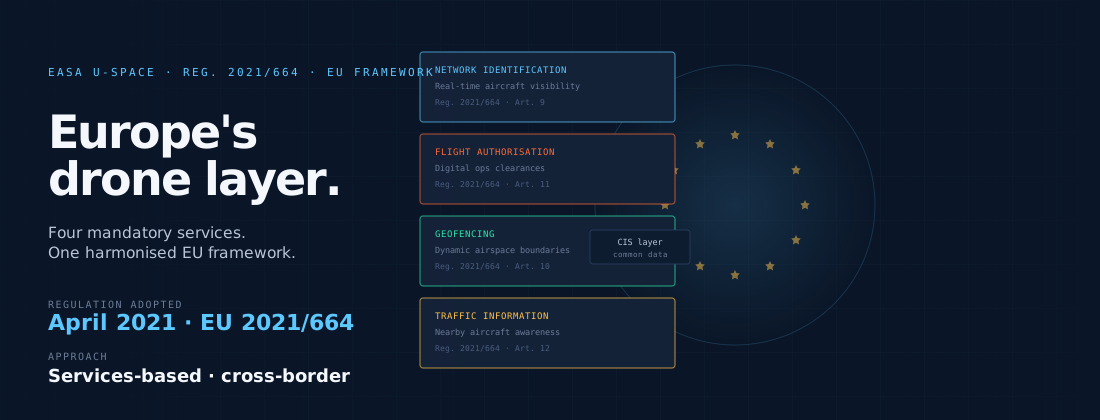
The European Union Aviation Safety Agency has developed a different framework for BVLOS operations through its U-space regulation, adopted in 2021. U-space defines a set of airspace management services — including network identification, geofencing, flight authorisation, and traffic information — that must be provided by certified U-space service providers in designated airspace areas. Operators accessing U-space are able to obtain flight authorisations for BVLOS operations through automated digital processes rather than case-by-case applications to national authorities.
The U-space approach is services-based rather than corridor-based: rather than authorising specific routes, it authorises access to defined volumes of airspace through a managed digital environment. This creates more operational flexibility than the corridor model but requires more sophisticated ground infrastructure and airspace management capability.
Why BVLOS capability defines the industry
The economics of drone delivery are fundamentally BVLOS economics. A hub serving a 500-metre VLOS radius can reach a limited number of addresses. A hub serving a 10-kilometre BVLOS radius can serve a population of meaningful commercial scale. The hub infrastructure, the aircraft fleet, the maintenance overhead and the regulatory compliance costs are broadly similar in both cases: the revenue potential is not. BVLOS is the unlock that makes the unit economics of delivery viable.
For this reason, regulatory progress on BVLOS in any given jurisdiction is the single most reliable leading indicator of when commercial drone delivery will become a meaningful industry in that market.