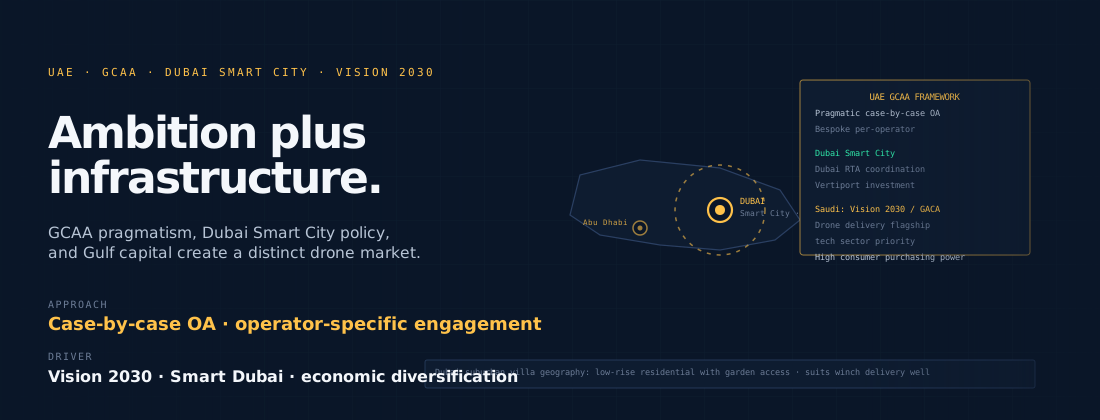
The UAE’s drone regulatory framework: what the GCAA has built and what Vision 2030 is driving
The United Arab Emirates occupies an unusual position in the global drone regulatory landscape. It is a small country — seven emirates covering approximately 84,000 square kilometres — with the resources and policy ambition of a much larger state, and with a government that has made the adoption of emerging technology a central pillar of economic development policy. The result is a drone regulatory framework that has, in stated ambition, been among the most permissive in the world, combined with the infrastructure investment and government coordination capacity to potentially make that ambition real.
The GCAA regulatory framework
The General Civil Aviation Authority — GCAA — is the UAE’s civil aviation regulator, responsible for all aviation operations in the country including unmanned aircraft systems. The GCAA has developed regulations for UAS operations that establish categories based on aircraft weight and operational risk, with operational authorisation requirements that range from simple registration for low-risk recreational operations to complex multi-agency coordination for commercial BVLOS operations over populated areas.
The GCAA’s approach to commercial drone delivery has been to engage with operators seeking BVLOS authorisations on a case-by-case basis, developing bespoke operational frameworks for specific operations rather than relying on a generic rules-based structure. This approach is consistent with the UAE’s broader regulatory philosophy for emerging technology sectors — engaging pragmatically with specific applications rather than waiting for comprehensive generic frameworks to be developed.
Dubai as the lead market
Within the UAE, Dubai has been the most active emirate in pursuing drone delivery development. Dubai’s Smart City initiative has explicitly identified autonomous delivery — including drone delivery — as a target application, and the Dubai Roads and Transport Authority has been involved in the coordination of urban mobility policy that encompasses drone operations.
Dubai’s urban geography is relevant to the delivery drone opportunity: the city’s newer residential developments — particularly the suburban villa communities that surround the older dense urban core — have the detached housing with private garden access that suits current-generation winch delivery mechanisms. The proportion of Dubai addresses that are physically deliverable by current-generation drone is higher than in the densely built older residential areas of many comparable cities.
Several international operators have expressed interest in and conducted engagement with Dubai for potential operations, attracted by the combination of regulatory openness, consumer purchasing power, and the marketing value of launching in a high-profile global city. The challenge has been converting that engagement into sustained commercial operations — a challenge that reflects both the regulatory complexity of obtaining authorisation for specific operations and the commercial challenge of building the retail and logistics partner infrastructure that commercial delivery requires.
Saudi Arabia and Vision 2030
Saudi Arabia’s Vision 2030 programme — the government’s plan to diversify the economy beyond hydrocarbon dependence — has identified drone delivery as one of the emerging technology sectors the kingdom wishes to develop. The General Authority of Civil Aviation — GACA — has engaged with international drone operators and technology companies as part of this development agenda, and has been developing regulatory frameworks for commercial drone operations in the Saudi context.
The Saudi market has characteristics that make it attractive for drone delivery infrastructure investment: a large population concentrated in a few major cities and their suburbs, high consumer purchasing power in those urban markets, government capital availability for infrastructure investment, and a government policy agenda that creates regulatory incentives for technology deployment. The gap between the stated ambition and the operational reality remains large, but the direction of travel is toward rather than away from commercial drone delivery at scale.
The Gulf as a regulatory reference
The UAE’s and Saudi Arabia’s drone regulatory development is watched by other emerging markets as a reference for how a government with resources and policy ambition approaches the problem of enabling commercial drone operations rapidly. The willingness to engage pragmatically with specific operator proposals, to invest in supporting infrastructure, and to treat regulatory development as a government policy objective rather than a purely procedural exercise is a model that other emerging markets seeking rapid drone deployment have studied.