Swoop Aero: the Australian company taking medical drone logistics to the Pacific and Africa
The narrative of drone delivery in established Western markets — suburban Australia, urban Ireland, sunbelt America — is one of technology looking for a commercial case. The narrative of drone delivery in island Pacific communities or rural African health systems is different: the commercial case is obvious, and the question is whether the technology can be made reliable and affordable enough to serve it. Swoop Aero, the Melbourne-based drone logistics company, has built its business in the second category.
The company and its aircraft
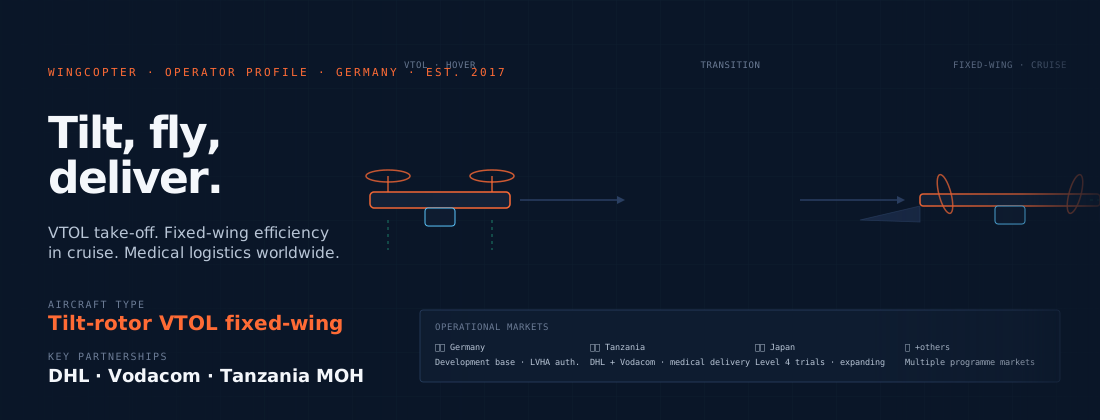
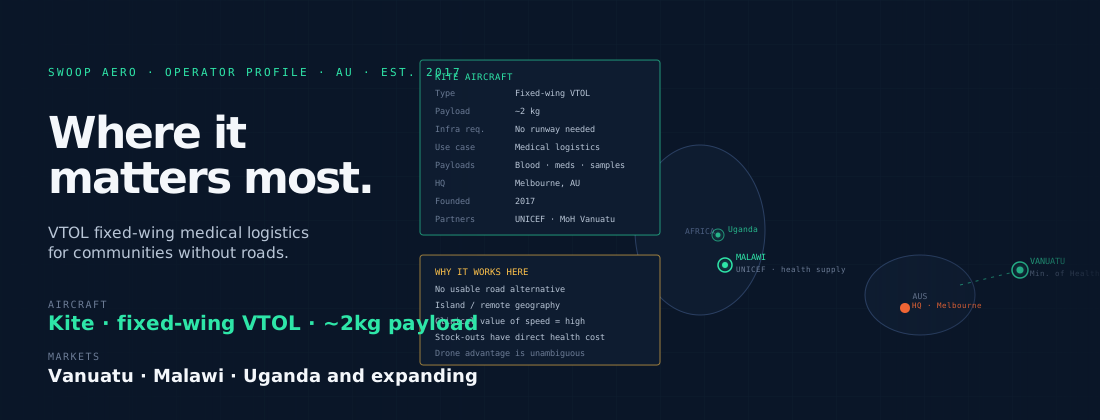
Swoop Aero was founded in 2017. The company has developed its own aircraft — a fixed-wing VTOL (vertical take-off and landing) design that can take off and land in confined spaces without the infrastructure a conventional fixed-wing aircraft requires, while achieving the range and efficiency of fixed-wing cruise flight. The aircraft, known as the Kite, carries a payload in the order of two kilograms over ranges of several tens of kilometres — well-suited to the medical logistics use case where blood products, diagnostic samples, and pharmaceutical items are the primary payloads.
The VTOL fixed-wing configuration is a deliberate design choice for the markets Swoop Aero serves. In Pacific island communities, suitable aircraft landing strips are absent or restricted; in rural African health facilities, the ground infrastructure for multirotor operations may be limited. The Kite’s ability to take off from and land in a defined area, without a runway, while achieving the range of a fixed-wing aircraft in cruise, makes it operational in environments where other configurations would require infrastructure investment that is not available.
The Vanuatu operations
Swoop Aero has operated medical logistics services in Vanuatu, the Pacific island nation, in partnership with the Vanuatu Ministry of Health. The Vanuatu context illustrates precisely the conditions under which drone delivery provides the most unambiguous value: island communities that are accessible by boat or small aircraft but where the time and cost of surface transport for medical supplies is prohibitive, combined with health facilities that lack reliable supply chains for blood products and essential medicines. In this environment, the speed and directness of drone delivery has clinical value that is immediate and measurable.
The regulatory environment for drone operations in Vanuatu is less developed than those of Australia or European countries, which has both advantages (fewer procedural barriers to operations) and challenges (less established framework for operational authorisation). Swoop Aero has worked with the Civil Aviation Authority of Vanuatu to develop the operational authorisations required for its flights.
African health system operations
Beyond the Pacific, Swoop Aero has conducted operations in African markets including Malawi, working with international health organisations including UNICEF on medical logistics challenges. The African context shares the Pacific’s fundamental characteristic: ground logistics that are inadequate for the time sensitivity of medical supply chains, combined with a geography where drone delivery can provide a meaningful advantage over available alternatives.
UNICEF’s involvement in supporting drone delivery trials in African markets reflects a broader recognition within the humanitarian sector that drone logistics represents a genuinely useful tool for health supply chain challenges in low-infrastructure environments, rather than a technology solution in search of a problem.
The humanitarian logistics model and its economics
Swoop Aero’s market is structurally different from the consumer retail delivery market. The customers are health ministries, international health organisations, and NGOs rather than individual consumers. The procurement process involves grant funding, development finance, and government contracts rather than per-delivery consumer fees. The value proposition is measured in health system outcomes — stock-out reduction, supply chain reliability, cold chain maintenance — rather than consumer convenience.
This model is harder to scale rapidly than a consumer retail model, but it has characteristics that make it more durable in the markets it serves. Health system partners have a sustained and predictable demand for medical logistics. The operations are less exposed to the consumer price sensitivity that constrains retail drone delivery economics. And the alignment between the operator’s commercial model and the health outcomes being delivered creates a partnership dynamic that consumer retail delivery cannot easily replicate.