Skyports: building the infrastructure layer for drone delivery in the UK and beyond
Most discussions of drone delivery focus on aircraft — who makes them, how far they fly, what they carry. Skyports has built its business around a different question: what does the ground infrastructure that makes drone delivery work actually look like, and who is going to build and operate it?
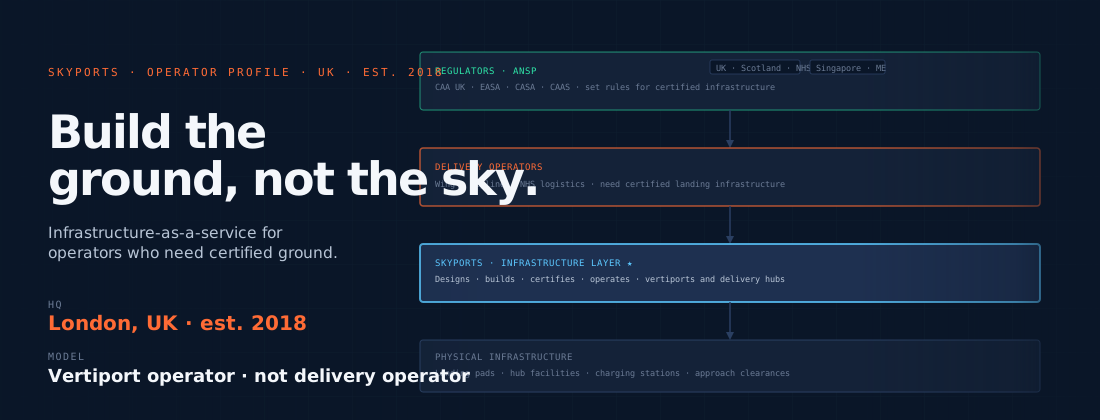
Founded in London in 2018, Skyports describes itself as a vertiport infrastructure company. Its commercial model is to design, build and operate the landing and launch infrastructure for both drone delivery operations and, more recently, advanced air mobility more broadly. The company’s clients are the operators who need that infrastructure — drone delivery companies that require certified landing sites, hub facilities, and ground support systems — rather than the end customers who receive deliveries.
The infrastructure-first model
The distinction between operating a drone delivery service and operating the infrastructure that enables one is commercially and operationally significant. An infrastructure provider’s business scales with the number of operators who use its facilities rather than with the number of deliveries any single operator makes. The customer base is operators and aviation authorities rather than consumers. The regulatory engagement required is primarily around the design and certification of ground infrastructure rather than flight operations.
Skyports has been explicit about this positioning. The company has described its role as analogous to that of an airport operator in the manned aviation world — providing the physical and operational infrastructure within which airlines (or, in this context, drone delivery operators) conduct their business. An airport operator does not fly aircraft; it provides the certified space and services within which aircraft operations are possible.
UK medical delivery trials
Skyports has been involved in a series of UK drone delivery trials with medical logistics as the primary use case. The company has worked with NHS trusts and health systems in Scotland and England on trials delivering medical supplies — blood products, laboratory samples, and pharmaceutical items — between health facilities. These trials have been conducted with CAA authorisation under the UK’s Specific Category framework.
The Scottish trials, which have included operations connecting island communities to mainland health services, represent a use case that maps closely to the conditions that have made medical drone delivery successful elsewhere: time-sensitive payload, meaningful distance advantage over surface transport, and a clear health system partner willing to work through the regulatory process.
International expansion
Skyports has pursued international development beyond its UK base. The company has been involved in vertiport development and drone delivery infrastructure in Singapore, which has an active regulatory environment for drone operations, and has engaged with infrastructure opportunities in the Middle East and other markets. The international strategy reflects the infrastructure-as-a-service model: a company that can design and certify vertiport infrastructure to aviation standards can, in principle, replicate that capability in any jurisdiction where the regulatory framework permits drone operations.
The regulatory relationship
Infrastructure providers occupy an interesting position in the regulatory landscape. The aircraft, the operator, and the flight operations are all subject to aviation regulation — but so is the ground infrastructure, in ways that are not always immediately obvious. Landing pads must be designed and certified to handle the aircraft that use them. Hub facilities have airspace implications. The relationship between the ground infrastructure and the flight operations must be reflected in the safety case that supports the operational authorisation.
Skyports’ engagement with the UK CAA and with aviation authorities in other markets has been central to its ability to develop certified infrastructure. The regulatory relationships built through that engagement are, like ANSP relationships in the UTM context, not easily or quickly replicated by new entrants.
The broader market thesis
The infrastructure model rests on a thesis about how drone delivery will develop: that the demand for landing and hub infrastructure will grow as more operators enter more markets, and that the operators themselves will prefer to use professionally operated, certified infrastructure rather than building and managing it independently. That thesis has strong parallels in the manned aviation world, where even large airlines use third-party-operated airports rather than building their own. Whether the drone delivery market develops in a way that validates this thesis is a key question for Skyports’ long-term position.