The UK CAA’s approach to BVLOS: what the Specific Category framework means in practice
When the United Kingdom left the European Union’s aviation regulatory framework, it simultaneously left EASA’s jurisdiction. The UK Civil Aviation Authority became responsible for the full spectrum of UK aviation regulation, including the increasingly significant question of how to regulate commercial unmanned aircraft operations. The framework that has emerged is based on the same underlying methodology as the EASA approach — the JARUS Specific Operations Risk Assessment, or SORA — but implemented and evolving independently.
The Specific Category and what it covers
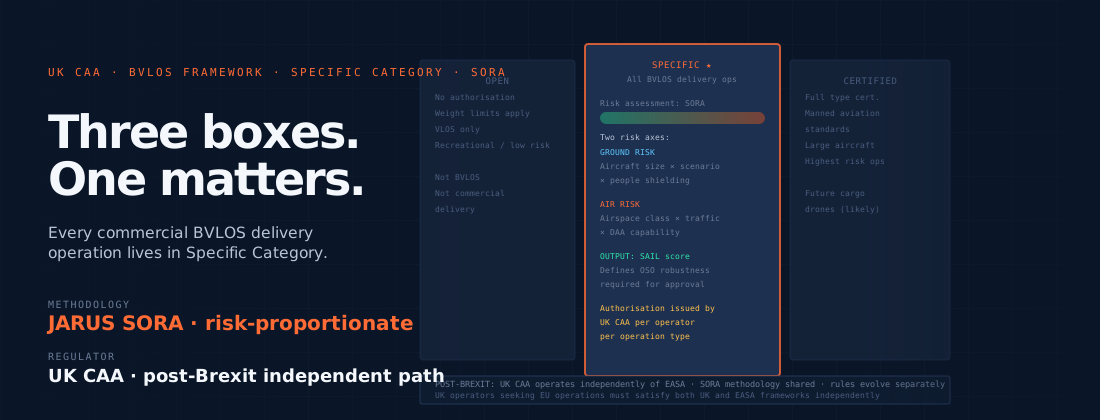
UK drone regulation, codified in the Air Navigation Order and accompanying CAA policy and guidance, divides unmanned aircraft operations into three categories. Open Category covers low-risk operations with limited aircraft weight and operational constraints, and does not require prior authorisation. Certified Category covers the most complex operations, treated similarly to manned aviation. Specific Category covers everything in between — the broad middle ground that encompasses essentially all commercial BVLOS delivery operations.
Specific Category operations require an Operational Authorisation from the CAA. To obtain one, the operator must submit a safety case demonstrating that the proposed operation is conducted at an acceptable level of risk. The methodology the CAA recommends for developing that safety case is the SORA process: a structured risk assessment that evaluates the operation against defined ground risk and air risk criteria and identifies risk mitigations required to bring the operation within defined safety performance levels.
How SORA works in practice
The SORA process, developed by JARUS and published as its document JARUS SORA, assesses two risk dimensions for any proposed operation. Ground risk reflects the likelihood and consequence of the unmanned aircraft impacting people on the ground — determined by the aircraft’s characteristic dimension (broadly, its size), the operational scenario (urban, suburban, rural), and the degree to which people on the ground are shielded from exposure. Air risk reflects the likelihood of a mid-air collision with manned aviation, determined by the airspace class, the level of traffic, and the detect-and-avoid capabilities employed.
The outcome of the SORA assessment is a required level of robustness for the operational safety objectives and the organisation’s safety management systems. Operators whose proposed operations score higher on the risk scale must demonstrate more robust safety measures. The structured nature of the SORA process means that operators and the CAA are working within the same analytical framework, which speeds up the authorisation process compared with a fully bespoke case-by-case assessment for each application.
The UK’s Pathfinder programme and beyond
The UK CAA has supported the development of commercial drone operations through a series of programmes designed to enable real-world operational experience within a managed regulatory framework. The CAA’s Drone Pathfinder programme, which ran in multiple phases, brought together operators, air navigation service providers, and regulators to develop and test the operational frameworks needed for BVLOS commercial operations, with a particular focus on building the evidence base that future rules-based regulation would require.
Operations conducted through the Pathfinder programme and subsequent CAA innovation programmes have included medical delivery trials connecting Scottish island communities to mainland health facilities, NHS blood and sample logistics trials in England, and package delivery demonstrators in suburban environments. Each operation has produced operational data and safety information that contributes to the evidence base for the next stage of regulatory development.
The direction of travel
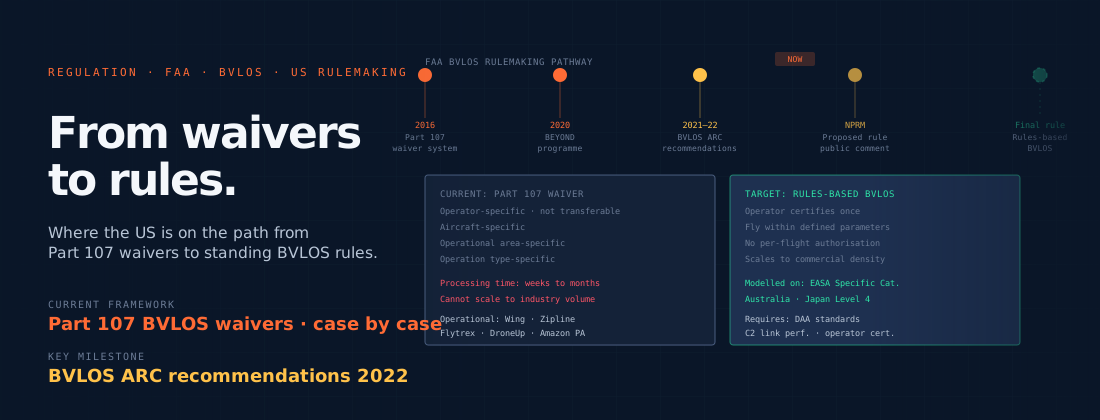
The current UK framework is explicitly transitional. The CAA has described its ambition to move from the current case-by-case Operational Authorisation approach toward a more scalable, rules-based framework for commercial BVLOS operations — analogous to the shift from individual instrument flight rule approach procedures to a standardised published approach system in manned aviation. The authorisation of individual operations is manageable at current volumes; it will not scale to the volumes that commercial drone delivery at national scale would require.
The UK CAA’s post-Brexit position has both advantages and constraints for this transition. The CAA has regulatory flexibility that EASA membership constrains — it can make rule changes without coordinating across 27 member states. It also lacks the regulatory harmonisation benefits of the EASA framework, which means UK operators seeking to operate in European markets must navigate two distinct regulatory regimes. The extent to which UK and EASA frameworks converge or diverge over time is one of the significant regulatory questions for operators with ambitions in both markets.