Flytrex and the North Carolina model: suburban food delivery under the FAA BEYOND programme
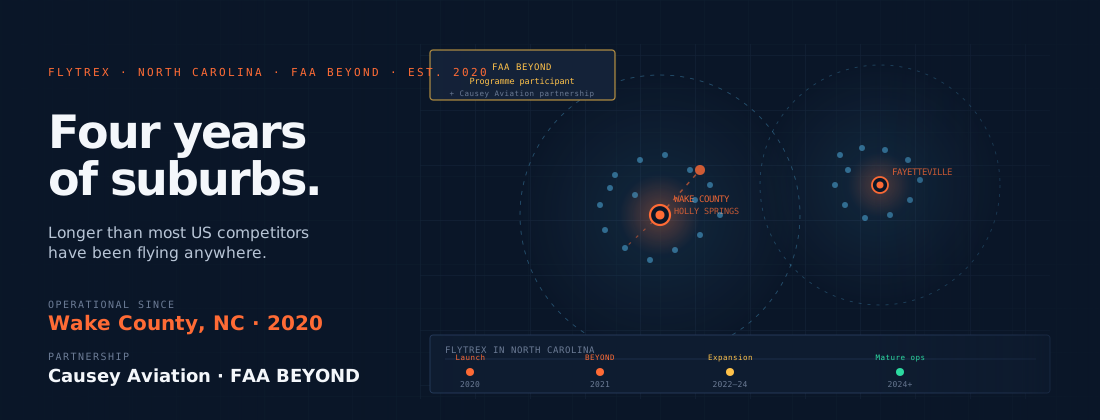
Flytrex is an Israeli drone delivery company that has been operating commercially in North Carolina longer than most of its competitors have been operating anywhere in the United States. Founded in 2013, Flytrex began its North Carolina operations in 2020 in partnership with Causey Aviation — a local aviation company that holds the FAA operating certificates under which the flights are conducted — and has been expanding its operational footprint in the state progressively since then.
The FAA BEYOND programme
Flytrex’s North Carolina operations are conducted under the FAA’s BEYOND programme — a programme established to enable and study UAS operations beyond the standard Part 107 limitations, with a focus on operations over people and beyond visual line of sight. BEYOND programme participants work directly with the FAA to develop and demonstrate operational capabilities, gathering data that informs the development of the broader regulatory framework.
Participation in BEYOND has allowed Flytrex to conduct BVLOS operations and deliveries over populated suburban areas under a framework that preceded the general rules-based authorisation system that is now developing. The programme has been a significant enabler for Flytrex’s North Carolina operations, providing the regulatory pathway for operations that would otherwise have required individual waivers under Part 107.
The Causey Aviation partnership
Flytrex’s partnership with Causey Aviation reflects a structural approach to US regulatory requirements that is common among drone delivery operators who are not themselves FAA-certificated aviation organisations. Causey Aviation holds the FAA air carrier and operating certificates that govern the flights; Flytrex provides the aircraft, the software platform, and the operational design. This division — a certificated aviation partner providing the regulatory standing, a technology company providing the delivery capability — allows Flytrex to operate commercially in the US without itself holding the full range of FAA certificates that a standalone air carrier would require.
Operations in Wake County
Flytrex’s North Carolina operations are centred in the Wake County area, including the communities of Holly Springs and Fayetteville. Wake County’s suburban geography — residential subdivisions with gardens, relatively clear airspace, and a population with high e-commerce adoption — suits the Flytrex operational model, which involves delivering to residential addresses from a hub facility.
The delivery model involves orders placed through partner retailers, with Flytrex’s aircraft delivering the package to the customer’s backyard or garden using a winch-based lowering system. The aircraft does not land at the customer’s address; it holds position above the delivery zone and lowers the package to the ground on a tether. This mechanism allows delivery to a wide range of residential addresses without requiring a prepared landing surface.
The aircraft
Flytrex uses a proprietary multirotor delivery aircraft that the company has developed and iterated over its operational period. The aircraft is designed for suburban residential delivery — moderate payload capacity, sufficient range to serve a residential catchment area from a hub facility, and a winch delivery mechanism. The company has not published detailed technical specifications for its current operational aircraft, but its operational design — hub-based VTOL delivery to residential addresses — is publicly documented through its FAA programme participation.
Commercial partnerships and retail integration
Flytrex has partnered with retail and food service companies to integrate drone delivery into their customer offering. Publicly documented partnerships have included food delivery in partnership with local restaurants and convenience retailers. The commercial model parallels that of other consumer-facing delivery operators: the retailer integrates drone delivery as an option within their existing ordering channel, and Flytrex handles the physical delivery from hub to customer.
What the North Carolina operation demonstrates
The significance of Flytrex’s North Carolina operation for the broader industry is its duration and its operational context. By 2024, Flytrex had been conducting commercial drone deliveries in Wake County for four years — a longer continuous operational period in a US market than most competitors can point to. That operational history provides a data set on real-world performance, failure modes, customer behaviour, and operational challenges that is genuinely useful to the regulatory process.
The suburban residential context is also representative of the market that most US delivery drone operators are targeting. Wake County’s demographics and geography are not exotic: they are broadly typical of the suburban residential markets that operators like Wing, Amazon Prime Air, and others are seeking to serve. Flytrex’s operational experience in that environment, accumulated over several years, is a meaningful contribution to the evidence base for what commercial suburban drone delivery looks like at operational maturity.