Counter-UAS and the legitimate operator problem: how detection systems affect commercial delivery
The proliferation of unmanned aircraft has driven a parallel proliferation of counter-UAS systems — technology designed to detect, track, identify, and in some cases defeat or neutralise drone flights near sensitive locations. Military installations, airports, prisons, critical infrastructure, and large public events have all become contexts where C-UAS systems are deployed, both by government agencies and, in some jurisdictions, by private operators.
The development of C-UAS technology creates a problem that the drone delivery industry has not yet fully resolved: the detection and interdiction capabilities of C-UAS systems do not reliably distinguish between authorised commercial delivery drones and unauthorised flights. As the geographic footprint of C-UAS deployment expands, the risk to legitimate commercial delivery operations grows.
How C-UAS systems work
Counter-UAS systems use a range of detection technologies to identify drone flights. Radio frequency detection identifies the wireless signals used for drone C2 links and video transmission. Acoustic sensors detect the characteristic sound signature of drone rotors. Radar systems track airborne objects by their radar cross-section and flight dynamics. Electro-optical and infrared cameras provide visual identification. Most operational C-UAS deployments use a combination of these technologies to improve detection confidence across different operating conditions.
Once a drone is detected, C-UAS systems respond through a range of means depending on the legal authority and technical capability of the deploying organisation. Soft countermeasures — jamming the GPS signal to cause the aircraft to lose position reference, or jamming the C2 link to disconnect the aircraft from its operator — are the most common non-destructive interdiction approach. More drastic physical countermeasures — directed energy weapons, kinetic interceptors — are reserved for the most sensitive contexts and the highest legal authority levels.
The problem for commercial operators
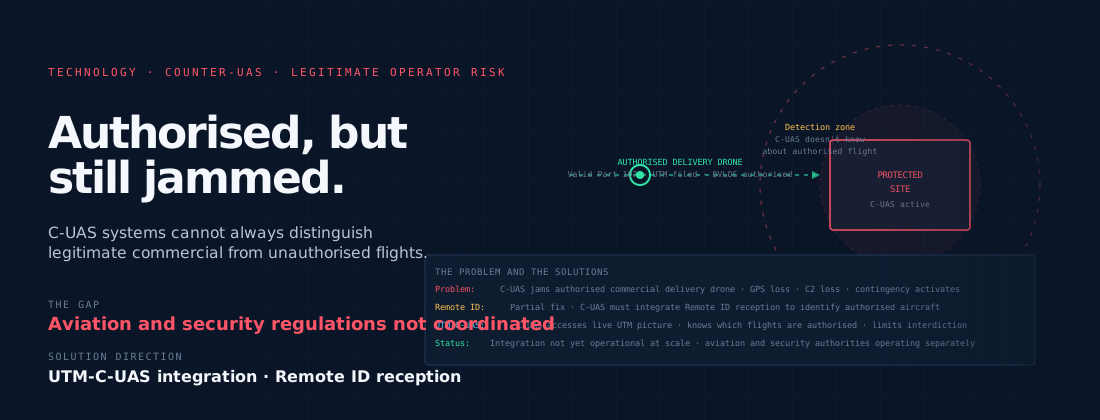
Commercial delivery drones use the same radio frequency bands, GPS systems, and C2 link technologies that C-UAS systems are designed to detect and jam. A delivery drone flying a legitimately authorised route within its operational corridor may pass through the detection footprint of a C-UAS system that has no knowledge of the authorised flight. The C-UAS system detects a drone, applies its countermeasures, and the delivery aircraft — which was legally operating and posing no threat — loses GPS reference, loses C2 contact, or activates its contingency procedures and returns to base.
The risk is not hypothetical. As C-UAS deployments have expanded — particularly near airports, major events, and government installations — there have been documented cases of interference with legitimate drone flights. The interference may not be immediately apparent to the operator: an aircraft that activates its GPS-loss contingency procedure may simply return to base with an unexplained navigation anomaly, without the operator knowing that C-UAS jamming was the cause.
The identification problem
Remote ID — the broadcast standard that requires commercial drones to transmit their identity and position — provides partial mitigation for the legitimate operator problem. A C-UAS system that incorporates Remote ID reception capability can, in principle, identify a detected drone as a registered commercial operator on an authorised flight, and modulate its response accordingly. In practice, the integration of Remote ID into C-UAS operational procedures is not universal, and the question of what authority a C-UAS operator has to identify and pass over a legitimate commercial flight is not always clearly defined in the regulatory frameworks that govern C-UAS deployment.
UTM integration offers a more systematic approach: if C-UAS systems had access to the real-time UTM picture — knowing which flights are authorised, their planned trajectories, and their identity — they could in principle limit interdiction to flights that are not accounted for in the authorised operations picture. This UTM-C-UAS integration is a direction of regulatory and technical development that the industry and regulators are actively pursuing, but it is not yet operational at scale in any major market.
The regulatory framework gap
The regulatory frameworks governing C-UAS deployment and the frameworks governing commercial drone operations have developed on separate tracks, with insufficient coordination between them. Aviation authorities regulate drone operations; security authorities regulate C-UAS systems. The interaction between the two regulatory domains — what happens when a C-UAS system interferes with a legally authorised commercial flight — is not clearly addressed in most regulatory frameworks.
Resolving this gap requires coordination between aviation and security regulatory authorities, and the development of operational protocols that protect both the security objectives of C-UAS deployment and the operational interests of legitimate commercial drone operators. The growth of commercial drone delivery at scale makes this coordination increasingly urgent: as the number of legitimate commercial drone flights per day increases, the probability of interference with C-UAS systems in any given operational area grows correspondingly.