What makes a drone delivery market mature: the five conditions that indicate readiness for scale
This article is DDG’s analytical framework for assessing drone delivery market maturity, based on publicly available information about regulatory, operational, and commercial conditions across current and emerging drone delivery markets.
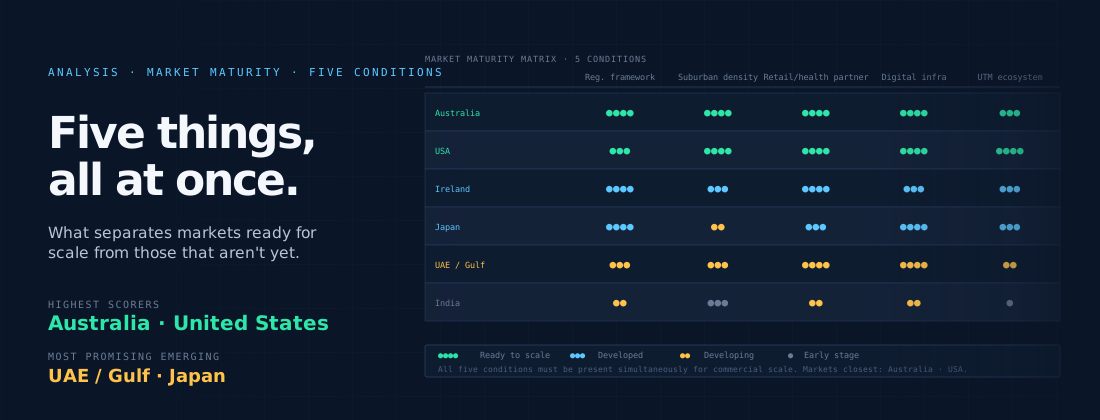
The question of which markets are ready for commercial drone delivery at scale is not simply a question of regulatory permission. A market can have regulatory permission and lack the commercial infrastructure, population density, or retail partner ecosystem to support viable operations. Conversely, a market can have all the commercial prerequisites and face a regulatory barrier that makes operations impossible regardless of market attractiveness. Market maturity for drone delivery requires the simultaneous presence of multiple conditions — and assessing which markets are closest to meeting all of them is a useful exercise for understanding where the industry is likely to grow next.
Condition one: a workable regulatory framework
The most fundamental prerequisite for commercial scale is a regulatory framework that permits the operations required. This means, at minimum, a pathway to BVLOS authorisation in the relevant airspace — whether through a rules-based framework or through an active waiver/SFOC programme — and an aviation authority that is actively processing commercial BVLOS applications rather than deferring them.
Markets with rules-based BVLOS frameworks — Australia, Japan, the United States (approaching this), EU member states under U-space — score more highly on this condition than markets where BVLOS requires novel case-by-case negotiation with aviation authorities that have limited experience with commercial drone delivery. The regulatory condition is binary in the sense that operations are either possible or not, but it is graduated in the sense that the friction of operating under an established framework differs substantially from operating under an emerging one.
Condition two: suburban-format residential density
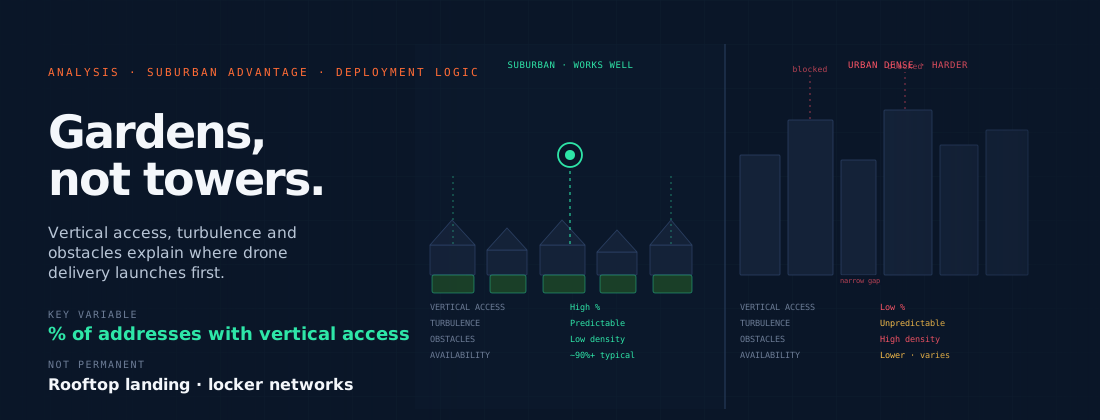
Current-generation delivery drones serve suburban residential environments better than dense urban ones, for the physical reasons analysed elsewhere on DDG. A market that consists primarily of high-rise urban density — with limited private outdoor delivery zones and complex urban airspace — has a structurally smaller addressable delivery market than one with suburban-format residential development.
This condition is geographic and difficult to change. It explains why Australian cities, the US sunbelt, and parts of the Middle East score more highly than central European cities or East Asian megacities on this dimension. It does not mean that dense urban markets are inaccessible — delivery locker infrastructure, rooftop landing facilities, and improved delivery mechanisms can expand the addressable market — but the infrastructure investment required to serve dense urban markets adds cost and time to the development path.
Condition three: retail or healthcare partner readiness
Commercial drone delivery requires a partner that provides the payload — a retailer offering consumer goods, a pharmacy supplying medications, a health system providing medical products — and that is willing to integrate drone delivery as a fulfilment option. The partner must be willing to invest in the operational integration, manage customer expectations around a new delivery mechanism, and accept the operational constraints that drone delivery imposes on the product range it can offer.
Markets with established, sophisticated retail sectors and health systems that have already engaged with logistics innovation are more likely to produce willing partners than markets where the retail sector is less developed or where healthcare system procurement operates through channels that make rapid logistics innovation difficult. This condition partially explains the success of operations in Ireland (Manna’s food and pharmacy partnerships) and the US (Wing and Amazon’s retail partnerships) relative to markets with comparable regulatory frameworks but less developed retail infrastructure.
Condition four: digital and cellular infrastructure
Commercial BVLOS drone delivery depends on reliable digital infrastructure: cellular coverage for C2 links, digital mapping for route planning and geofencing, and the connectivity infrastructure that supports remote pilot operations. Markets with patchy cellular coverage, limited digital mapping data, or unreliable internet infrastructure face operational constraints that limit the viability of BVLOS operations in the affected areas.
This condition is improving broadly, but it remains a meaningful differentiator between markets. The rollout of 5G networks, with their improved low-altitude coverage and network slicing capabilities, will progressively improve this condition in markets where 5G deployment is advanced. In markets where even 4G coverage is incomplete, this condition remains a material constraint.
Condition five: established UTM infrastructure
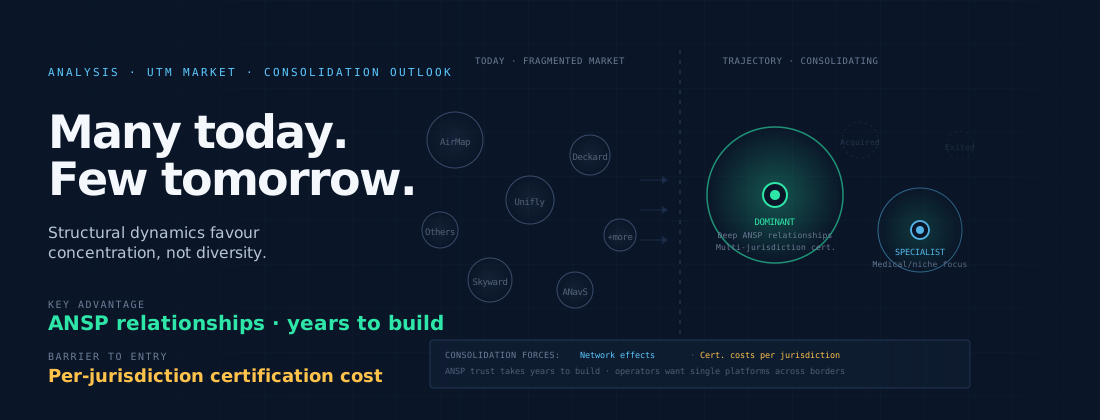
Commercial drone delivery at scale requires the UTM infrastructure that enables multiple operators to share airspace safely. A market without an operational USS ecosystem, without ANSP engagement in UTM development, and without the digital airspace management infrastructure that BVLOS operations require cannot support multiple operators at the density that makes the market economically interesting.
This condition is present in mature markets — the US LAANC ecosystem, the developing European U-space infrastructure, Australia’s ATM integration processes — and absent or immature in early-stage markets. The development of UTM infrastructure is a prerequisite for market maturity that is being built in parallel with regulatory framework development, but the two do not always progress at the same pace.
The current leaders
Mapping current markets against these five conditions, Australia scores highest — rules-based framework developing, suburban-format density in major cities, engaged retail partners, excellent cellular coverage, ANSP engagement in UTM. The US is close behind, with a maturing regulatory framework, the world’s largest suburban residential market, the most sophisticated retail sector, and an established LAANC UTM ecosystem. Ireland scores highly on regulatory engagement and retail partner readiness, but its market size limits the scale of operations possible.
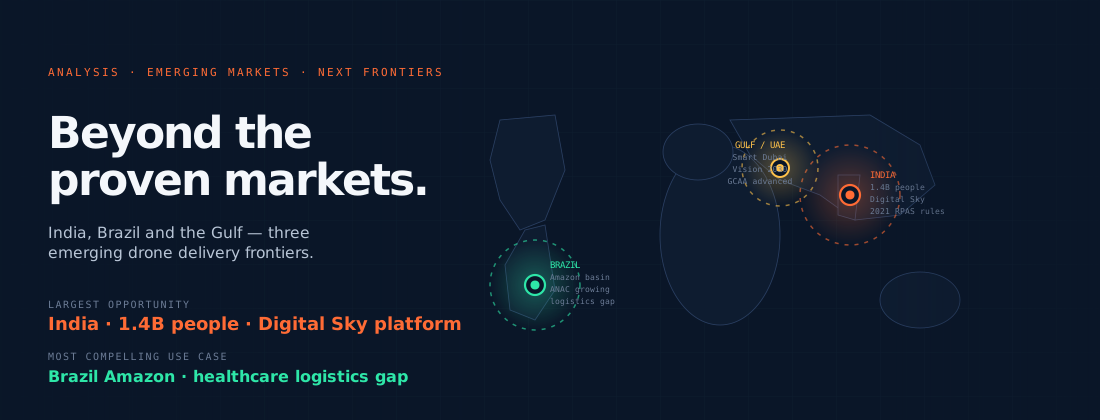
Japan scores highly on regulatory framework (Level 4) and cellular infrastructure, but its dense urban format reduces the addressable delivery market without infrastructure investment. The UAE and other Gulf markets score well on retail partner readiness and infrastructure, but are earlier-stage on UTM development and have regulatory frameworks that are progressive in statement but still developing in implementation.
The markets that score highest on all five conditions are the markets where commercial drone delivery at scale is most likely to develop next. They are also the markets where competition between operators is likely to be most intense — which is itself a signal of maturity.