Transport Canada’s RPAS regulations: how Canada has approached commercial drone delivery
Transport Canada’s Remotely Piloted Aircraft Systems regulations — formally SOR/2019-11, which came into force on 1 June 2019 — established the current regulatory framework for commercial drone operations in Canada. The regulations replaced a patchwork of Special Flight Operations Certificates that had governed drone operations under the previous framework, and established a more structured set of categories and pilot certification requirements.
The Canadian regulatory framework
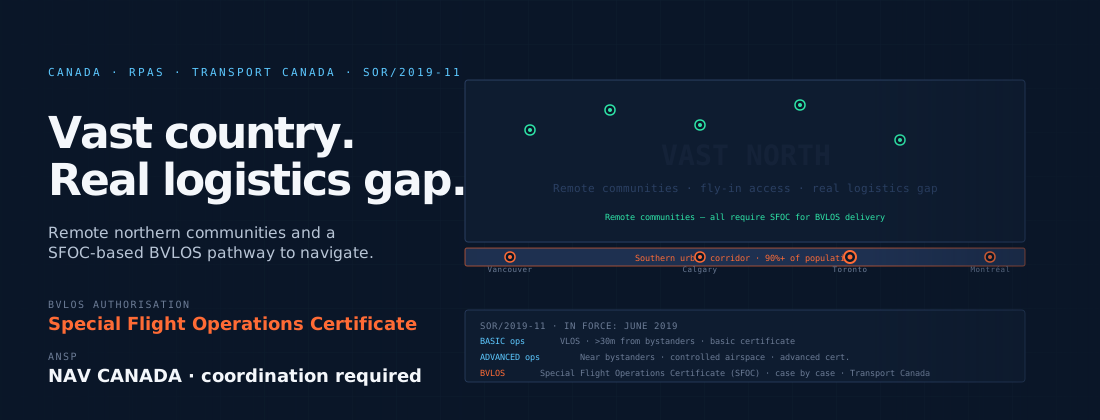
The Canadian RPAS framework divides drone operations into two primary categories: Basic and Advanced. The categorisation is primarily driven by the proximity of the operation to bystanders and the level of risk that proximity creates.
Basic operations — in uncontrolled airspace, more than 30 metres from bystanders, with no flight over bystanders — require the remote pilot to hold a basic RPAS pilot certificate. Advanced operations — closer to bystanders, in controlled airspace, or over bystanders — require an advanced RPAS pilot certificate, which involves a more demanding examination process and a flight review conducted by a qualified aviation ground school.
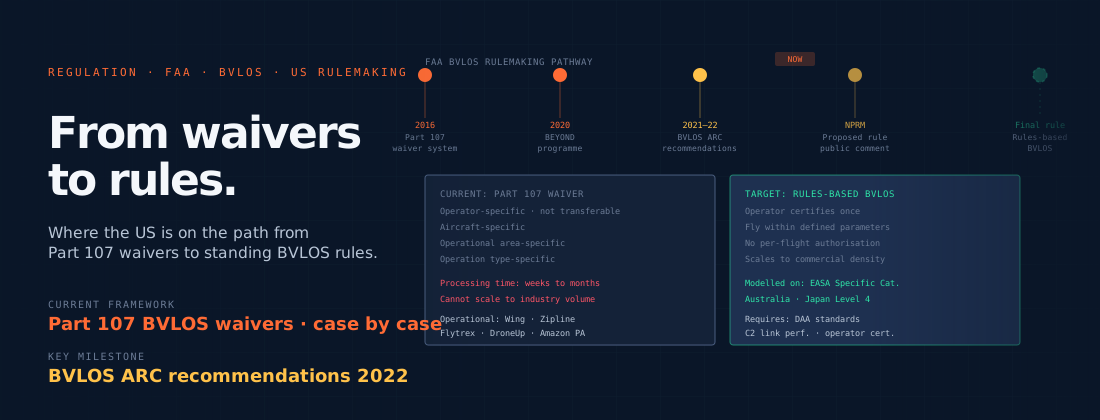
BVLOS operations in Canada fall outside both the Basic and Advanced categories. They require a Special Flight Operations Certificate — an SFOC — issued by Transport Canada on a case-by-case basis. The SFOC requirement for BVLOS means that Canada has, like the pre-rules-based US framework, a waiver-by-waiver approach to BVLOS rather than a standing framework of rules that BVLOS operators can operate within.
Canada’s geography and the delivery opportunity
Canada’s geography creates a compelling case for drone delivery in ways that densely populated European markets do not. The country’s vast landmass, combined with a population that is heavily concentrated in a few urban centres along the southern border and significantly dispersed across a large northern and remote region, produces logistics challenges that conventional surface and air transport addresses only expensively.
Remote and northern communities in Canada — First Nations communities, northern settlements, fly-in communities accessible only by air or seasonal road — face healthcare logistics challenges directly analogous to those that made Zipline’s African operations so compelling. Blood products, vaccines, pharmaceuticals, and medical equipment for these communities must currently be transported by small aircraft, at significant cost and with service levels that depend on weather and aircraft availability. Drone delivery, for the right payload categories, could provide a cheaper and more reliable alternative.
The barrier is regulatory: BVLOS operations in the remote and northern environments where this opportunity is most compelling require SFOC authorisation, and the authorisation process for novel operations in complex airspace environments is not fast. Several operators have conducted trials in Canadian remote community contexts, but sustained commercial operations at the scale that would make a meaningful difference to northern healthcare logistics have not yet materialised.
Urban commercial delivery
In Canada’s major urban markets — Toronto, Vancouver, Montreal, Calgary — the delivery drone opportunity is more similar to what operators are pursuing in American and European suburban markets. The regulatory path for urban commercial BVLOS operations in controlled airspace around major airports is correspondingly more complex, requiring coordination with NAV CANADA, the country’s air navigation service provider, as well as Transport Canada authorisation.
Several companies have conducted urban drone delivery trials in Canadian markets, typically under specific SFOCs for defined operational contexts. The path from SFOC-based trials to scaled commercial operations follows the same logic as in other markets: accumulate operational data, demonstrate safety, and use that evidence to support the development of standing rules that replace individual authorisations.
The direction of regulatory development
Transport Canada has engaged with international regulatory development processes — ICAO standards, bilateral regulatory conversations with the FAA, and awareness of EASA framework development — in developing its approach to BVLOS. The structural parallels between the Canadian and EASA frameworks suggest that Canadian regulatory evolution is likely to track, with some lag, the direction of development in those frameworks. Rules-based BVLOS authorisation, when it develops in the US and EU, will create comparable regulatory development pressure in Canada.