Nigeria and West Africa: the next chapter of African drone delivery beyond Rwanda and Ghana
The proof of concept for commercial drone delivery in Sub-Saharan Africa was established in Rwanda and Ghana, where Zipline and other operators demonstrated that sustainable, clinically valuable medical logistics operations were achievable. The question of where African drone delivery goes beyond those early markets is one of the most consequential in the sector’s development — because Africa’s healthcare logistics gaps, its geography, and its scale represent a potential market for drone delivery that dwarfs anything that has been achieved to date.
Nigeria: scale, complexity, and regulatory development
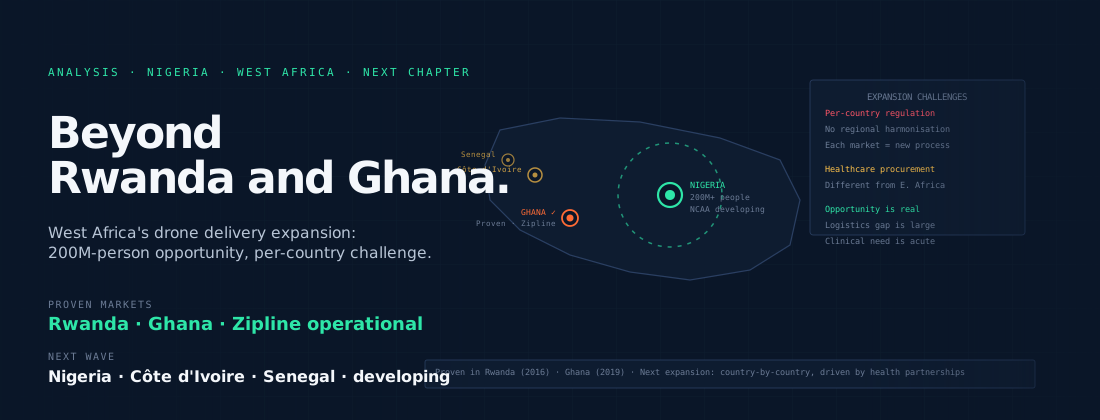
Nigeria is Sub-Saharan Africa’s most populous country and its largest economy by GDP. Its healthcare logistics challenges are correspondingly large: a population of over 200 million spread across a diverse geography that includes dense coastal urban areas, inland riverine communities, and remote rural regions, served by a healthcare system whose supply chain has chronic reliability and reach limitations. The logistics gap that drone delivery can address is not marginal in Nigeria — it is substantial and consequential for health outcomes at scale.
The Nigerian Civil Aviation Authority — NCAA — has been developing a regulatory framework for commercial drone operations, including BVLOS applications. The development of this framework has been more complex and slower than in Rwanda or Ghana, reflecting both Nigeria’s regulatory environment and the greater complexity of operating in a densely populated, institutionally complex country compared to the smaller East African markets where drone delivery first proved its concept.
Several international operators and logistics organisations have conducted engagement with Nigeria around potential drone delivery programmes, attracted by the scale of the opportunity. The translation of that engagement into operational programmes has been limited by regulatory uncertainty, operational complexity, and the challenge of finding sustainable commercial models in a market where healthcare system procurement operates differently from the East African contexts that produced Zipline’s early partnerships.
Francophone West Africa
Francophone West African countries — including Côte d’Ivoire, Senegal, Mali, and others — have been engaging with drone delivery as a solution to healthcare logistics challenges. The French-speaking regulatory traditions of these countries, combined with their participation in ICAO frameworks and the influence of French development finance institutions, create a regulatory development context that is different from the anglophone East African markets.
Zipline has expanded into markets beyond Rwanda and Ghana, and other operators have engaged with Francophone West African health systems. The healthcare logistics challenges of these markets — similar to those of East Africa in their fundamental structure — are addressable with the operational models that have been proven in Rwanda and Ghana, but the regulatory and commercial development of each new market requires engagement specific to that country’s regulatory environment and health system structure.
The regional regulatory coordination opportunity
One of the structural challenges of African drone delivery expansion is the fragmentation of regulatory frameworks across countries. An operator that has achieved authorisation for medical logistics operations in Rwanda faces a separate and not necessarily faster regulatory engagement process in Nigeria, Côte d’Ivoire, or any other market. The lack of regional regulatory harmonisation — comparable to EASA’s role in Europe or ICAO’s role in international aviation — means that each market entry requires bespoke regulatory development.
The African Union and regional bodies including the Economic Community of West African States have engaged with aviation regulatory harmonisation at a general level, but the specific development of harmonised drone regulatory frameworks across African markets remains at an early stage. The development of regional regulatory frameworks that reduce the per-country regulatory burden for operators seeking to scale across multiple African markets is one of the most significant structural enablers of drone delivery’s African expansion — and one of the most challenging to achieve.
What the next chapter looks like
The trajectory of African drone delivery expansion is likely to be country-by-country rather than regional, driven by specific partnerships between operators and national health systems, and by government development priorities that vary by country. The countries most likely to develop sustained commercial operations in the near term are those that combine a clear healthcare logistics need, government willingness to engage pragmatically with regulatory development, a willing health system partner, and the infrastructure — cellular coverage, airport and airstrip access — that BVLOS operations require.
Nigeria’s scale and the quality of its healthcare logistics gap make it the most significant potential market. The complexity of achieving the regulatory and commercial conditions for commercial operations there makes it also the most challenging. The countries that develop commercial drone delivery first in the next wave of African expansion are likely to be those where those conditions can be assembled most quickly — which may or may not be Nigeria first.