Unifly: the Belgian company building U-space infrastructure across Europe
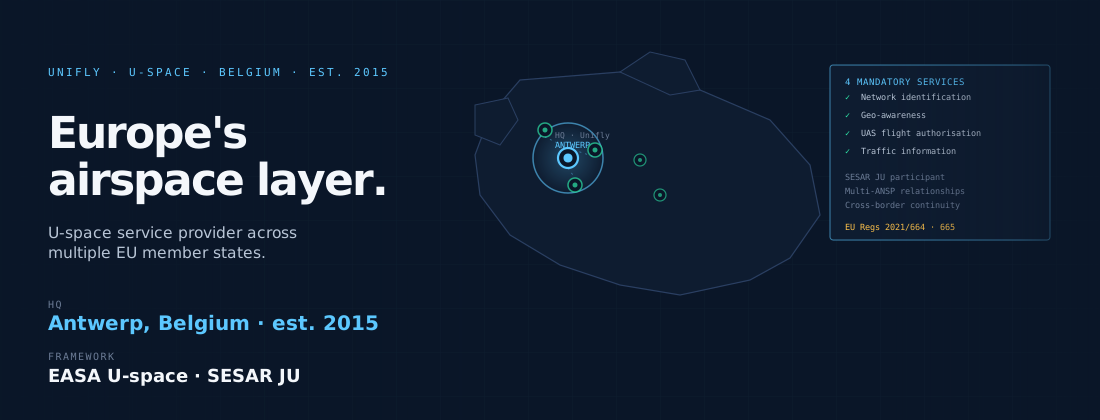
Unifly was founded in Antwerp, Belgium in 2015. The company’s founding preceded the formal development of the EASA U-space framework by several years, positioning it as a pioneer in European UTM development rather than a company that entered an established market. The regulatory framework that now governs U-space services in EU member states — European Commission Implementing Regulations 2021/664 and 2021/665 — defines requirements that Unifly has been building toward throughout its development.
The U-space regulatory context
The EASA U-space framework, which applies across EU member states, requires that unmanned aircraft operations in designated U-space airspace use a set of mandatory services provided by certified U-space Service Providers — USSPs. The four mandatory U-space services are network identification, geo-awareness, UAS flight authorisation, and traffic information services. A certified USSP must be able to provide these services, demonstrate their technical capability to the relevant National Competent Authority, and maintain the service quality and safety management standards required for certification.
For Unifly, the U-space regulatory framework represents both an opportunity and a constraint. The certification requirement creates a barrier to entry that favours established providers who have already built the technical systems and organisational infrastructure to achieve certification. It also constrains expansion: each new member state requires separate certification engagement, which adds time and cost to geographic expansion.
ANSP relationships and national deployments
Unifly has developed relationships with Air Navigation Service Providers across multiple European countries, working with national ANSPs to provide UTM services that are integrated with the national airspace management infrastructure. These ANSP relationships are central to the value that a U-space service provider delivers: the integration between the U-space layer and the manned aviation ATC infrastructure determines how well drone operations and manned aviation can coexist in shared lower airspace.
The company has been involved in SESAR Joint Undertaking U-space demonstration projects, contributing operational data and technical development to the European-wide effort to prove the U-space concept before the regulatory framework required its commercial deployment. This early involvement in SESAR projects has provided both technical development funding and regulatory relationship development that would be difficult to replicate for a later entrant.
The Belgium-Netherlands-Luxembourg cluster
Unifly’s home market — the Benelux cluster — represents a useful operational proving ground for European UTM. The region has relatively high drone activity, well-developed aviation infrastructure, and ANSPs that have been engaged in UTM development. Belgium’s relatively central position in European airspace and its role as a hub for European aviation regulatory development through its proximity to Brussels has given Unifly early access to regulatory discussions that shape the framework it operates in.
Cross-border operations and harmonisation
One of the most practically significant challenges in European U-space is cross-border operations: a drone operation that crosses a national border potentially encounters two separate U-space jurisdictions with different service providers, different technical standards, and different ANSP relationships. The interoperability requirements in the U-space framework address this problem in principle, but the practical implementation of seamless cross-border U-space services is a challenge that the market has not yet fully resolved. Unifly’s presence across multiple national markets positions it to offer cross-border continuity that a single-country provider cannot match.