What happens to the smaller delivery operators as the market matures
This article is DDG’s analytical assessment of competitive dynamics in the drone delivery operator market. It is based on publicly available information about the market’s current structure and the forces that typically drive consolidation in infrastructure-intensive industries. Forward-looking observations are analytical rather than predictive.
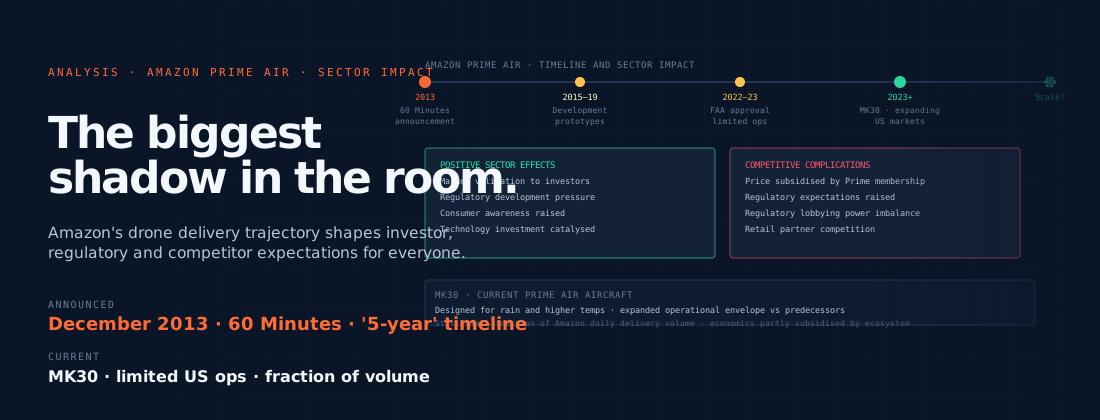
The current drone delivery operator market has a wide spread of participants. At the global scale, operators like Wing (Alphabet), Zipline, and Amazon Prime Air have the resources of large technology companies behind them, giving them access to capital that smaller operators cannot match. At the other end, regional specialists — operators with a handful of authorisations covering specific markets — operate with much tighter resources and more constrained ambitions. In between, a range of mid-sized operators have built meaningful operations in specific geographies or use cases.
How this structure evolves as the market matures is one of the most consequential questions for participants at every level of the market.
The capital intensity problem for smaller operators
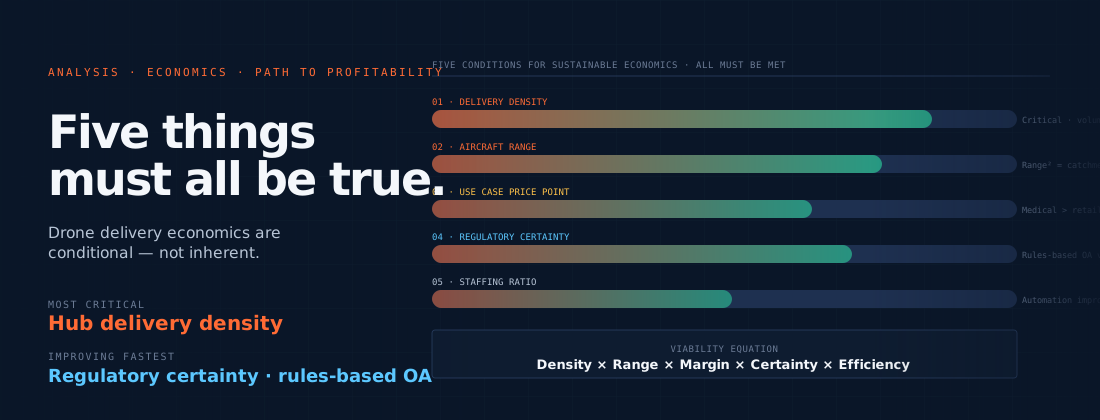
Drone delivery operations are capital-intensive. Aircraft development or acquisition, hub establishment, regulatory engagement, ground control infrastructure, and maintenance systems all require upfront investment before a single commercial delivery generates revenue. The ongoing operating cost structure has high fixed costs relative to variable delivery costs — meaning that operations below a threshold delivery density are loss-making regardless of per-delivery pricing.
Smaller operators face this capital structure with less access to external capital than their larger competitors. Venture funding for drone delivery has been concentrated among a small number of well-capitalised operators; the long regulatory engagement timelines and uncertain economics of early-stage operations make the sector challenging for earlier-stage investment. Operators that have relied on grant funding, government partnerships, or healthcare system contracts have found somewhat more stable revenue than those dependent on consumer retail delivery fees, but the capital intensity problem remains.
Regulatory relationships as a durable competitive advantage
One of the most significant assets in the drone delivery operator market is not technical but relational: the operational authorisations, regulatory track records, and authority relationships that enable an operator to fly commercially in a given jurisdiction. These are not easily or quickly replicated by new entrants or by existing operators entering new markets. An operator with five years of operational history in a jurisdiction, a safety record that regulators have reviewed and approved repeatedly, and established relationships with the relevant flight standards office or aviation authority has something that capital alone cannot buy: regulatory trust accumulated over time.
This dynamic tends to favour incumbents in any given market. A new entrant seeking to establish operations in a market where an existing operator has already navigated the regulatory engagement faces a disadvantage that is not just the time required to complete the process, but the uncertainty about whether the process will succeed — uncertainty that the incumbent has already resolved. The value of this regulatory incumbency increases as regulatory frameworks mature and the bar for authorisation rises.
The density economics and why scale concentrates
The fixed cost structure of drone delivery operations means that the economics improve dramatically with scale. An operator that has achieved high delivery density in its catchment area — through retail partnerships, brand recognition, or operational reliability — is operating with significantly lower cost per delivery than one at early-stage density levels. This creates a competitive dynamic that favours operators who have achieved scale in their markets: they can price more competitively, invest more in operational quality, and attract more retail partnerships than lower-density competitors.
In markets where two operators are competing for the same retail partnerships and customer base, the density economics tend to favour the operator that achieves critical mass first. Retail partners prefer the operator with the highest reliability and most established operations; that operator achieves more volume, improves its economics, and can invest more in maintaining its quality advantage. The dynamic is self-reinforcing.
The likely consolidation pattern
The consolidation that these dynamics suggest is likely to take several forms. In specific geographic markets, the pattern points toward one or two dominant operators that have achieved the scale and regulatory depth to sustain profitable operations, with smaller competitors either exiting, being acquired, or finding defensible niches in use cases or geographies that larger operators have not prioritised.
At the global level, the well-capitalised operators with technology company backing — Wing, Zipline, Amazon — have structural advantages in the capital-intensive development phase that the market is currently in. Their ability to sustain losses in pursuit of market position is substantially greater than that of independent operators. The independent operators best positioned to remain independent are those that have developed specialised capabilities or geographic positions that larger operators find difficult or unattractive to replicate — the medical logistics specialist in a market the retail operators have not prioritised, or the operator with established operations in a regulatory environment that creates high barriers to entry for newcomers.
The consolidation of the drone delivery operator market, when it occurs more visibly, will look less like a single dramatic wave and more like a progressive thinning of the competitive landscape in each geographic market — the same pattern that has characterised the consolidation of road courier, rail freight, and aviation markets over longer time horizons.