Packaging for drone delivery: the design constraints that shape what gets delivered
The packaging requirements for drone delivery are not simply a scaled-down version of road delivery packaging requirements. The physics of the delivery mechanism — whether winch, drop, or landing — impose specific constraints on packaging design that have no direct equivalent in a parcel van. Understanding those constraints clarifies both what drone delivery can handle well and where it remains limited relative to conventional courier services.
Weight and dimensional constraints
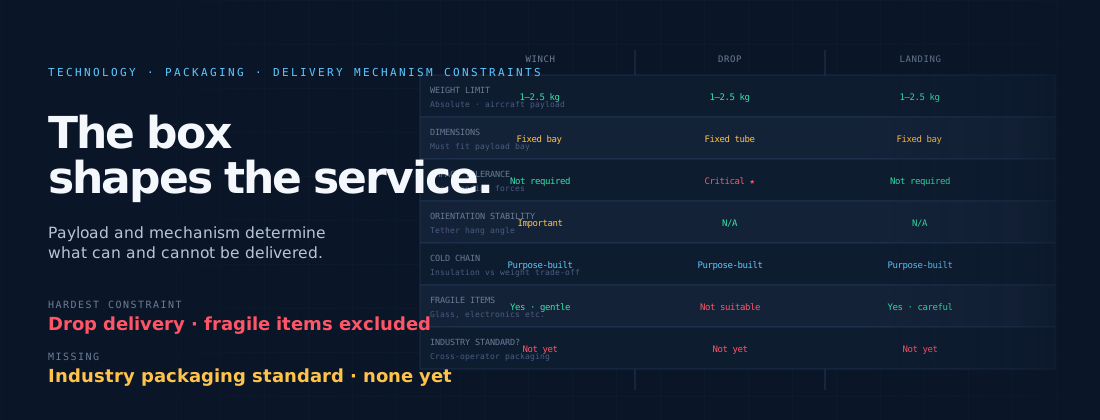
The most fundamental packaging constraint is the aircraft’s payload capacity. Current-generation commercial delivery drones typically carry payloads in the range of one to two and a half kilograms — sufficient for a pharmacy order, a small grocery selection, or a light electronics item, but not for a case of bottled water, a large household appliance, or a dense industrial component. The weight ceiling imposed by the aircraft is absolute: packaging that brings the total payload weight above the aircraft’s limit cannot be carried regardless of how efficiently the package is designed.
Dimensional constraints are similarly absolute. The payload bay of the aircraft defines the maximum package dimensions. Unlike road delivery, where a van can accommodate a wide range of package sizes, a drone’s payload bay has fixed dimensions that the package must fit within. Long thin items, wide flat items, or oddly shaped packages that exceed the payload bay’s dimensions cannot be carried. Packaging for drone delivery must, therefore, be designed or selected to fit within the specific dimensions of the aircraft’s payload bay — a constraint that some retail product lines are better suited to meeting than others.
Drop delivery and impact tolerance
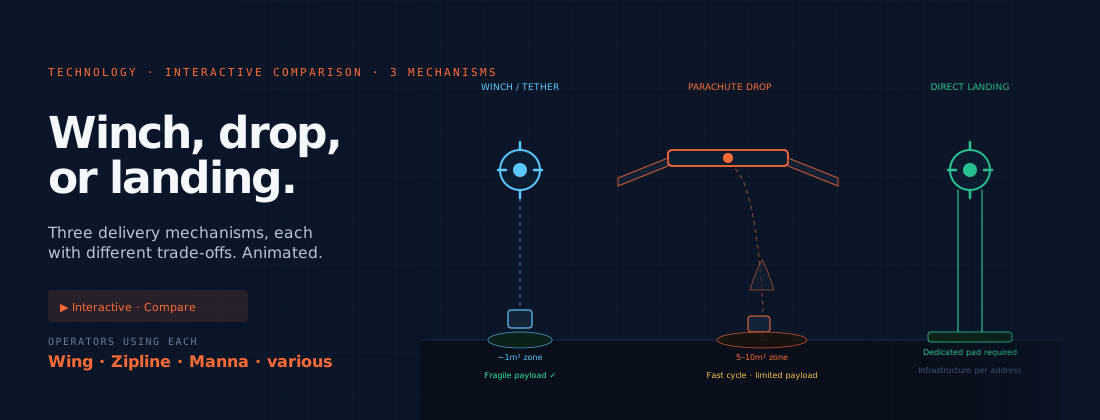
For drop delivery systems, in which the package is released from a defined altitude and falls to the delivery zone in a padded container, impact tolerance is a critical packaging consideration. The package must survive the deceleration at landing without damage to its contents. Zipline’s drop container — a padded cylinder that tumbles and absorbs impact on landing — has been designed specifically for the blood products and pharmaceutical items that represent the primary payloads of its medical logistics operations.
The implication for retail delivery using drop mechanisms is significant: items that cannot tolerate the impact of drop landing — glass containers, fragile electronics, liquid-filled items that might leak under impact — are generally not suitable for drop delivery without specially designed protective packaging. The development of effective impact-absorbing packaging for a broader range of retail items is a genuine engineering challenge for operators using drop mechanisms who wish to serve a wider product catalogue.
Winch delivery and orientation stability
Winch delivery systems lower the package on a tether from a hovering aircraft. The package hangs from the tether during descent and must maintain a stable orientation — it cannot arrive upside down or at an angle that causes the contents to shift or spill. Liquid-containing items, items with a defined upright orientation (a potted plant, for example, or a topped-up coffee), and items that require careful placement are all packaging challenges for winch delivery that sealed, rigid, or impact-tolerant items avoid.
The tether attachment point and the package’s centre of gravity must be designed to produce a stable hang angle during lowering. Poorly balanced packages, or packages with attachment points that do not correspond to the item’s centre of gravity, can spin or swing on the tether in wind — creating delivery accuracy problems and extending cycle time as the aircraft waits for the package to stabilise before releasing.
Cold chain packaging
Medical logistics operations that carry temperature-sensitive payloads — blood products, certain pharmaceuticals, vaccines — require packaging that maintains temperature within defined limits for the duration of the flight. The thermal requirements are similar to those of other cold chain transport modes, but the weight and dimensional constraints of the drone payload bay limit the options for insulation thickness and thermal mass.
Operators serving medical cold chain use cases have developed payload containers specifically designed to balance thermal performance against the weight and dimensional constraints of their aircraft. The development of effective, lightweight cold chain packaging for drone payloads is an area of active product development — not just for medical applications but for food delivery where freshness is a customer requirement.
Standardisation and the retail integration challenge
The diversity of packaging requirements across different delivery mechanisms, aircraft types, and payload categories creates a fragmentation problem for retailers seeking to integrate drone delivery into their operations. A retailer partnering with a drop delivery operator faces different packaging requirements than one partnering with a winch delivery operator. A pharmacy stocking products for drone delivery faces different requirements than a consumer electronics retailer.
The absence of industry-wide packaging standards for drone delivery — the equivalent of the standard pallet sizes and container specifications that have rationalised road freight logistics — is a friction point in the integration of drone delivery into existing retail and logistics operations. Standards bodies and industry groups have begun working on drone delivery packaging guidelines, but the diversity of the delivery mechanism landscape makes comprehensive standardisation difficult until the market converges further on dominant delivery approaches.