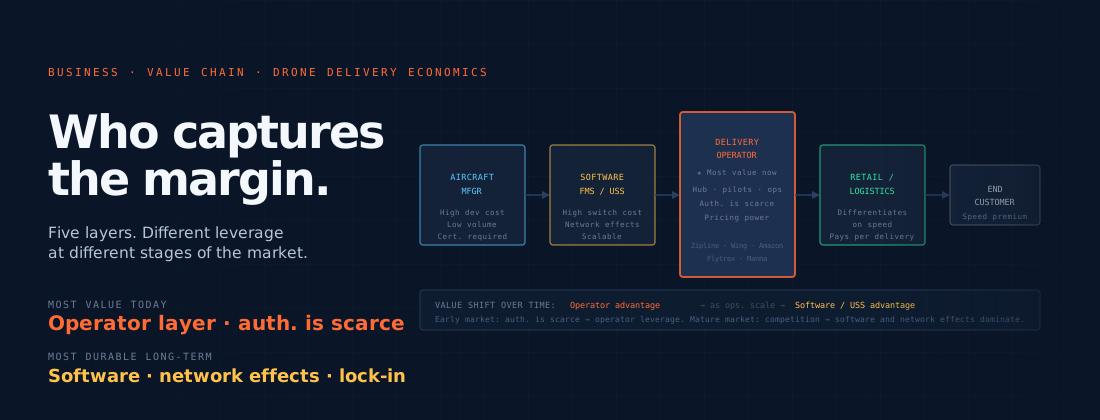
The drone delivery value chain: mapping where the economics sit across the industry
The drone delivery industry is frequently discussed as though it were a single business: an operator buys or builds aircraft, launches a service, and delivers packages. In practice, the industry has a layered value chain in which different participants capture value at different points, and where the relationships between layers are sometimes collaborative, sometimes competitive, and always consequential for the economics of the whole.
Aircraft manufacturers
The aircraft manufacturer occupies the most visible position in the public imagination of drone delivery — the company that builds the flying machine. In commercial delivery, aircraft are manufactured by dedicated drone manufacturers (some of which also operate delivery services), by vertically integrated delivery operators who build their own aircraft, and by subsidiaries of larger aerospace or consumer electronics companies.
The economics of aircraft manufacture in drone delivery are challenging. Development costs are high, production volumes are currently low relative to consumer drone volumes, and the certifications required for commercial aviation hardware add cost and time to the development cycle. Manufacturers selling to third-party operators can spread development costs across multiple customers; operators building their own aircraft internalise those costs but gain control over the platform roadmap and avoid dependency on an external supplier.
The most commercially interesting aircraft manufacturing positions are likely those where proprietary hardware creates a durable advantage — a design that demonstrably outperforms alternatives on a key metric that operators care about, such as range, payload efficiency, or operational cost per flight.
Software and flight management systems
The software layer — flight management systems, route planning platforms, operational management dashboards, maintenance tracking systems — sits between the aircraft and the operator and is, in many respects, where the operational intelligence of a delivery service resides. The aircraft flies the route the software plans and monitors the aircraft the software tracks.
Software businesses in drone delivery can be capital-efficient relative to hardware businesses: once developed, software can be deployed to additional customers with low marginal cost. The challenge is that the switching cost for operators moving between flight management systems is high — transitioning involves retraining staff, recertifying procedures, and potentially modifying aircraft integrations. This creates lock-in that benefits established software providers but makes market entry difficult for new ones.
USS and airspace management
UAS Service Suppliers occupy the middle layer of the UTM stack, providing the airspace coordination services that commercial BVLOS operators require. USS businesses earn revenue from operators for airspace management services — typically a per-flight or subscription fee structure. The economics of USS businesses benefit from the same network effects discussed in the UTM consolidation analysis: more operators on the platform means a more complete airspace picture and better service quality, which attracts more operators.
Delivery operators
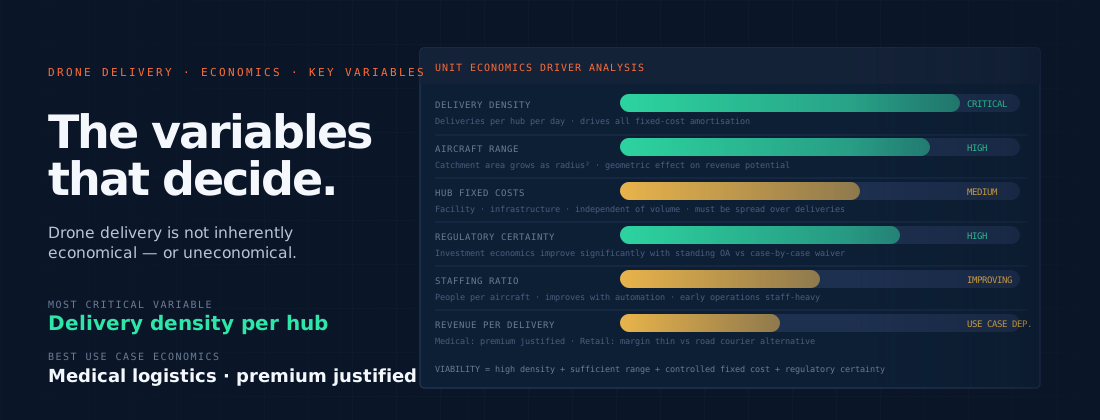
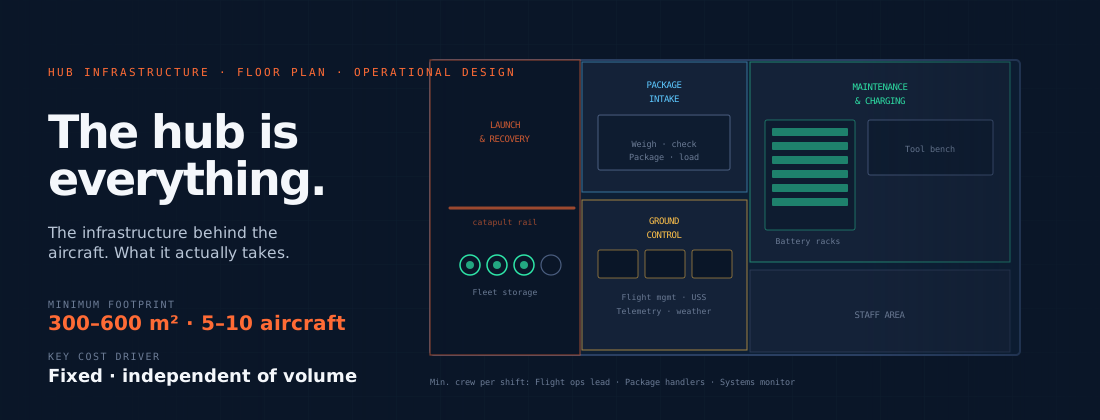
The delivery operator — the company that actually runs the delivery service, operates the hub, employs the remote pilots, and fulfils the customer orders — sits at the operational centre of the value chain. The operator’s business model is primarily a logistics business: fixed infrastructure costs, variable delivery costs, and revenue from delivery fees paid by retail partners or end customers.
Operators vary significantly in their vertical integration. Some build their own aircraft, develop their own flight management software, and operate their own USS infrastructure — capturing more of the value chain but incurring more development cost and complexity. Others buy aircraft from manufacturers, license flight management software, and use third-party USS platforms — paying for those services but focusing their investment on operational execution and customer relationships.
Retail and logistics partners
The retailer or logistics company that integrates drone delivery into its service offering is the customer-facing layer of the value chain. From the retailer’s perspective, drone delivery is a fulfilment capability — a way to offer faster delivery than road alternatives, differentiate on service speed, or reach customers in locations where road delivery is slow or expensive.
The retailer’s negotiating position relative to the delivery operator depends on whether drone delivery is genuinely scarce — which it is in early markets where few operators are licensed — or commoditised, which occurs as more operators achieve authorisation and compete for retail partnerships. In early markets, the delivery operator has significant leverage. In mature markets with multiple competing operators, the leverage shifts toward the retailer.
Where the value concentrates
In the early stage of the industry, the largest value capture tends to be at the operator layer — companies that have achieved regulatory authorisation, established operational infrastructure, and built retail partnerships are rare and command pricing power accordingly. As the industry matures and competition increases at the operator level, the software and airspace management layers may prove more durable value capture points, given their network effects, switching costs, and scalability advantages relative to physical operations.