UTM consolidation: why the airspace management market is likely to concentrate — and what determines the winners
This article represents DDG’s editorial analysis of competitive dynamics in the UTM market. It is based on publicly available information about platform capabilities, market structure, and regulatory frameworks. Forward-looking assessments are analytical in nature.
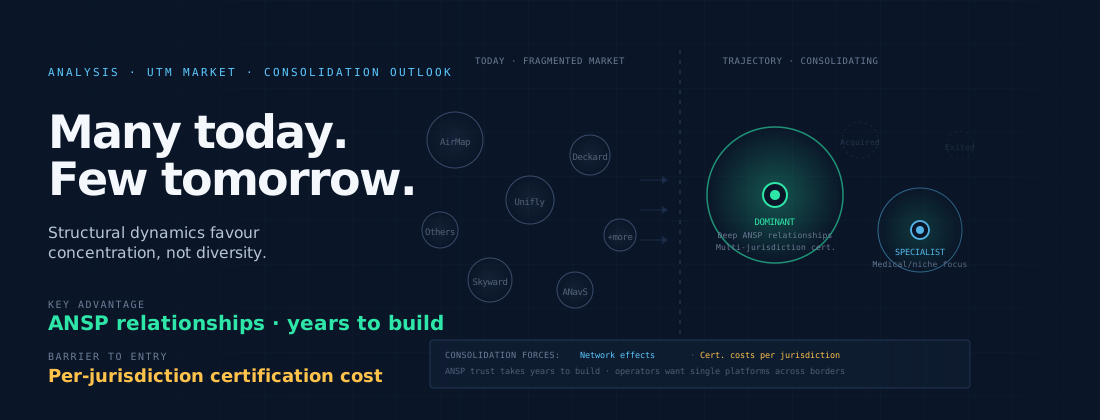
The UTM market — the ecosystem of UAS Service Suppliers, software platforms, and data infrastructure providers that enables commercial drone operations to coexist in managed airspace — currently contains a large number of competing participants. In the United States, LAANC-approved USS platforms include multiple providers. In Europe, U-space service provider certification is being sought by companies across multiple member states. The market looks, at this moment, like the early stage of many technology markets: numerous entrants, diverse approaches, substantial uncertainty about which solutions will prove durable.
The structural dynamics of the UTM market suggest that this fragmentation is unlikely to persist indefinitely. Several forces favour consolidation, and understanding those forces helps clarify what a more concentrated market is likely to look like — and what operators, regulators, and investors should be watching.
Network effects and airspace coordination
The core function of UTM — coordinating multiple operators sharing the same airspace — benefits from network effects. An operator using a USS platform that is used by many other operators in the same airspace benefits from better conflict detection and resolution than one using a platform with few other participants in the same space. The more operators on a platform, the more complete the airspace picture that platform can maintain. This is not a strong network effect of the kind that produces winner-take-all outcomes in consumer markets, but it is a meaningful advantage for larger platforms over smaller ones.
The network effect is reinforced by the requirement for USS interoperability: platforms must be able to exchange data with other USS platforms to coordinate operations when operators using different platforms share the same airspace. The cost and complexity of maintaining interoperability with many platforms favours fewer, larger platforms that represent a higher proportion of the traffic.
Regulatory certification costs
In the European U-space framework, USS must be certified by national aviation authorities in each member state where they wish to operate. The certification process involves demonstrating technical capability, organisational competence, and safety management systems. It takes time and costs money — in regulatory engagement, testing, documentation, and legal compliance work.
These certification costs are largely fixed per jurisdiction, regardless of the operator’s size. A small USS entering the European market faces the same per-country certification burden as a large one, but has fewer customers across whom to spread that cost. The economics of multi-jurisdiction certification favour larger platforms with established customer bases over smaller new entrants, creating a barrier to entry that tends to reinforce the position of established players over time.
ANSP relationships
The relationship between USS platforms and national ANSPs — the FAA, NATS, Eurocontrol equivalents — is central to the value that USS provides to operators. The quality of the data feed from the ANSP, the responsiveness of the ANSP to USS requests, and the ANSP’s confidence in the USS’s safety management are all relationship-dependent rather than purely technical. Building those relationships takes time, demonstrated performance, and sustained engagement.
Platforms that have invested in ANSP relationships over multiple years of operation have an advantage over newer entrants that technical capability alone cannot easily replicate. The ANSP tends to favour established, trusted partners when expanding the scope of operations it will support, which reinforces the position of incumbents with established track records.
What the consolidation might look like
The consolidation that these structural dynamics suggest is not likely to produce a single global USS platform. The jurisdictional specificity of UTM regulation — each country’s airspace management has its own characteristics, rules, and ANSP — means that a platform that dominates in the United States may not dominate in Europe, and vice versa. Regional or functional specialisation is a plausible outcome: platforms that lead in medical logistics UTM, platforms that lead in retail delivery UTM, platforms that lead in specific geographic markets.
What the consolidation does suggest is that the current large number of competing platforms will reduce over time. Platforms that cannot achieve the customer scale to justify certification costs, maintain ANSP relationships, and invest in interoperability infrastructure face a progressively difficult economic environment as the market matures and competition concentrates on capability and relationships rather than novelty.
What determines the survivors
Based on the structural analysis above, the UTM platforms best positioned for the consolidation phase are those with: the deepest ANSP relationships in their target jurisdictions; the most comprehensive certification coverage across the markets where their target operators wish to fly; the strongest interoperability record with other major platforms; and the customer scale to generate the revenue required to sustain continuous regulatory engagement and technical development. These characteristics tend to favour platforms that entered the market early and invested in relationships and certification rather than those that entered later with technically superior but less-established products.
Technical capability matters but is not the primary determinant of long-run market position in a regulated infrastructure market. The UTM market, as it matures, is likely to follow the same pattern as other regulated aviation infrastructure markets: dominated by a small number of platforms with deep regulatory relationships, sustained by the combination of network effects, certification barriers, and the ANSP trust that takes years to build.