What a drone delivery hub actually needs: infrastructure, space and staffing
Drone delivery is often discussed as though the aircraft is the entire system. It is not. The aircraft is the visible, mobile part of a system whose fixed components — the hub — determine as much of the operational capability and cost structure as the vehicle itself. Understanding what a commercial drone delivery hub actually requires, and why, is essential to understanding the economics and the practical constraints of the sector.
Location requirements
Hub location is determined by the intersection of several constraints that often pull in different directions. Proximity to the delivery catchment area is fundamental — the closer the hub to the population it serves, the shorter the delivery radius required, the faster the delivery time, and the lower the energy cost per delivery. Ideally, the hub is located near the geographic centre of the planned delivery zone.
Against this, hubs require commercial or industrial zoning — residential locations are generally not available or appropriate for facilities with continuous aircraft operations. Commercial and industrial zones tend to be at the periphery of residential areas rather than the centre, which means operators often compromise between delivery-optimal location and available property.
Airspace characteristics matter. A hub site that would require aircraft to cross a controlled airspace boundary immediately after take-off faces a more complex authorisation challenge than one that can launch directly into uncontrolled airspace. Sites near airports, hospital helipad approach paths, or other established aviation infrastructure require careful assessment and coordination.
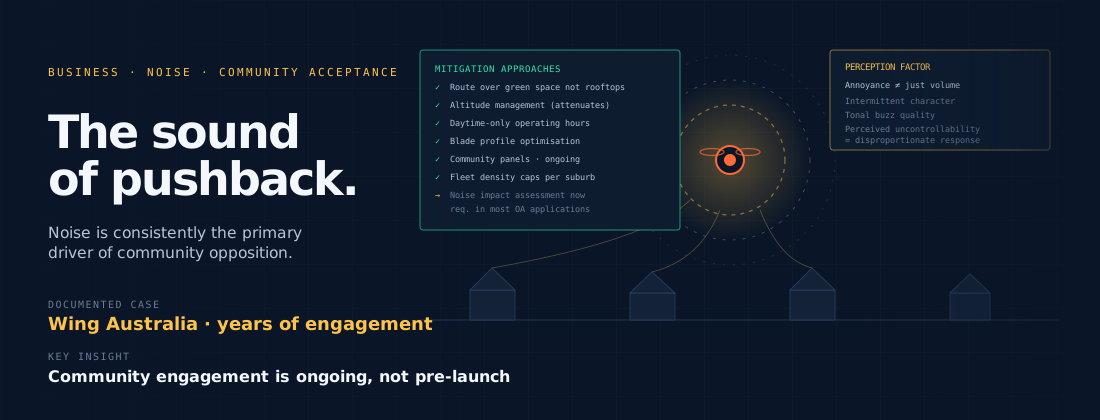
Planning permission and community acceptance are practical constraints that vary by jurisdiction and local context. Drone delivery hub operations involve a level of aircraft noise and visual activity that some communities object to. Engaging with local authorities and residents early in the site selection process is an operational risk management step, not just a courtesy.
Physical space requirements
The minimum physical footprint of a drone delivery hub depends on the launch and recovery system used. For catapult-and-arrestor systems like those used by Zipline, a clear space of sufficient length for the catapult rail and the arrestor wire, plus clearance for the aircraft’s approach and departure, is required — typically an area of several hundred square metres at minimum. For vertical take-off and landing operations, a smaller cleared area may suffice for the aircraft, but the overall facility still requires space for the operational functions that happen on the ground.
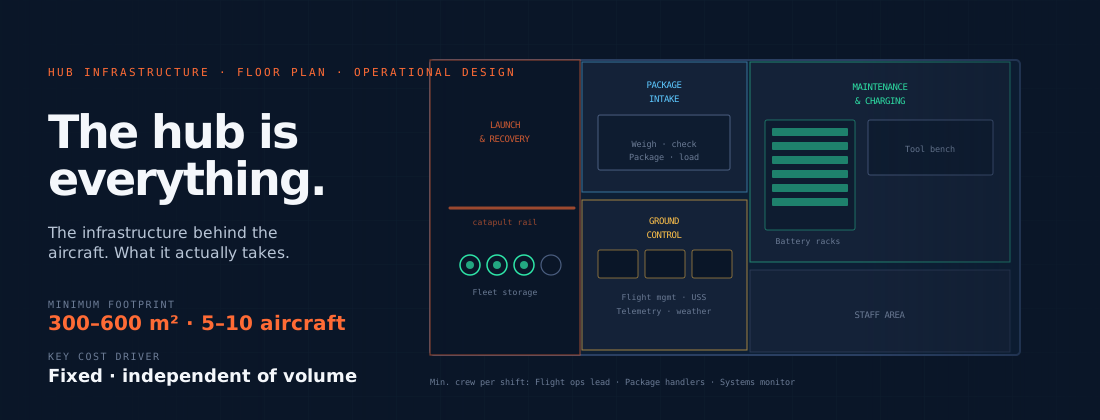
Inside the facility, the core functions requiring dedicated space include package intake and preparation — where incoming packages are checked, weighed, packaged for flight if necessary, and loaded onto aircraft; aircraft maintenance and storage — where aircraft are inspected, batteries are managed, and minor repairs are conducted; ground control station — typically a desk-based workstation environment where the operations team monitors flights, communicates with the USS, and manages the flight schedule; and staff areas — welfare facilities, briefing space, and administrative functions.
A minimal but functional hub for a small operation — perhaps five to ten aircraft — might require a total facility area of 300 to 600 square metres, depending on the launch and recovery system and the volume of package processing. Larger operations, or operations with catapult-based systems that require outdoor infrastructure, need proportionally more space.
Power infrastructure
Electric drone delivery aircraft require significant electrical infrastructure for charging. A fleet of ten aircraft, each with a battery pack of one to three kilowatt-hours, cycling multiple times per day, represents a charging demand of tens to hundreds of kilowatt-hours per day. This is manageable on a normal commercial electricity supply, but the peak demand during simultaneous charging of multiple aircraft can be substantial and may require attention to the electrical service capacity of the facility.
Some operators install battery charging management systems that stagger charging across the fleet to reduce peak demand and optimise battery longevity. Others use swappable battery systems with separate charging racks. Either way, the electrical infrastructure of the hub — the switchgear, charging points, cable management and power monitoring — represents a non-trivial element of the capital cost and the fit-out complexity.
Ground control station
The ground control station is the nerve centre of the hub: the workspace from which the operations team monitors aircraft positions, communicates with the USS, manages flight schedules, and responds to anomalies. Its technical requirements include reliable communications infrastructure (cellular and potentially satellite backups), displays showing aircraft positions and status in real time, and the software interfaces for the flight management system and USS platform.
Connectivity redundancy is important: a hub that loses its communication link with the aircraft or with the USS faces an immediate safety issue. Most operators design for multiple independent communication pathways, with defined procedures for each failure mode.
Staffing
Hub staffing requirements vary with operational design, volume, and the degree of automation in hub processes. At minimum, a hub operating shift-based delivery typically requires a flight operations lead responsible for the operational safety of the shift, package handlers to receive, check and load outbound packages and process returned packaging, and a systems monitor watching aircraft telemetry, the USS feed, and the flight schedule.
Maintenance functions may be handled by dedicated maintenance technicians on site, by a visiting maintenance team on a scheduled basis, or by a combination of in-house first-line maintenance and contracted second-line support. The staffing model chosen has significant implications for the fixed cost base of the hub and for the operational flexibility available when aircraft require unscheduled attention.