EASA U-space: how Europe is building its framework for commercial drone operations
In April 2021, the European Union adopted a package of regulations establishing the U-space framework — the EU’s approach to managing unmanned aircraft operations in low-level airspace. The framework, developed by the European Union Aviation Safety Agency and adopted through Commission Implementing Regulation (EU) 2021/664 and related regulations, represents the most comprehensive attempt by any major regulatory authority to create a structured, services-based framework for drone operations across multiple jurisdictions simultaneously.
What U-space is
U-space is defined as a set of services and procedures designed to support safe, efficient, and secure access to airspace for a large number of unmanned aircraft. The concept differs from the US UTM approach in a significant way: while US UTM is primarily a coordination mechanism that operates within existing airspace classification structures, U-space creates designated airspace volumes — U-space airspace — within which specific service requirements apply and within which drones can operate under defined conditions.
The designation of U-space airspace is a decision made by member states in coordination with their national aviation authorities and air navigation service providers. Within designated U-space airspace, operators must use certified U-space service providers to access the services required for safe operation. Outside designated U-space airspace, different rules apply depending on the airspace classification and the category of operation.
The U-space services
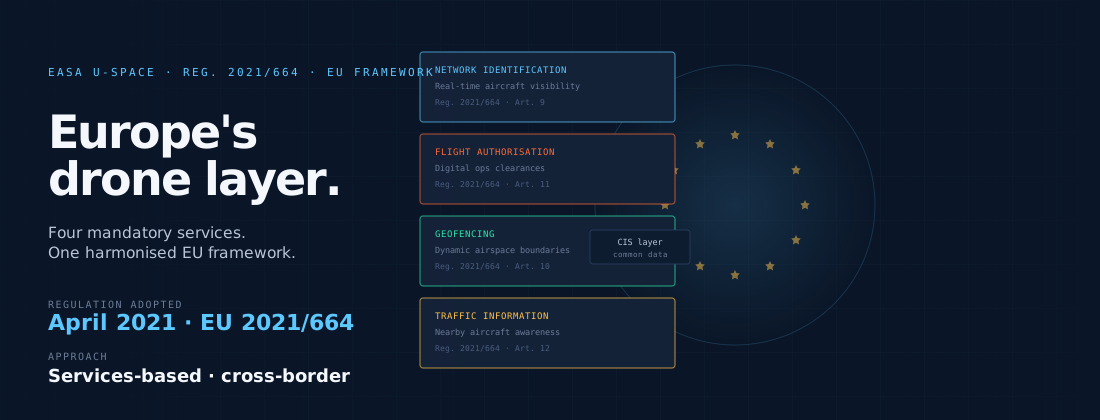
The U-space regulation defines specific services that must be available within U-space airspace. These include network identification — which provides real-time information about unmanned aircraft operating within the U-space volume to authorised parties; geofencing — which ensures that aircraft operating within U-space airspace respect the geographic and altitude boundaries applicable to their operation; flight authorisation — the process by which operators receive permission to conduct specific flights within U-space airspace; and traffic information services — which provide operators with information about other aircraft operating in proximity to their own.
Additional services — weather information, conformance monitoring — are defined in the regulation as services that U-space service providers may offer but are not universally mandated. The framework is designed to be modular, allowing the service environment within specific U-space volumes to be calibrated to the density and complexity of operations expected in that volume.
U-space service providers
Access to U-space services is provided through certified U-space service providers — companies that have demonstrated to the relevant national aviation authority that they have the technical capability, organisational structure, and safety management processes required to provide the designated services. Certification requirements are defined in Commission Delegated Regulation (EU) 2022/1658.
The U-space service provider market has developed progressively since the adoption of the regulations, with companies including Altitude Angel, Unifly, ANavS, and several others developing the technical platforms and obtaining the national certifications required to operate as certified providers in various EU member states. The market is still developing, with the geographic coverage and service depth of certified providers varying significantly across member states.
The common information services layer
A distinctive feature of the European U-space architecture is the Common Information Services layer — a set of standardised data services, including aeronautical information and airspace status data, that are made available to U-space service providers through a defined interface. The CIS layer is intended to ensure that all service providers are working from the same underlying airspace data, reducing the risk of inconsistencies between providers that could create safety risks.
The entity responsible for providing CIS in each member state is the designated Common Information Service provider — typically the national ANSP or an entity designated by the national aviation authority. Standardising the CIS interface across member states is a key mechanism for enabling the cross-border compatibility that makes U-space potentially more interoperable across EU borders than the US UTM approach.
Implementation progress
U-space implementation has varied across EU member states. Some member states have moved ahead with designating U-space airspace and certifying service providers; others have been slower to put the national-level infrastructure in place. The pace of U-space deployment is directly connected to the pace at which commercial drone delivery can expand in European markets: without designated U-space airspace and certified service providers, the regulatory pathway for complex drone operations is more limited.
EASA has been monitoring implementation progress across member states and has published materials supporting national implementation. The progressive maturation of the U-space ecosystem across Europe represents one of the key regulatory enablers for the growth of commercial drone delivery in European markets over the coming years.