The four airframe configurations in commercial drone delivery — and the trade-offs between them
There is no single right answer to the question of what a drone delivery aircraft should look like. Different configurations excel at different things: range versus hover precision, payload capacity versus operational simplicity, mechanical complexity versus aerodynamic efficiency. The aircraft choices that operators have made reflect their specific operational requirements, regulatory constraints, and engineering philosophies as much as any universal assessment of which configuration is best.
Multirotor
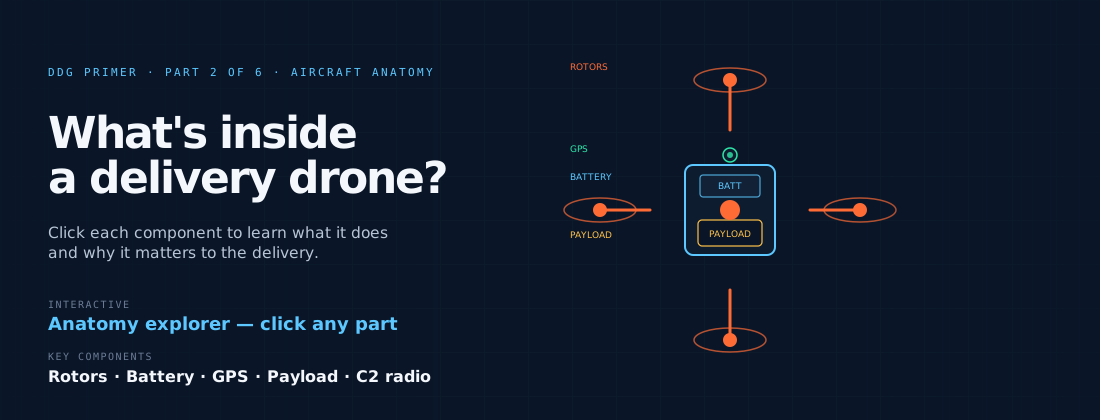
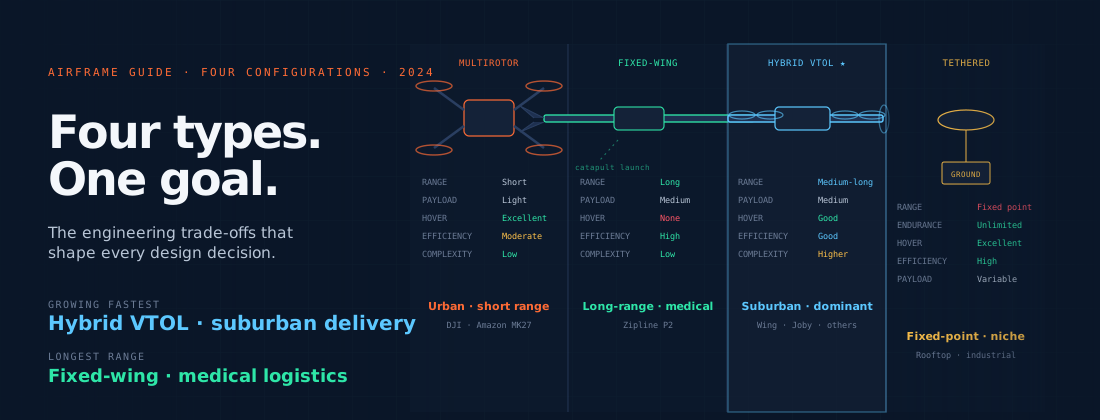
Multirotor aircraft generate lift through multiple spinning rotors arranged symmetrically around a central body. Quadrotors (four rotors), hexarotors (six rotors), and octorotors (eight rotors) are the most common configurations. The multirotor’s core advantage is hover capability: it can maintain position with high precision, take off and land vertically in confined spaces, and manoeuvre in three dimensions with a degree of control that fixed-wing aircraft cannot match. This makes it well-suited to dense urban environments and applications requiring precise positioning at the delivery point.
The trade-off is energy efficiency. Maintaining flight in a multirotor requires all rotors to generate continuous thrust — there is no mechanism for gliding or recovering energy during descent. Over short distances, this is not a significant constraint. Over longer distances, the energy cost of continuous powered lift becomes a meaningful limit on range and payload, and the economics of multirotor operation favour short-range, high-frequency delivery rather than long-range logistics.
The multirotor configuration is the most mechanically simple of the delivery-capable configurations, which is an advantage for maintenance, reliability, and cost. It is also the configuration with the most mature supply chain, given the enormous commercial drone market built around consumer and professional multirotor products.
Fixed-wing
Fixed-wing aircraft generate lift aerodynamically — through the shape and angle of the wing as it moves through air. In cruise, a fixed-wing aircraft is substantially more energy-efficient than a multirotor of comparable size, because the wing generates lift passively rather than requiring continuous powered thrust. This efficiency advantage compounds over distance: for long-range delivery applications, the fixed-wing configuration can cover substantially more ground per unit of energy than any rotary-wing design.
The limitation of fixed-wing aircraft for delivery is the requirement for forward velocity to maintain lift. Fixed-wing aircraft cannot hover; they must maintain a minimum airspeed or they will stall. For a delivery application, this means the aircraft must either land conventionally — requiring a prepared landing strip or suitable flat surface at the delivery point — or be operated with a catapult launch and arrestor recovery system that eliminates the need for a runway. The catapult-arrestor approach, used notably by Zipline, adds hub infrastructure requirements but enables rapid turnaround cycles and removes the dependency on prepared landing surfaces at the delivery end.
Delivery from a fixed-wing aircraft that cannot land at the delivery point typically requires either a drop mechanism or a winch lowering system, both of which impose constraints on payload types and delivery zones.
Hybrid VTOL
Hybrid VTOL aircraft attempt to combine the vertical take-off and landing capability of multirotor designs with the cruise efficiency of fixed-wing designs. They take off using powered vertical lift — typically from rotors arranged to provide vertical thrust — and then transition to fixed-wing cruise for the main portion of the flight. On approach to the delivery zone, they transition back to hover mode for precision positioning and delivery.
The transition from hover to cruise is the critical engineering challenge in hybrid VTOL design. During the transition, the aircraft passes through a regime in which neither the hover lift system nor the cruise lift system is fully effective, requiring careful flight control management to maintain stable flight. Different manufacturers have approached this challenge differently: some use tilt-rotor designs in which the same rotors provide both hover and cruise thrust at different orientations; others use separate lift and cruise propulsion systems (lift-plus-cruise) that simplify the mechanical design at the cost of carrying propulsion weight that is only used for part of the flight.
Wing’s aircraft, which uses twelve rotors along the wing that fold flat during cruise, represents a distinctive variant of the hybrid VTOL approach — one that prioritises aerodynamic cleanliness in cruise while retaining full multirotor capability for take-off, landing, and hovering delivery.
Tethered and gantry systems
A smaller but practically relevant category of delivery systems uses tethered aircraft — drones that remain connected to a fixed ground station by a power and data tether, which both supplies energy (eliminating battery limitations) and constrains the aircraft’s range to the tether length. Tethered systems are suited to fixed-point delivery applications — a building rooftop receiving supplies, an industrial site receiving components — where the delivery point is known and fixed, and where the unlimited flight duration enabled by tethered power is more valuable than geographic range.
Gantry-based delivery systems — essentially cable-suspended carriages that travel along an overhead rail between fixed points — represent a further variant that trades aircraft versatility for operational simplicity and reliability in specific corridor applications.
Choosing a configuration
The appropriate configuration for a drone delivery application depends primarily on range requirements and delivery zone characteristics. Short-range urban delivery to variable residential addresses favours multirotor designs. Long-range logistics to fixed facility endpoints favours fixed-wing designs. Medium-range suburban delivery covering a variable residential catchment area favours hybrid VTOL designs. Fixed-point high-frequency delivery applications may favour tethered designs. Most commercial operators have made configuration choices that reflect these trade-offs, though the boundaries between categories are not sharp and engineering innovation continues to shift the performance envelope of each.