What is UTM? The airspace management layer that makes drone delivery possible
Unmanned Traffic Management — UTM — is the system that allows multiple drone operators to share low-altitude airspace safely and efficiently. It is the digital equivalent of air traffic control for unmanned aircraft, though it operates very differently from conventional ATC: at the volumes and operational tempos that drone delivery at scale will eventually require, human controllers cannot manage the workload. UTM is designed to be largely automated, using digital data exchanges between operators, service providers, and air navigation systems to coordinate operations that would be impossible to manage manually.
Why UTM is necessary
The conventional air traffic management system — the network of radar, radio communication, and human controllers that manages manned aviation — is not designed for the characteristics of drone delivery. Drones fly at low altitudes, in airspace that is not systematically covered by radar, on flight paths that may change frequently, and in numbers that will eventually far exceed the capacity of human controllers to track individually. A commercial drone delivery ecosystem at meaningful scale might involve thousands of simultaneous flights in a single metropolitan area. Managing that through a conventional ATC paradigm is not feasible.
UTM addresses this by automating the coordination functions that ATC performs manually for manned aviation. Rather than a controller issuing clearances to individual aircraft, UTM uses digital protocols through which operators submit flight plans, receive automated conflict checks against other operations and airspace restrictions, and receive clearances or conflict notifications through software interfaces. The human element remains — operators are still responsible for their aircraft, and supervisory roles exist within the system — but the routine coordination functions are handled digitally at a scale and speed that humans cannot match.
The architecture: operators, USS, and ANSPs
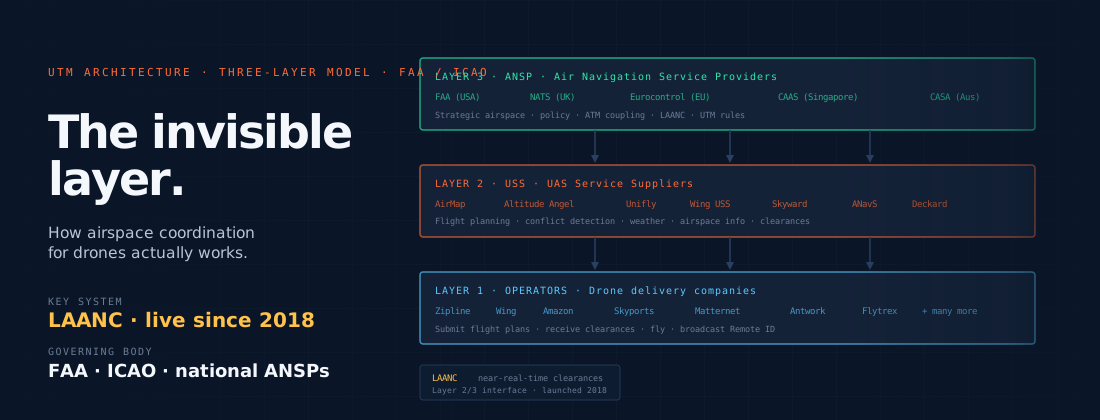
The UTM architecture developed by the FAA and adopted in various forms by other aviation authorities involves three principal layers.
At the bottom are the operators: the drone delivery companies, logistics operators and other UAS users who want to fly. Operators connect to UTM through UAS Service Suppliers — companies certified to provide UTM services including flight planning, conflict detection, weather data, and airspace information. Rather than dealing directly with the FAA for each flight, operators work through their USS, which handles the coordination with the broader airspace system.
USS platforms receive flight plan submissions from operators, check them against the flight plans of other operators using the same or overlapping airspace, and flag potential conflicts. When conflicts exist, they are resolved either through automated negotiation between the USS systems of the conflicting operators or through escalation to human oversight. USS platforms also provide operators with real-time information about the airspace environment — temporary restrictions, other aircraft, weather — that is relevant to their planned operations.
At the top of the architecture are the Air Navigation Service Providers: the national bodies responsible for the overall management of a country’s airspace. In the United States, this is the FAA; in the UK, NATS; across the EU, national ANSPs coordinating through Eurocontrol. The ANSP sets the rules under which UTM operates, designates the airspace available for UTM services, and maintains the strategic picture of all aviation activity — manned and unmanned — within its jurisdiction.
LAANC: the US implementation
In the United States, the FAA’s most publicly visible UTM implementation is the Low Altitude Authorization and Notification Capability — LAANC. Launched progressively from 2018, LAANC allows drone operators to receive near-real-time authorisation to fly in controlled airspace — the airspace around airports — through automated digital applications rather than manual coordination with air traffic control.
LAANC works by publishing the airspace available for UAS operations around each airport in defined altitude grids, then allowing operators to submit flight plans through approved applications and receive near-instant automated authorisation for operations within the available altitude limits. Operations above the available altitude, or in airspace not covered by the grid, require manual coordination through conventional channels. LAANC has been expanded progressively since its launch and now covers a large proportion of controlled airspace in the United States.
UTM development globally
The UTM architecture developed in the United States has informed regulatory development globally, though different jurisdictions have implemented variations reflecting their specific airspace environments and regulatory philosophies. The European Union’s U-space framework, for example, operates on similar principles to the US UTM architecture but implements them through a different regulatory structure and with different service category definitions. ICAO, the international civil aviation organisation, has been working on standards for UTM interoperability that would eventually allow UTM systems in different countries to exchange data in compatible formats — a prerequisite for any meaningful international drone delivery operation.