Weather constraints on drone delivery: what atmospheric conditions mean for operations
Weather is one of the most persistent practical constraints on drone delivery operations, and one of the least discussed in coverage that focuses on aircraft technology and regulation. A delivery drone that performs perfectly in the controlled conditions of a test facility may face significant limitations in the real-world atmospheric conditions of an operational market. Understanding those limitations — and how operators design around them — is part of understanding how commercial drone delivery actually works.
Wind
Wind is the most operationally significant weather variable for most delivery drone operations. Drone delivery aircraft are small and relatively light — a combination that makes them susceptible to wind in ways that larger manned aircraft are not. Wind affects operations in several ways.
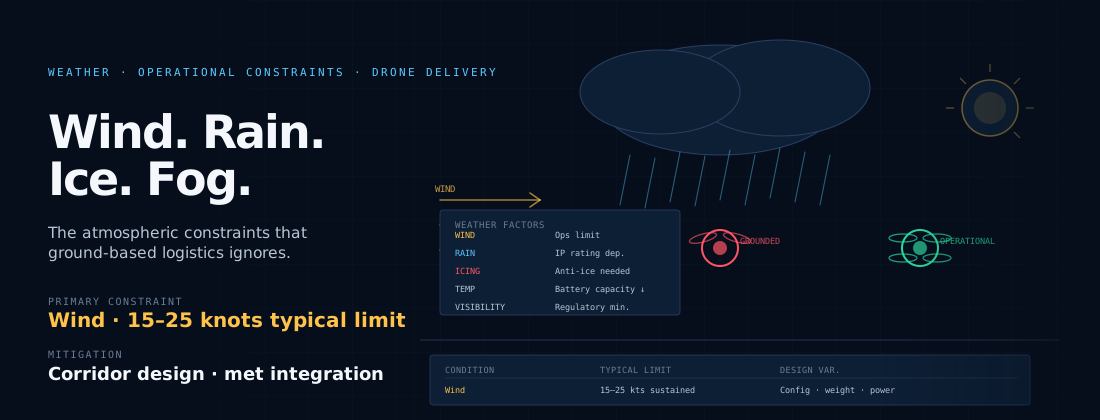
Sustained wind above an aircraft’s design speed limit grounds it entirely: flying into a headwind stronger than the aircraft’s maximum cruise speed is physically impossible. Most commercial delivery drones have operational wind limits in the range of fifteen to twenty-five knots sustained, though this varies by aircraft design and configuration. Hybrid VTOL and fixed-wing designs tend to have higher wind tolerance than multirotors of equivalent size, because their aerodynamic configuration allows them to maintain controlled flight at lower airspeeds relative to the ground.
Crosswinds affect multirotor aircraft differently from fixed-wing designs. A multirotor hovering for delivery must work continuously against a crosswind to maintain position — consuming battery energy and increasing the demands on the control system. Strong gusts during the hover phase create stability challenges that are more significant than steady winds of the same speed. The precision of winch-based delivery is also affected by wind: a package lowered on a tether in a crosswind will not descend vertically, requiring the aircraft to account for the offset.
Turbulence — particularly the mechanical turbulence generated by buildings, trees and terrain features at low altitude — creates flight quality challenges that are distinct from sustained wind speed. An aircraft that can manage a steady fifteen-knot headwind may encounter more difficulty with the turbulent eddies behind a row of houses in a ten-knot crosswind. Urban environments are generally more turbulent at low altitudes than open countryside, which is one reason why suburban delivery operations typically perform better than dense urban operations with current aircraft designs.
Precipitation
Rain affects drone delivery operations through several mechanisms. Water ingestion into motors and electronic systems is the primary concern for aircraft that are not waterproofed to an adequate standard. Most commercial delivery drones are rated for light rain operations — the IP (Ingress Protection) ratings on motors and electronics establish how much water exposure they can tolerate. Operations in heavy rain, or sustained exposure to moderate rain, typically exceed the design limits of aircraft that are not specifically designed for adverse weather.
Rain also affects the performance of sensors used for navigation and obstacle detection. Optical sensors — cameras used for visual positioning and obstacle detection — are degraded by rain droplets on the lens and by reduced visibility. Ultrasonic sensors used for altitude hold can be affected by precipitation. Radar-based systems are generally more weather-resistant, but radar capable of fine obstacle detection at the relevant ranges is expensive and heavy for small aircraft.
Operators in markets with high rainfall frequency — Ireland and the UK being notable examples — must design operations and aircraft that can cope with precipitation, or accept significantly reduced operational availability. Manna Drone Delivery’s operations in Ireland demonstrate that workable commercial delivery operations are achievable in Atlantic climate conditions, but the aircraft and operational design must account for the conditions from the outset.
Temperature extremes
At low temperatures, battery performance degrades, as discussed in detail elsewhere. But temperature extremes in both directions create additional challenges. At high temperatures, electronic systems and motors run hotter during operation, potentially triggering thermal protection cut-offs. Battery charging may be slower or restricted at high temperatures. The air itself is less dense at high temperatures — and less dense air provides less aerodynamic lift, reducing the effective payload capacity of fixed-wing and hybrid VTOL designs.
Icing is a significant concern for operations at low temperatures with precipitation. Ice accumulating on rotor blades changes their aerodynamic profile and weight distribution, degrading performance and potentially creating safety issues. Fixed-wing aircraft are generally more susceptible to airframe icing than multirotors, given the larger wing area. Anti-icing systems add weight and complexity; the alternative is to restrict operations to conditions where icing is not forecast.
Visibility
Regulatory requirements typically specify minimum visibility conditions for drone operations, even BVLOS operations where the remote pilot cannot see the aircraft. The rationale is that reduced visibility increases the risk of conflict with other aircraft that may also have reduced detection capability, and degrades the effectiveness of observers and monitoring systems. In the UK, CAA requirements specify minimum visibility conditions as part of operational authorisation conditions; similar requirements apply across most regulatory jurisdictions.
How operators manage weather
Commercial drone delivery operations manage weather risk through a combination of aircraft design, operational procedures, and meteorological data integration. The flight management system typically integrates weather data — wind speed and direction at the operational altitude, precipitation probability, temperature — and applies pre-set operational limits that pause or redirect flights when conditions approach the aircraft’s envelope boundaries.
Corridor design also takes weather into account. A corridor that crosses an exposed hilltop or open water body may experience significantly more severe wind conditions than the conditions at hub level suggest. Detailed meteorological analysis of proposed corridors — including terrain-induced turbulence and local wind phenomena — is part of the safety case for authorisation applications in most regulatory jurisdictions.