The C2 link: how operators maintain control of aircraft they cannot see
In manned aviation, the pilot sits in the aircraft. The aircraft responds to control inputs through direct mechanical or fly-by-wire connections. The feedback loop between pilot and aircraft is immediate, physical, and reliable. In unmanned aviation, specifically in BVLOS operations where the remote pilot may be kilometres from the aircraft, that feedback loop is replaced by a radio link — and the reliability, latency, and range of that link determine whether the operation is safe.
The Command and Control link — universally abbreviated as C2 — is the communication channel through which the remote pilot sends instructions to the aircraft and the aircraft returns its status. It is the digital equivalent of the pilot’s hands on the controls. Its failure is the scenario that drone delivery operators and regulators think about most carefully.
What the C2 link carries
The C2 link is distinct from the telemetry data link, though they are often implemented together. Telemetry carries information from the aircraft to the ground — position, altitude, speed, battery status, system health. The C2 link carries control commands from the ground to the aircraft — route modifications, altitude changes, payload release commands, return-to-home instructions.
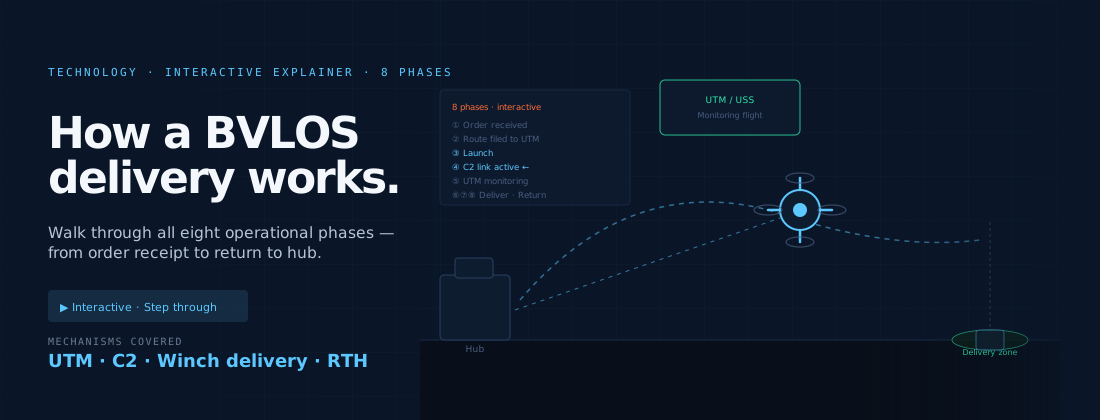
For a fully autonomous aircraft executing a pre-planned route, the C2 link may carry little traffic during the cruise phase of flight: the aircraft knows where it is going and is executing without moment-to-moment input. The C2 link becomes most critical at the beginning of flight (pre-launch checks, launch authorisation), at the delivery zone (payload release commands, hover adjustments), and whenever an anomaly occurs that requires pilot intervention.
The radio frequency options
C2 links operate across a range of radio frequency bands, each with different characteristics that suit different operational contexts.
Sub-GHz frequencies — primarily the 900 MHz band — offer the greatest range of any licence-exempt or lightly licensed spectrum. The longer wavelength penetrates foliage and low-level obstacles better than higher frequencies and travels further with a given transmit power. The trade-off is lower data bandwidth, which is acceptable for C2 commands that are typically small data packets, but constrains the amount of telemetry data that can be carried alongside.
The 2.4 GHz and 5.8 GHz bands, widely used in consumer drones, offer higher bandwidth but shorter range and less penetration. They are suitable for VLOS operations and short-range BVLOS in relatively open environments but are generally insufficient for long-range commercial delivery corridors.
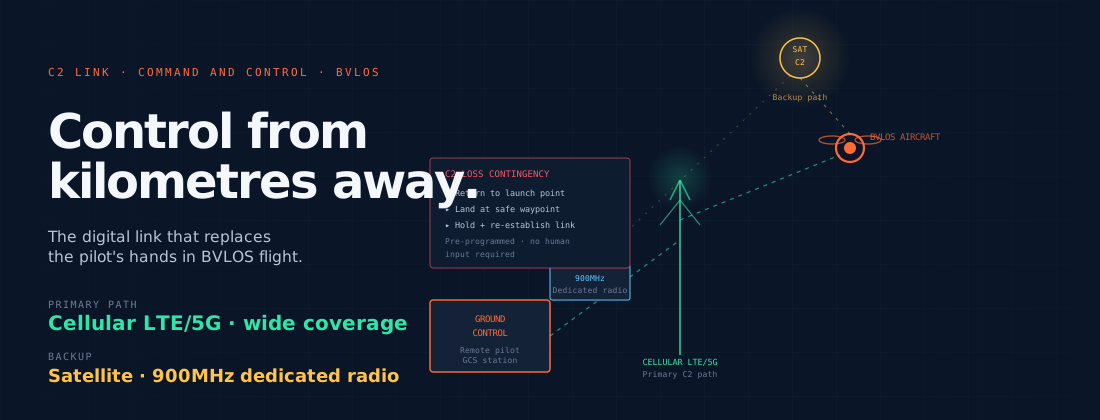
Cellular networks — LTE and the developing 5G infrastructure — have become increasingly important for C2 in commercial delivery operations. Cellular provides wide geographic coverage, managed spectrum with defined quality of service characteristics, and the kind of network infrastructure maintenance that licensed radio systems require. The limitation of cellular for C2 is coverage: cellular networks, particularly at low altitude, have gaps that can be significant in rural or semi-rural delivery corridors. Operators using cellular C2 must map coverage for their proposed corridors and design contingency procedures for anticipated gap areas.
Satellite communication provides C2 coverage in locations where no other system reaches — remote areas, oceanic routes, high-latitude operations. The trade-offs are latency (signal delay through satellite links can be significant for real-time control applications), cost, and the terminal weight and power consumption that satellite modems add to the aircraft.
Redundancy and C2 link loss
For commercial delivery operations, single-link C2 architectures are generally insufficient for regulatory approval in most jurisdictions. The consequence of a C2 link failure depends entirely on what the aircraft does when it loses contact, and the design of that contingency behaviour is a central element of the safety case for any BVLOS operation.
Operators typically address C2 reliability through two approaches, often combined. Redundant C2 links use two independent communication paths — typically cellular plus a dedicated radio link — such that the failure of one path does not result in total loss of C2. The aircraft continues operating on the second path while the failure is investigated and resolved.
C2 link loss contingency procedures define what the aircraft does if all C2 paths are lost simultaneously. Standard approaches include returning to the launch location on the pre-planned route, landing at a pre-designated safe location within the corridor, or entering a holding pattern at a defined altitude while attempting to re-establish the link. The appropriate contingency depends on the airspace environment, the aircraft’s energy state, and the nature of the corridor.
Regulatory authorities in most jurisdictions require operators to demonstrate their C2 architecture and loss contingency procedures as part of the authorisation process for BVLOS operations. The adequacy of the C2 system is one of the primary risk factors assessed in safety case evaluations.
Evolving standards
ICAO has published guidance on C2 link requirements for remotely piloted aircraft systems in its Manual on Remotely Piloted Aircraft Systems (Doc 10019), and standards bodies including EUROCAE have published minimum operational performance standards for C2 systems. These standards provide the technical basis for regulatory acceptance of C2 architectures in certification and authorisation processes.
As cellular networks evolve — and particularly as 5G networks with network slicing capabilities that can provide guaranteed quality of service for specific applications develop — the performance of cellular C2 for drone delivery is expected to improve. Dedicated spectrum for unmanned aviation C2 is also under discussion in several regulatory frameworks, which would provide operators with more predictable communication environments than shared commercial spectrum allows.