The cargo drone question: will heavy-lift unmanned aircraft reshape logistics above the parcel level
This article is DDG’s analytical assessment of where heavy-lift unmanned aircraft development is heading, based on publicly available information about current development programmes and the market conditions they address. Forward-looking observations reflect our reading of current trajectories.
The aircraft that carry blood products in Rwanda and coffee orders in Canberra operate at roughly the same scale: payloads of one to three kilograms, ranges of tens of kilometres, operations oriented around residential or health facility delivery. The vast majority of the commercial drone delivery industry, in operational terms, lives in this space. It is a space defined by the technology that has been developed, certified, and commercially deployed.
At the margins, a different class of development is taking place: unmanned aircraft designed to carry payloads of tens or hundreds of kilograms over ranges of hundreds of kilometres. The commercial category for this class of aircraft — often described as cargo drones — addresses a different market: not the last-mile residential delivery problem, but the inter-city or inter-island freight movement problem that current commercial aircraft serve at high cost and with limited frequency.
The market these aircraft address
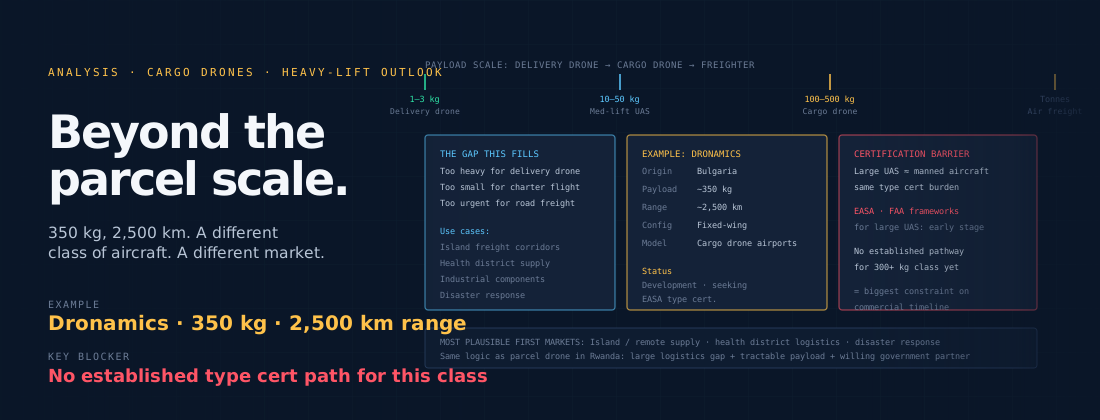
The logistics market that cargo drones aspire to serve is the tier between parcel delivery and full air freight: cargo that is too heavy or bulky for current-generation delivery drones but too small or time-sensitive to justify a full freight aircraft load. Think inter-island cargo in Pacific or Caribbean communities, medical equipment and supplies at the health district level rather than the individual patient level, or time-sensitive automotive or manufacturing components that currently travel by road courier over long distances.
This market is real and large. The economics of existing solutions — road freight over long distances, chartered light aircraft for island connections, small air freight for time-sensitive industrial components — are poor enough that a lower-cost automated alternative would find customers. The question is whether the technology can reach the point where cargo drone operations are commercially viable at scale.
Where development stands
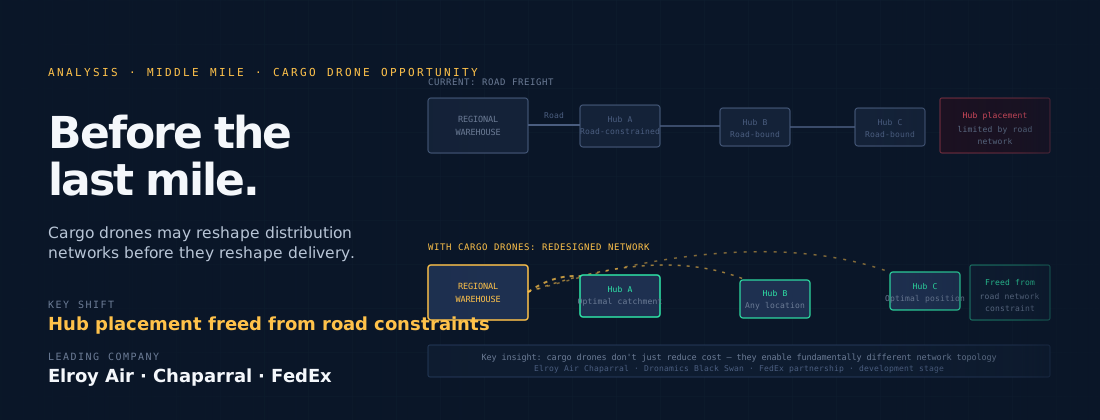
Several companies have been developing heavy-lift cargo drone systems. Dronamics, a Bulgarian company, has been developing a fixed-wing unmanned cargo aircraft designed to carry payloads of up to 350 kilograms over ranges of up to 2,500 kilometres — a specification that would make it competitive with small turboprop aircraft for inter-city cargo routes. The company has described plans for commercial freight operations using dedicated cargo drone airports, a different infrastructure model from the hub-based residential delivery approach of parcel delivery operations.
Other developers have pursued different configurations: multi-rotor heavy-lift designs for shorter ranges, hybrid wing-body designs for maximum payload efficiency, and eVTOL-derived designs that leverage urban air mobility development for cargo applications. The diversity of technical approaches reflects both the genuine uncertainty about which configuration will prove most commercially viable and the breadth of the market segment that different configurations might address.
The certification challenge
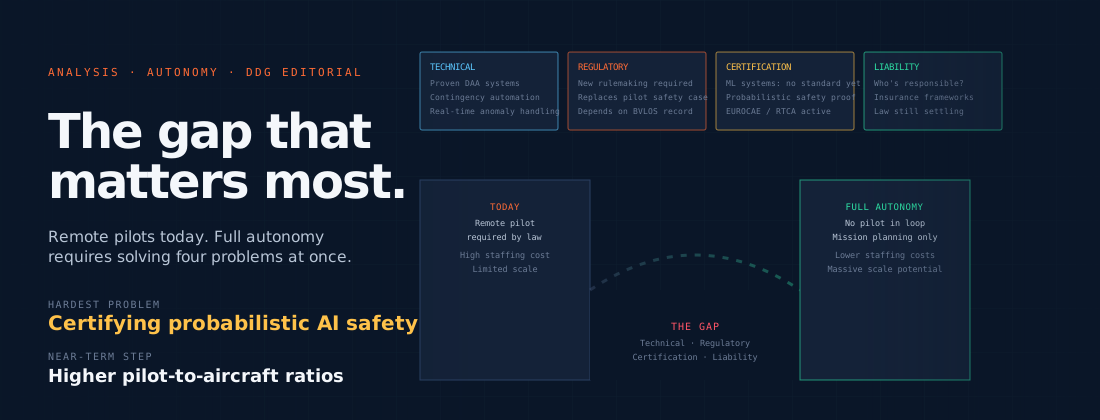
The certification pathway for a large unmanned cargo aircraft is substantially more demanding than that for a small delivery drone. A 350-kilogram payload aircraft is a significant piece of aviation infrastructure — one that, in the event of a failure over populated areas, poses risks that are orders of magnitude greater than those posed by a two-kilogram delivery drone. The type certification process for aircraft in this class requires demonstrating airworthiness to standards comparable to those applied to manned commercial aircraft, even if the specific standards for unmanned aircraft in this category are still being developed.
Aviation authorities including EASA and the FAA have begun developing type certification frameworks for large unmanned aircraft, but the process is at an earlier stage than the corresponding framework for small delivery drones. The absence of a clear, established certification pathway is a constraint on the pace at which cargo drone development can translate into commercial operations.
The trajectory and what would accelerate it
The conditions that would accelerate cargo drone development from proof-of-concept to commercial operations are the same conditions that have driven parcel delivery drone development: a clear regulatory pathway for certification and operation, initial markets where the value proposition is strong enough to justify early-stage economics, and sufficient operational data from initial deployments to support progressive expansion of the operational envelope.
The most plausible near-term markets for cargo drones are, predictably, those where the ground logistics alternative is worst: island and remote community supply chains where current solutions are expensive and unreliable, health system logistics at the district or regional level in markets with poor road infrastructure, and disaster response scenarios where conventional supply chains have been disrupted. These are markets where the economic case for cargo drones can be made even at early-stage cost levels — a characteristic the parcel delivery sector found most compellingly in medical logistics, and which cargo drones are likely to find in analogous segments of the freight market.