Singapore’s drone regulatory environment: what CAAS has built and why it matters
Singapore presents an interesting case study in drone regulation for a specific reason: it is a very small, very densely populated country that has chosen to engage seriously with drone delivery rather than default to restriction. The Civil Aviation Authority of Singapore — CAAS — has developed a regulatory framework that accommodates commercial drone operations in one of the most challenging urban environments in the world.
The regulatory framework
CAAS regulates unmanned aircraft operations under Singapore’s Air Navigation Act. The framework distinguishes between different categories of unmanned aircraft operations by weight and operational context, with increasingly stringent requirements as the complexity and potential risk of operations increases.
For commercial delivery operations, CAAS has developed an Operator Accreditation Scheme — OAS — that provides a defined pathway for organisations seeking to conduct commercial drone operations beyond the standard recreational or small-scale commercial permit categories. The OAS requires operators to demonstrate safety management systems, operational procedures, and organisational competency before receiving accreditation to conduct the operations they have applied for.
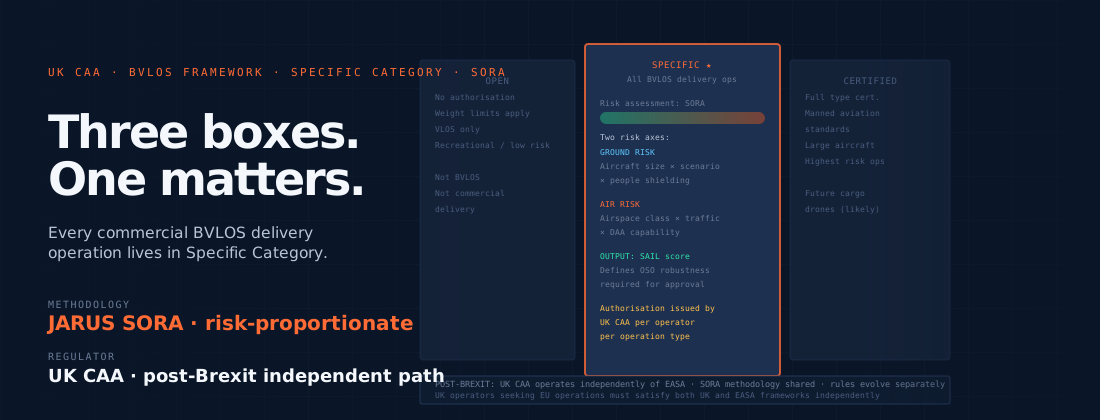
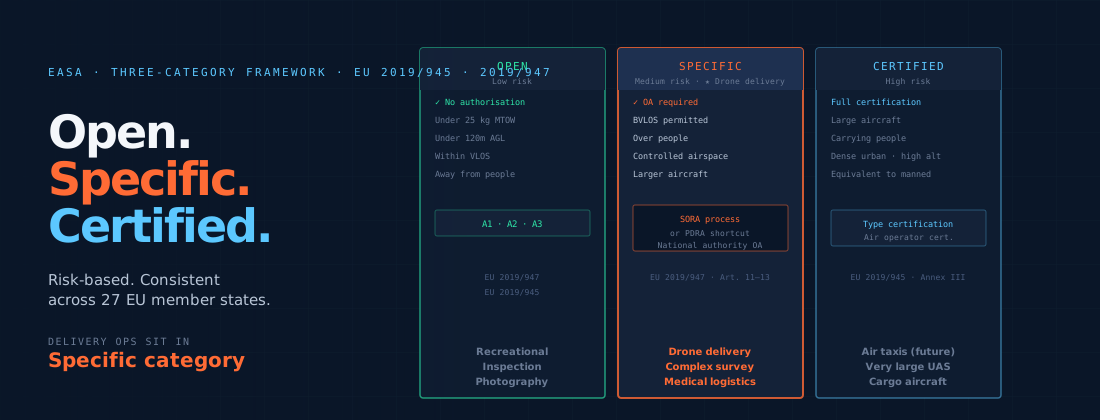
The OAS framework reflects a risk-based regulatory philosophy similar to EASA’s Specific Category approach: the authorisation is specific to the operator, the aircraft, and the type of operation, and the requirements are proportionate to the risk the operation presents. It avoids both the blanket prohibition approach (which prevents the industry from developing) and the blanket permission approach (which ignores the genuine risks of complex drone operations in populated areas).
The One-North corridor
One of CAAS’s most distinctive contributions to drone regulation is the One-North corridor — a designated test corridor in the One-North business district of Singapore that provides operators with a defined airspace in which to conduct trials and demonstrations under controlled conditions. The corridor has served as a development environment for operators working toward full commercial authorisation, allowing them to accumulate operational experience and safety data within a defined regulatory framework before applying for broader operational authorisations.
The concept of a designated test corridor with a defined regulatory environment is replicable in other urban contexts and has been referenced in regulatory discussions elsewhere. The ability to gather real-world operational data in a controlled environment, with regulatory visibility into what operators are doing and how their systems perform, is valuable for both operators (who need the data to support authorisation applications) and regulators (who need the data to make informed authorisation decisions).
Singapore’s geographic context
Singapore’s geography creates specific challenges and specific opportunities for drone delivery. At 730 square kilometres, the entire country is roughly the size of a major city’s metropolitan area. Almost all of it is populated — there is no rural hinterland where BVLOS operations over non-populated areas can provide a gentle regulatory stepping-stone to the harder question of populated-area operations. Operations over populated areas are, for Singapore, essentially the only option.
The constraint forces regulatory engagement with the difficult questions that other jurisdictions can defer. Singapore cannot adopt the approach of starting with rural BVLOS and progressively expanding toward urban operations — the rural category barely exists. This constraint has pushed CAAS to engage directly with populated-area BVLOS in a way that larger countries with more geographic variety have been slower to do.
Regional influence
Singapore’s CAAS has been an active participant in ICAO working groups on unmanned aviation standards and has engaged bilaterally with aviation authorities in neighbouring countries on drone regulatory development. For Southeast Asian aviation authorities looking to develop drone regulatory frameworks, CAAS’s OAS and the One-North corridor provide a reference model that is geographically and economically relevant in a way that European or North American frameworks may not be.
The influence of regulatory models tends to travel through ICAO processes, bilateral relationships, and the choices made by operators who work across multiple jurisdictions and have a commercial interest in regulatory harmonisation. Singapore’s engagement with all three channels gives it a degree of regulatory influence disproportionate to its size.