Japan’s Level 4 drone regulations: what the December 2022 reforms actually changed
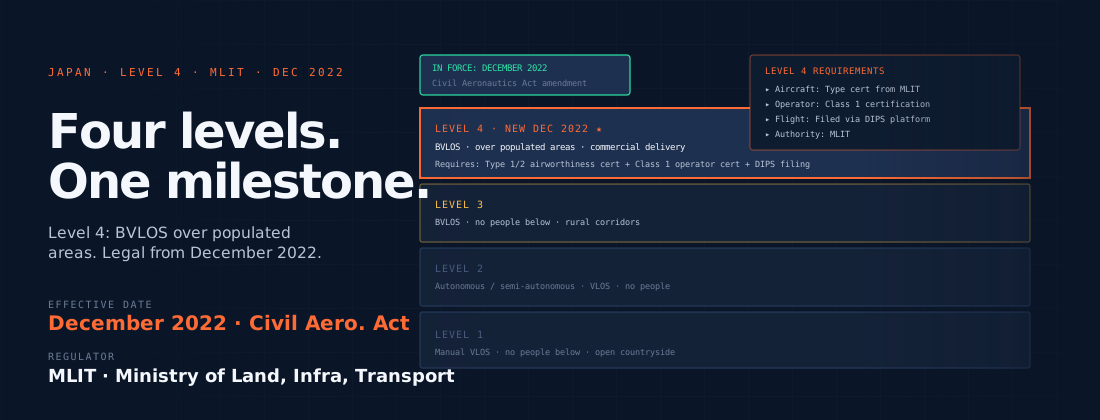
In December 2022, amendments to Japan’s Civil Aeronautics Act came into force establishing a new category of drone operations: Level 4. The designation covers unmanned aircraft flights beyond visual line of sight over populated areas — precisely the operational profile required for commercial drone delivery in urban and suburban environments. Japan became one of the first countries in the world to create an explicit regulatory pathway for this type of operation.
Japan’s level system for drone operations
Japan’s regulatory framework for unmanned aircraft categorises operations by the nature of the airspace and the degree of human oversight involved. The levels are defined broadly as follows:
Level 1 covers manual flight within visual line of sight in areas without people. Level 2 covers autonomous or semi-autonomous flight within visual line of sight, again without people below. Level 3 covers BVLOS flight in areas without people — the kind of corridor that Zipline has used for rural medical delivery in other markets. Level 4, the category introduced in December 2022, covers BVLOS flight over populated areas — the operational profile most relevant to urban drone delivery.
The level framework provides a logical progression: as operations become more complex and the risk to third parties increases, the regulatory requirements and certification standards become correspondingly more stringent. Level 4 is the most demanding category, requiring both aircraft certification and operator certification under the revised rules.
What Level 4 requires from operators
To conduct Level 4 operations under the December 2022 rules, operators must meet requirements in two areas: the aircraft and the organisation.
On the aircraft side, Level 4 operations require that the unmanned aircraft hold a Type 1 or Type 2 airworthiness certificate issued by Japan’s Ministry of Land, Infrastructure, Transport and Tourism — MLIT, the ministry responsible for civil aviation in Japan. The certification process is analogous to the type certification process for manned aircraft, requiring demonstration that the aircraft meets defined performance and safety standards. This was a new requirement: prior to December 2022, drone airworthiness certification of this kind did not exist in Japan.
On the organisation side, operators conducting Level 4 operations must hold a first-class unmanned aircraft operator certification, which requires demonstration of specific competencies, safety management processes, and operational procedures. The certification is issued by MLIT following an examination and audit process.
Flight plans for Level 4 operations must be filed through Japan’s Drone Information Platform System — DIPS — which provides the digital infrastructure for flight authorisation, conflict management, and operational monitoring that Level 4 requires.
The significance of Level 4 for commercial delivery
Before December 2022, commercial drone delivery in populated Japanese cities was not possible under a standing regulatory framework. Operators could conduct BVLOS flights in rural or unpopulated areas under earlier rules, but the populated-area restriction was a fundamental barrier to urban and suburban delivery at scale.
The Level 4 framework removed that barrier by creating a defined pathway to authorisation rather than requiring operators to negotiate one-off permissions for each proposed operation. An operator that achieves Level 4 certification operates within a known regulatory framework with defined requirements rather than navigating an undefined approval process.
Japan’s population density, concentrated in relatively small urban footprints with high e-commerce adoption, makes the market economically attractive for drone delivery if the regulatory pathway is clear. The December 2022 reforms provided that clarity.
Early developments following the rule change
Following the introduction of the Level 4 framework, several operators engaged with the MLIT certification process. The process of achieving Type 1 or Type 2 airworthiness certification for existing aircraft is not instantaneous — it involves the same kind of regulatory engagement and technical demonstration that aviation certification processes require in any jurisdiction.
Zipline, which had established a relationship with Japanese partners prior to the rule change, was among the operators engaged in developing Level 4-compliant operations. Other operators with a presence in Asian markets also engaged with the new framework.
The Level 4 reform placed Japan in a position comparable to Australia and ahead of most European markets and the United States in terms of having an explicit regulatory pathway for populated-area BVLOS delivery. How rapidly the framework is used at operational scale depends on how quickly operators can achieve the required certifications and build the operational infrastructure the Japanese market requires.