Battery technology and the range constraint: the energy problem shaping drone delivery
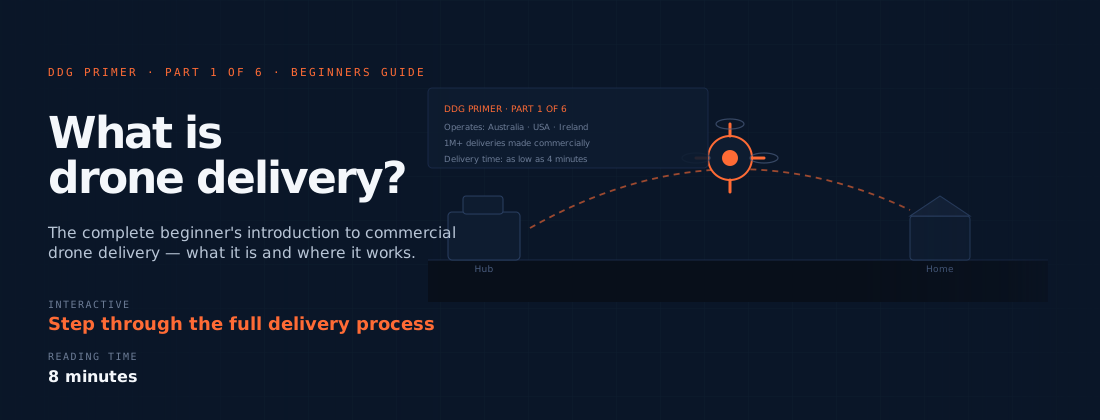
Electric drone delivery aircraft are, at their core, battery-powered flying machines. The range they can achieve, the payload they can carry, the speed they can sustain, and the conditions they can tolerate are all shaped, to a first approximation, by one number: the energy density of the battery. Everything else in the design is, in some sense, working around that constraint.
Energy density and why it matters
Energy density is a measure of how much energy can be stored in a given weight of battery. It is typically expressed in watt-hours per kilogram (Wh/kg). The higher the energy density, the more energy can be stored per unit of weight — and since weight is the fundamental enemy of flight, more energy per kilogram means more range, more payload capacity, or both.
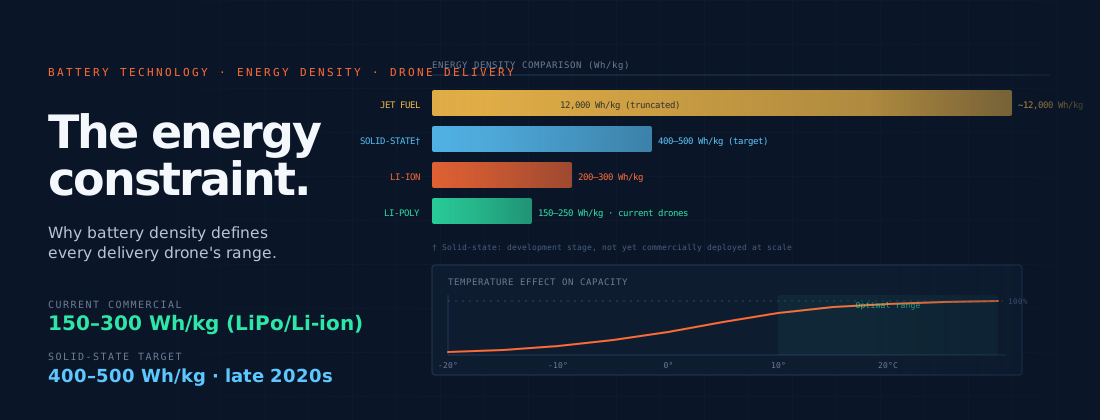
Contemporary lithium-polymer (LiPo) and lithium-ion (Li-ion) batteries, which power virtually all commercial delivery drones, have gravimetric energy densities in the range of approximately 150 to 300 watt-hours per kilogram at the cell level. At the pack level — accounting for the structure, casing, battery management electronics and wiring that make cells into a usable battery — usable energy density is typically somewhat lower.
By comparison, jet fuel has an energy density of roughly 12,000 watt-hours per kilogram. Even accounting for the efficiency difference between electric motors (typically 85 to 95 per cent efficient) and jet turbines (typically 25 to 35 per cent efficient), fossil fuels contain vastly more energy per kilogram than any commercial battery chemistry currently available. This difference is the fundamental reason why the range of electric aircraft is so much shorter than equivalent fuel-powered designs.
What this means for delivery drones
A typical small commercial delivery drone might have a maximum take-off weight of five to fifteen kilograms. The battery might represent 20 to 35 per cent of that weight — a battery pack of one to five kilograms. The energy stored in that battery, together with the efficiency of the propulsion system and the aerodynamic efficiency of the airframe, determines how far the aircraft can fly with a given payload.
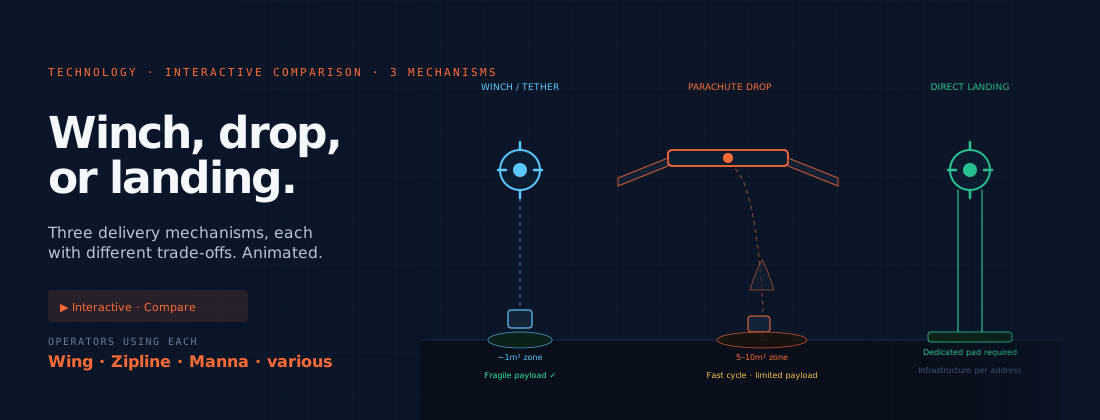
For multirotor designs, which rely on continuous powered lift and have relatively poor aerodynamic efficiency, the energy constraint is particularly acute. A quadrotor carrying a one-kilogram payload might achieve a range of ten to twenty kilometres on a single charge. A fixed-wing or hybrid VTOL design, which uses aerodynamic lift for the majority of its flight and can cover distance far more efficiently, can achieve substantially greater range from the same battery — often two to four times the distance for comparable payload and battery weight.
This is the energy physics behind the design choices that delivery operators have made. Zipline’s fixed-wing aircraft, which operates at ranges of up to 160 kilometres according to company specifications, achieves that range precisely because its aerodynamic design extracts much more distance from the same energy than a multirotor would.
Temperature effects
Battery performance is sensitive to temperature. Lithium chemistry batteries lose capacity and power output at low temperatures — below about five degrees Celsius, capacity begins to decline meaningfully, and below minus ten degrees Celsius, some chemistries become effectively unusable without active thermal management. High temperatures also degrade battery performance and accelerate long-term capacity loss.
For operators in temperate climates, low-temperature performance is a real operational constraint. A delivery drone that can achieve a fifteen-kilometre range in summer may achieve meaningfully less in winter, particularly for operations that occur early in the morning or late in the evening when ambient temperatures are lowest. Operators must account for this in their corridor design and in the safety margins they apply to battery state of charge at the end of flights.
Charging and cycle management
The economics of hub-based drone delivery depend significantly on how quickly aircraft can be turned around between flights. Battery charging time is a key determinant of turnaround rate. Fast charging reduces turnaround time but accelerates battery degradation — lithium batteries have a finite number of charge-discharge cycles before their capacity falls below operational thresholds, and high-rate charging reduces that cycle count. Slow charging preserves battery life but extends turnaround time and reduces hub throughput.
Operators address this trade-off in different ways. Some use swappable battery packs — the discharged pack is removed and replaced with a charged one in a matter of minutes, while the discharged pack charges at a controlled rate. This approach maximises aircraft availability at the cost of a larger battery fleet. Others accept the turnaround time associated with charging the aircraft in place, accepting lower hub throughput in exchange for simpler logistics and lower battery fleet investment.
The future: solid-state and beyond
Solid-state battery technology — which replaces the liquid electrolyte in conventional lithium batteries with a solid material — has the potential to achieve substantially higher energy densities than current lithium-polymer or lithium-ion chemistries, with improved safety characteristics and better low-temperature performance. Several major battery manufacturers and automotive companies have announced development programmes targeting solid-state batteries for commercial production in the late 2020s.
If solid-state batteries achieve commercially deployable energy densities of 400 to 500 watt-hours per kilogram — figures that have been discussed in industry roadmaps — the impact on drone delivery would be significant. At 400 Wh/kg, the range achievable by a multirotor design increases substantially; at 500 Wh/kg, medium-range hybrid VTOL delivery at meaningful payload capacities becomes considerably more tractable. The qualification and integration of new battery chemistries into certified commercial aircraft also takes time, so the practical impact on operational drone delivery is likely to lag the battery development timeline by several years.