The economics of drone delivery: key variables and what determines viability
One of the most persistent oversimplifications in coverage of drone delivery is the treatment of economics as a binary: either drone delivery will be cheap and therefore disruptive, or it will be expensive and therefore a niche. The reality is more specific. Drone delivery has a cost structure that makes it economical under certain conditions and uneconomical under others. The conditions under which it works are the conditions that determine which markets, use cases, and operators succeed.
The cost structure
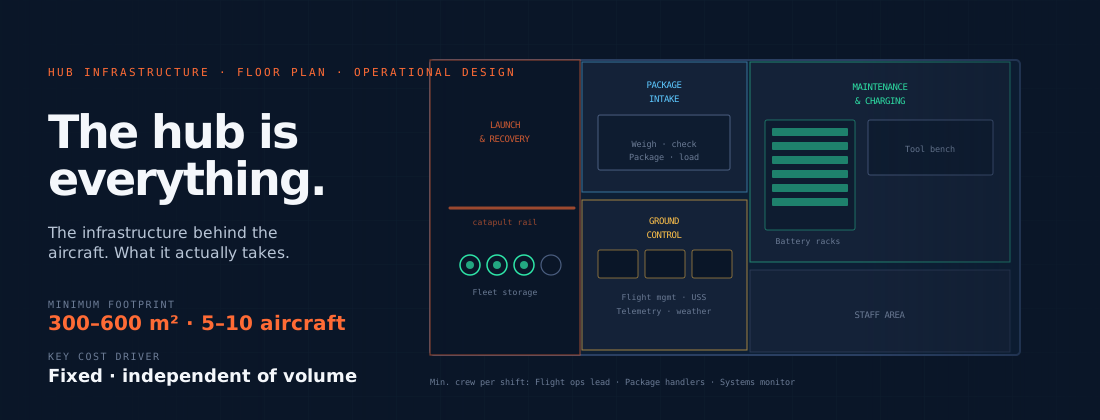
The costs of a drone delivery operation fall into several categories. Hub infrastructure costs include the facility, launch and recovery equipment, charging or fuelling systems, and the ground station infrastructure for flight operations. These are largely fixed costs that must be covered regardless of delivery volume — which means that hub economics improve significantly as delivery volume increases. A hub with low utilisation has poor unit economics regardless of how efficient the aircraft is; the same hub at high utilisation can achieve substantially better numbers.
Fleet costs include aircraft acquisition or depreciation, maintenance, battery replacement (for electric aircraft), and the certification costs associated with keeping the fleet in airworthy condition. Aircraft that can sustain high flight cycle rates — many flights per day, with rapid turnaround — amortise their acquisition cost over more deliveries, improving unit economics. Aircraft that require lengthy maintenance cycles or have high failure rates have worse unit economics regardless of their purchase price.
Staffing costs cover the flight operations team, package handlers, maintenance technicians, and any customer-facing functions. Staffing efficiency — the ratio of deliveries per staff member per shift — is a key variable that operators work to optimise as their operations mature. High staff-to-aircraft ratios are an early-stage phenomenon; mature operations typically achieve better ratios through process optimisation and, in some cases, increased automation of hub functions.
Regulatory and compliance costs include the ongoing expense of maintaining operating authorisations, Remote ID compliance, insurance, and engagement with regulatory processes. These costs are largely fixed relative to volume — an operator maintaining an OA for a given corridor incurs similar compliance costs whether it flies 50 deliveries per week or 500.
The revenue side
Drone delivery generates revenue either through direct charges to end customers, through platform fees charged to retail or logistics partners who use the delivery capability, or through long-term service contracts — common in the medical logistics context — that provide revenue certainty in exchange for defined service commitments.
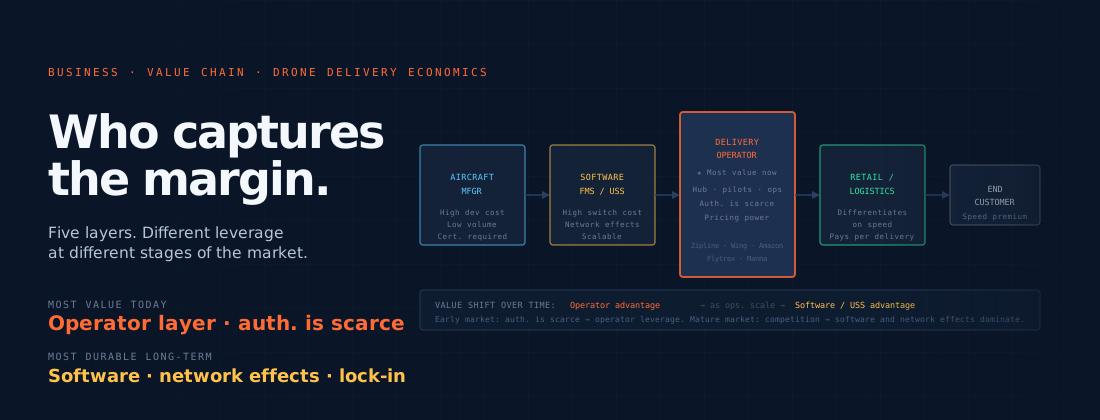
Pricing power for drone delivery depends heavily on the alternative available to the customer. In markets where the relevant comparison is road courier delivery — a commodity service in most urban markets — drone delivery can command a premium only if it offers meaningfully faster or more reliable service. In markets where the comparison is air ambulance or helicopter logistics — inherently expensive and capacity-limited — drone delivery can offer substantial savings even at early-stage cost levels.
This is why the medical logistics use case has proved economically more tractable than consumer retail for early-stage operators: the relevant alternative is expensive, the customer — typically a health system — has a procurement relationship that can support service contracts, and the value of the time saving is measurable in clinical terms as well as financial ones.
The variables that matter most
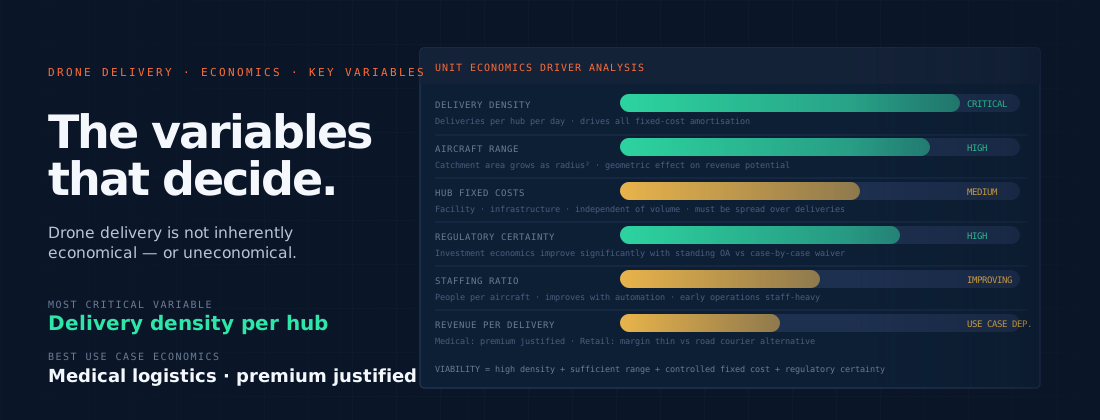
Delivery density — the number of deliveries achievable per hub per day — is probably the single most important economic variable. It determines revenue per hub, drives the amortisation of fixed costs, and affects the efficiency of staff utilisation. Delivery density is in turn determined by the catchment area served, the order frequency within that catchment, and the flight cycle time of the aircraft.
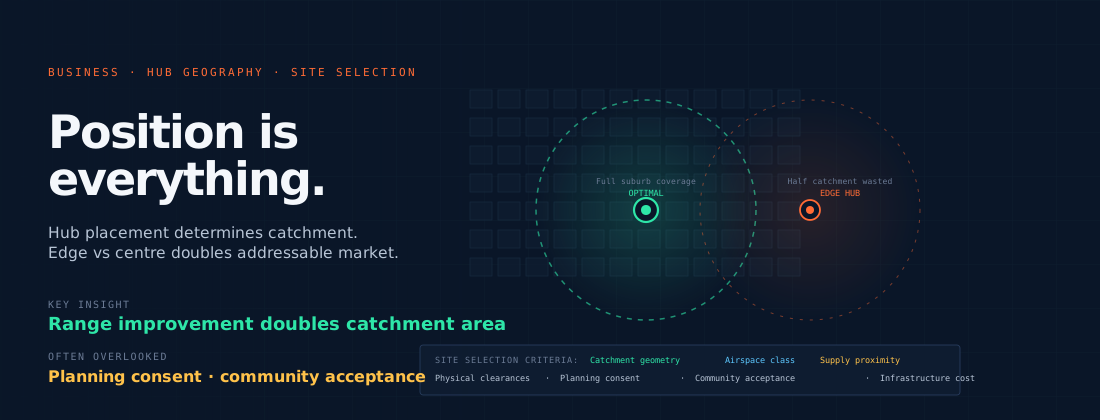
Range determines catchment area. A hub serving a 2-kilometre radius around a warehouse reaches a limited population; the same hub with an aircraft capable of a 10-kilometre operational radius serves a population roughly twenty-five times larger. Range improvements have a disproportionate impact on potential delivery density because of this geometric relationship between radius and catchment area.
Regulatory certainty affects investment economics. An operator that cannot obtain a standing operating authorisation for a defined period must treat every investment in hub infrastructure as contingent on continued regulatory access. The shift from waiver-based to rules-based authorisation frameworks — the direction of travel in both the US and EU — improves investment economics by giving operators greater confidence that authorised corridors will remain accessible as infrastructure investments amortise.
A framework for assessment
Evaluating the economic viability of a specific drone delivery operation requires understanding the hub fixed cost base, the achievable delivery density at the operational design point, the revenue per delivery achievable in the relevant market, and the regulatory cost and certainty level. Operations that combine low hub costs with high achievable density, strong revenue per delivery, and high regulatory certainty are the most economically viable. Operations that face high hub costs, low density, thin margins, or regulatory uncertainty face substantially harder economics regardless of the aircraft technology involved.
This framework suggests that viability assessments should be market-specific and use-case-specific rather than technology-generic. The question is not whether drone delivery works economically in the abstract but whether it works in this market, for this use case, at this volume, under this regulatory framework — and the answer varies considerably across those dimensions.