Wing: Alphabet’s drone delivery programme, eight years on
Wing is the drone delivery subsidiary of Alphabet, Google’s parent company. It began as a project within Google’s experimental research division, Google X, around 2012, and became a standalone Alphabet company in 2018. It has been operating commercial drone delivery services longer than any other company in the United States and has accumulated more commercial delivery flights than most competitors globally.
Origins and early development
Project Wing, as it was originally known, spent several years in research and testing before its first public disclosures. The project became publicly known in 2014, when Google revealed that it had been conducting experimental drone delivery tests in Queensland, Australia. Early testing involved a range of aircraft configurations, and the project went through significant design evolution before settling on its current approach.
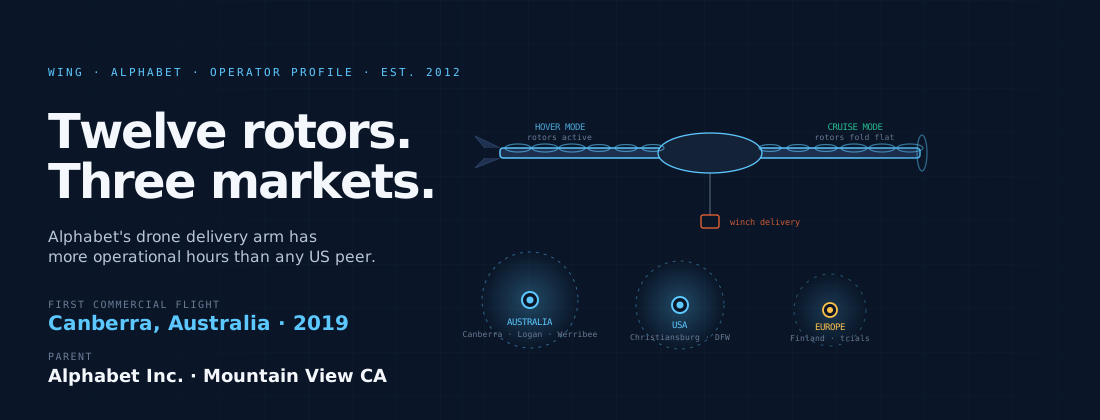
Wing received its Air Operator Certificate from Australia’s Civil Aviation Safety Authority in 2019 — the first certification of its kind for a drone delivery operator in Australia — and launched commercial delivery services in the Canberra region later that year. The Australian operation, which expanded over subsequent years to cover a growing number of Canberra suburbs, provided Wing with a large base of real-world operational experience in a market with a relatively permissive regulatory environment and a population that proved receptive to the service.
Aircraft design
Wing’s aircraft uses a distinctive configuration: a fixed-wing design with twelve electric rotors distributed along the wings. During take-off and landing, the rotors provide vertical lift; during cruise, they fold flat and the aircraft flies as a conventional fixed wing, with a separate tail-mounted pusher propeller providing forward thrust. This configuration gives the aircraft fixed-wing efficiency in cruise while retaining the vertical take-off and landing capability required for operation without a runway.
Delivery is accomplished via a winch system: the aircraft hovers above the delivery zone and lowers the package on a tether until it reaches the ground, at which point the package detaches and the tether is retrieved. The system allows delivery to gardens, driveways and other outdoor residential spaces without the aircraft needing to land.
US operations
Wing launched its first US commercial delivery service in Christiansburg, Virginia, in 2019, partnering with local retailers and the Virginia Tech campus. The Christiansburg operation gave Wing its first experience with the US regulatory environment and the FAA’s authorisation processes for drone delivery in controlled airspace.
Wing has subsequently expanded its US operations to additional markets, most notably in the Dallas-Fort Worth metropolitan area in Texas, where it has been operating commercial deliveries in partnership with retailers including Walgreens and various food service providers. The DFW expansion represented a significantly larger and more complex operating environment than Christiansburg, with multiple hubs serving suburban residential areas across a wide geographic area.
Business model
Wing operates as a delivery platform rather than a logistics operator in the traditional sense. Its commercial model involves partnerships with retailers and logistics companies who use Wing’s delivery capability to offer drone delivery to their customers. The end customer places an order through the retailer’s existing channels; Wing handles the physical delivery. This positions Wing as infrastructure rather than a direct competitor to existing last-mile logistics providers — a positioning that has shaped its partnership strategy and its regulatory engagement approach.
The company has focused primarily on consumer retail and food delivery use cases in its commercial markets, differentiated from competitors like Zipline by the lighter payload, shorter range, and higher frequency characteristics of consumer retail delivery relative to medical logistics.
Safety record and regulatory engagement
Wing has been public about its commitment to safety transparency and has published information about its operational safety record and incident reporting. The company has been an active participant in FAA regulatory development processes, including the UTM Pilot Program and the development of BVLOS operating standards, contributing operational data and technical input to the regulatory framework that governs the industry.