Remote ID: what it is, what it requires, and what drone operators need to know
Remote Identification for unmanned aircraft — Remote ID — is the regulatory framework that requires drones to broadcast identification and location information during flight, making them visible to regulators, law enforcement, and airspace management systems in a way that unidentified aircraft cannot be. The FAA’s Remote ID rule, first published in January 2021 and enforceable from September 2023, is one of the most significant pieces of UAS regulation in the United States since Part 107.
What Remote ID requires
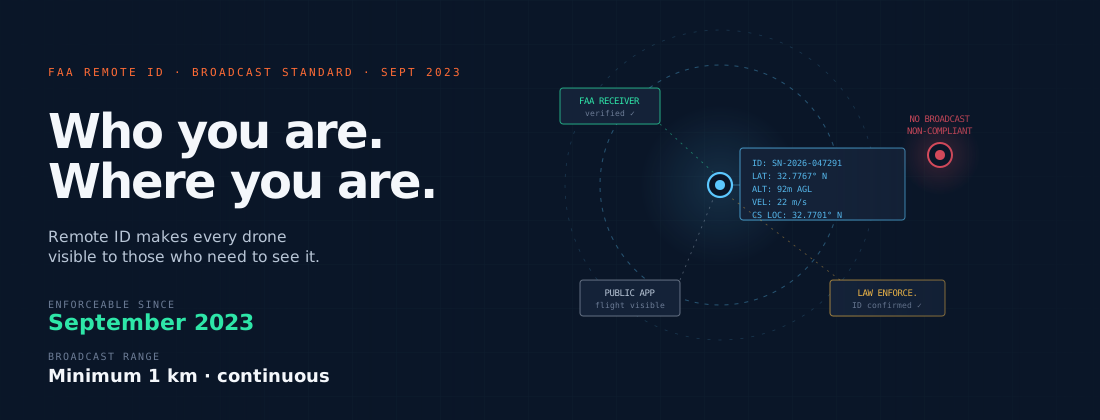
The Remote ID rule requires that unmanned aircraft broadcast a standard set of data during flight: the aircraft’s identification number (either its serial number or a session ID), its current location and altitude, its velocity, the location of its control station (or takeoff point, for aircraft that cannot determine control station location), a time mark, and an emergency status indicator.
The broadcast must be transmitted throughout the flight — from takeoff to landing — and must be receivable by any standard receiver within a minimum range of one kilometre. The broadcast uses radio frequencies that allow reception by a range of devices, including purpose-built Remote ID receivers and, in some implementations, mobile devices running compatible applications.
Who Remote ID applies to
Remote ID applies to all unmanned aircraft that are required to be registered with the FAA and that operate in airspace requiring authorisation. This covers the vast majority of commercial drone operations and a significant proportion of recreational operations involving registered aircraft above 250 grams.
The rule establishes two categories of compliant operation. Standard Remote ID aircraft have Remote ID capability built into the aircraft itself — the broadcast hardware and software are integrated into the airframe. This is the requirement for aircraft manufactured after the rule’s effective date. For aircraft manufactured before the rule, operators can add compliance through FAA-accepted Remote ID broadcast modules that attach to or integrate with the aircraft.
The second category is operations at FAA-Recognised Identification Areas — FRIAs — which are defined zones, typically established by recreational flying clubs and organisations, where aircraft without Remote ID capability may operate. Commercial delivery operations do not fall within this category.
The operational implications for drone delivery
For commercial drone delivery operators, Remote ID is not merely a compliance requirement but an enabling technology. The same broadcast that satisfies the regulatory obligation also provides the data stream that allows UTM systems to maintain situational awareness of aircraft in a given airspace volume. An operator with a properly functioning Remote ID broadcast is an operator whose aircraft can be positively identified as lawfully operating by any ground-based system capable of receiving the broadcast.
This has practical implications for airspace management. As UTM systems become more sophisticated and more integrated with other airspace users, the ability to positively identify aircraft and verify their operating status becomes the basis for automated conflict detection and resolution. Remote ID is, in this sense, the foundation on which more advanced airspace coordination capabilities are built.
Compliance requirements in practice
For operators of new aircraft purchased after the rule’s effective date, compliance is straightforward: aircraft must have Standard Remote ID capability built in, and operators must ensure the system is functioning and active during flight. Operators should verify that their aircraft’s Remote ID system is functioning correctly before each flight, using one of the Remote ID display applications available for this purpose.
For operators with existing aircraft lacking built-in Remote ID, the options are to retrofit with an FAA-accepted broadcast module, to transition to compliant aircraft, or to restrict operations to FRIAs where applicable. For commercial delivery operators, the FRIA option is not available, making retrofit or fleet transition the only paths to compliance.
Broadcast modules must appear on the FAA’s list of accepted Remote ID broadcast modules to be used for compliance purposes. Operators should verify current acceptance status before purchasing and fitting modules, as the list is updated as modules are reviewed and accepted.
Enforcement
The FAA began enforcing the Remote ID requirement from September 2023. The agency has stated publicly that enforcement will target the most serious violations — deliberate disabling of Remote ID equipment, commercial operators with no reasonable basis for non-compliance — and that the pace of enforcement actions will increase as the compliance period matures. Civil penalties for Remote ID violations can be significant, and deliberate non-compliance in commercial operations carries the highest penalty exposure.
For commercial drone delivery operators, Remote ID compliance is not optional and the enforcement trend is clearly toward increased scrutiny. Operators who are not yet fully compliant should treat this as an urgent priority.