Manna Drone Delivery: how Ireland became a serious testing ground for urban BVLOS
Manna Drone Delivery, founded in Dublin in 2018 by Bobby Healy, has built a commercial delivery operation in Ireland that is notable for two reasons. First, it operates BVLOS deliveries to residential addresses in populated areas — a capability that most operators globally are still working toward rather than demonstrating. Second, it has done so in a European regulatory environment, under IAA authorisation, while the broader EU U-space framework has been developing.
The Irish regulatory context
Drone operations in Ireland are regulated by the Irish Aviation Authority, which operates within the EASA regulatory framework as Ireland is an EU member state. Commercial BVLOS operations require specific authorisation from the IAA under the EASA Specific Category framework — a risk-based process in which operators demonstrate that their proposed operations can be conducted safely based on the nature of the operation, the aircraft, the operating environment, and the operator’s safety management capabilities.
Manna received IAA authorisation for BVLOS operations over populated areas — a more demanding authorisation than operations over open countryside — following an engagement process with the regulator that the company has described publicly as involving extensive safety case documentation, operational design review, and incremental demonstration of the system’s capabilities.
Operations in Oranmore and beyond
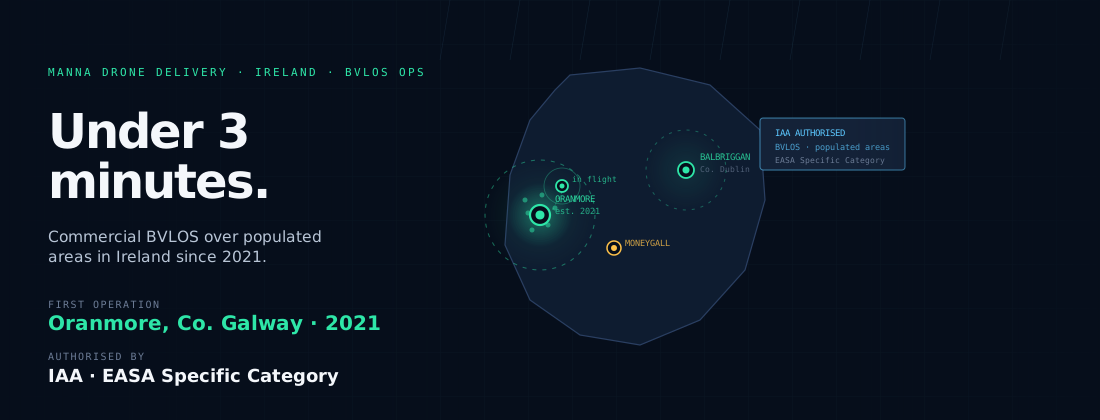
Manna launched its first commercial delivery operations in Oranmore, County Galway, in 2021. Oranmore is a suburban town of several thousand residents located near Galway city, and its geography — residential streets, moderate population density, relatively clear airspace — suited the initial operational design. The operation involved deliveries from a local hub to residential addresses within a defined delivery radius, using Manna’s proprietary aircraft.
The company subsequently expanded its operational footprint to additional Irish locations including Balbriggan in County Dublin and Moneygall in County Offaly. Each expansion required additional IAA engagement and authorisation, reflecting the incremental, location-specific nature of the regulatory process for populated-area BVLOS operations.
The aircraft and delivery mechanism
Manna’s delivery aircraft is a proprietary design that the company has developed and iterated over its operational period. The aircraft uses a multirotor configuration for take-off, landing and hover, with the delivery accomplished by lowering the package on a tether while the aircraft holds position above the delivery zone. This winch-based delivery mechanism avoids the need for the aircraft to land at the customer’s address, which would require a prepared landing surface and impose constraints on eligible delivery locations.
The aircraft is designed to operate in the wind and precipitation conditions typical of Irish weather — a practical constraint that has shaped the design more than might be obvious, given that Ireland’s Atlantic climate produces conditions that would ground many consumer-grade drones on a regular basis.
The commercial model
Manna’s commercial model involves partnerships with retailers and food service providers who offer drone delivery as a premium option within their existing ordering channels. The customer places an order through the retailer’s app or website; Manna fulfils the delivery by drone to the customer’s address within the delivery radius of the relevant hub. The proposition to the retailer is differentiation — a delivery capability that road courier services cannot match on speed — and the proposition to the customer is convenience.
Manna has partnered publicly with a range of food service and retail partners in its operational locations. The company has described its target delivery time as under three minutes from dispatch in optimal conditions — a figure that reflects the speed advantage of direct point-to-point flight over road-based delivery, which must navigate traffic and road networks.
What Ireland’s experience demonstrates
The significance of Manna’s Irish operations is that they provide one of the most directly applicable data sets for operators and regulators working on populated-area BVLOS delivery in European regulatory environments. Ireland is not an unusual or specially permissive environment — it operates under the same EASA framework as other EU member states, with an aviation authority that applies the same risk-based assessment processes. Manna’s authorisations demonstrate what is achievable through that framework when an operator presents a thorough safety case and builds a regulatory relationship incrementally.
The operational record from Oranmore and subsequent locations — weather events, failure modes, near-miss data, customer interaction patterns — represents a body of real-world evidence that is directly useful to other operators seeking similar authorisations in similar environments.