Elroy Air and the Chaparral: autonomous cargo drones for the middle mile
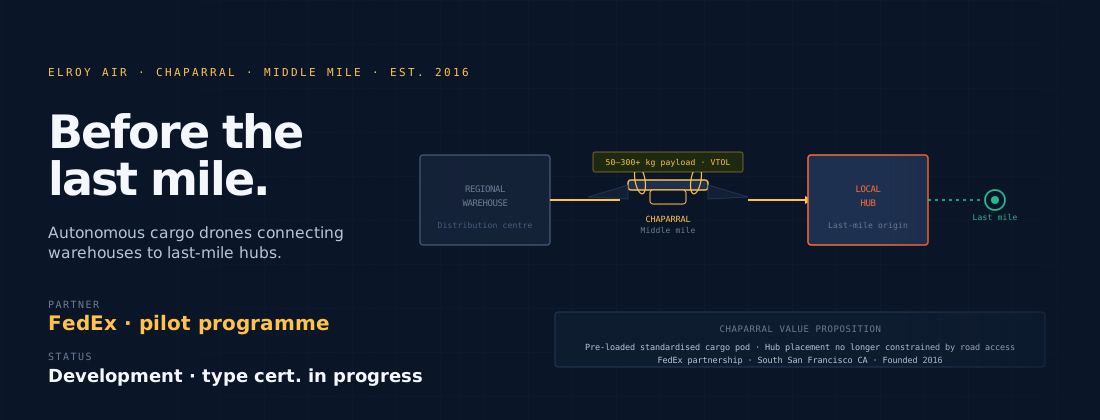
Elroy Air was founded in 2016 in South San Francisco, California. The company’s focus is a logistics problem that is distinct from the residential drone delivery applications that most of the sector’s attention has been directed toward: the middle mile. While parcel-scale delivery drones like Wing’s or Flytrex’s aircraft move packages from hubs to individual addresses — the last mile — Elroy Air is developing an autonomous cargo drone designed to move freight between distribution infrastructure nodes, connecting central warehouses to the local hubs from which last-mile delivery operates.
The Chaparral
Elroy Air’s aircraft, the Chaparral, is a VTOL cargo drone designed around a substantially larger payload and range capability than parcel-scale delivery aircraft. The Chaparral is designed to carry cargo in a standardised pod that can be pre-loaded, attached to the aircraft at a distribution facility, and detached at the destination hub — minimising ground handling time and enabling rapid turnaround.
The pod-based design is a deliberate logistics integration choice. A cargo aircraft that requires custom loading for each flight is harder to integrate into existing logistics workflows than one that works with standardised containers that can be managed independently of the aircraft. The Chaparral’s design anticipates that its value lies not just in the flight capability but in its fit with the broader logistics infrastructure that surrounds it.
The middle-mile opportunity
The logistics problem Elroy Air is addressing is real and significant. Moving freight between regional distribution centres and local delivery hubs involves a class of freight — too large for parcel drones, too frequent and time-sensitive for standard air freight, too expensive for road transport across certain distances — that has no ideal current solution in many markets. The cost of road transport for frequent, relatively small freight movements between hub nodes is substantial, and the time required degrades the speed advantage that the logistics network is designed to provide.
An autonomous cargo drone capable of flying hub-to-hub at meaningful payload capacity and range could, in principle, restructure the economics of the distribution network by enabling hub layouts that are not constrained by road transport time and cost. A last-mile delivery hub that can be resupplied in 30 minutes by cargo drone rather than two hours by van can be positioned differently, serve a wider catchment area, and operate at lower inventory.
The FedEx partnership
Elroy Air has announced a partnership with FedEx for pilot testing of the Chaparral in FedEx’s logistics network. The partnership is significant because FedEx represents a customer with exactly the middle-mile logistics challenge that Elroy Air is designed to address, at the scale and network complexity that makes autonomous cargo drone operations economically interesting rather than marginal.
For Elroy Air, the FedEx partnership provides operational context, customer input into design requirements, and the kind of credibility with investors and regulators that comes from engagement with a major incumbent logistics operator. For FedEx, the partnership provides early access to a potentially significant logistics technology and a degree of influence over how it develops.
The regulatory path for cargo drones
The Chaparral’s payload and range put it in a different regulatory category from parcel-scale delivery drones. A cargo aircraft of this class requires engagement with type certification frameworks that are still being developed by the FAA and other aviation authorities for large unmanned aircraft — a process that is more demanding and slower than the operational authorisation pathway that parcel-scale operators have used.
Elroy Air’s development timeline is therefore partly dependent on the pace of regulatory framework development for large unmanned cargo aircraft — a factor outside the company’s direct control. The company’s engagement with the FAA and its participation in industry standard-setting processes reflects the understanding that building the regulatory framework for this class of aircraft is as important as building the aircraft itself.