Wingcopter: the German tilt-rotor operator delivering medicine from Tanzania to Japan
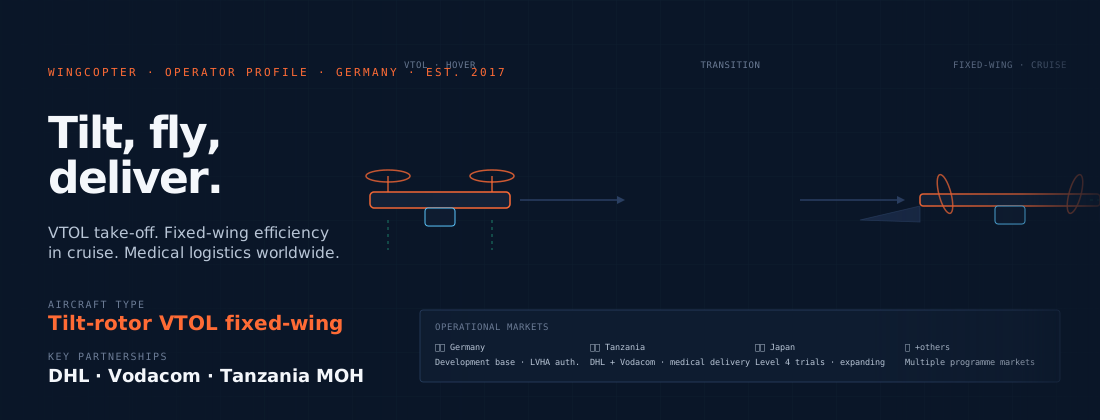
Wingcopter was founded in Darmstadt, Germany in 2017. The company has developed a fixed-wing VTOL aircraft that uses a tilt-rotor mechanism: multiple rotors that pivot from vertical orientation for take-off and landing to horizontal orientation for forward flight, combining the vertical take-off capability of a multirotor with the range and efficiency of a fixed-wing aircraft in cruise.
The design choice — more complex than either a pure multirotor or a conventional fixed-wing, but combining the operational advantages of both — reflects a specific view of what commercial delivery operations require. Wingcopter’s aircraft can take off from and land in confined spaces without a runway, fly extended distances at fixed-wing cruise efficiency, and deliver payloads in a range of environments that either pure configuration would struggle with.
The Wingcopter 198
Wingcopter’s primary commercial platform is a fixed-wing VTOL aircraft designed for payload delivery in demanding environments. The aircraft carries its payload in an underslung pod that can be released at the delivery point, or lowered on a line in some configurations. The design prioritises reliability and operational flexibility in markets where ground infrastructure for drone operations is limited.
The aircraft’s performance specifications — including payload capacity, range, and weather tolerance — have been validated across a range of operational environments, from the tropical conditions of east Africa to the more temperate conditions of Germany and Japan. This multi-environment validation provides a commercial track record that single-market operators cannot match.
Tanzania and African operations
Wingcopter’s most publicly documented operations have been in Tanzania, conducted in partnership with DHL and Vodacom. The Tanzania operation delivers medical supplies — vaccines, pharmaceuticals, and medical equipment — to remote health facilities that are difficult to reach by road. The partnership with DHL brings logistics expertise and distribution network knowledge; the partnership with Vodacom provides connectivity infrastructure in markets where reliable cellular coverage is commercially valuable.
The Tanzania operation represents the same fundamental use case that made Zipline’s African operations so significant: a healthcare system with real logistics gaps, payloads that are time-sensitive and appropriate for drone delivery, and government partners willing to develop the regulatory framework needed to make the operations legal. The Wingcopter-DHL-Vodacom partnership demonstrates that the model can be replicated with different operator, logistics, and connectivity partners from those Zipline has used.
Japan and Asian market development
Wingcopter has also conducted trials and development work in Japan, engaging with that country’s Level 4 regulatory framework that came into force in December 2022. Japan’s combination of an ageing rural population with healthcare logistics challenges, a technology-positive regulatory environment, and significant corporate investment in drone delivery creates a market context where Wingcopter’s capabilities are relevant.
The Japan engagement also reflects a strategic understanding that the most significant long-term market opportunities in drone delivery are in Asia — where population scale, infrastructure gaps, and regulatory development are all moving in directions that favour commercial operations.
Germany and the European regulatory environment
As a German company, Wingcopter operates within the EASA regulatory framework that governs all EU member states. The German aviation authority — Luftfahrt-Bundesamt — has been among the more active European authorities in processing authorisations for BVLOS commercial operations. Germany’s combination of regulatory engagement, strong engineering culture, and established aerospace industry creates a useful home base for a company developing novel aircraft systems.
Wingcopter’s German operations and engineering development have benefited from participation in European Union research programmes, including SESAR Joint Undertaking projects developing the U-space framework. This regulatory engagement provides both operational experience and influence in the development of the frameworks that will govern European drone delivery at scale.