Matternet and the Swiss model: what a mature medical drone network looks like
Matternet was founded in 2011 with a mission that its founders described as building the internet of things for physical goods — a network through which supplies could be moved on demand to any location, regardless of road conditions or infrastructure. The initial focus was on connecting remote communities in developing countries. What the company ultimately built, and where it has achieved its most sustained operational success, is something more specific: a hospital logistics network in Switzerland that has been running routine operations since 2017.
The Swiss Post partnership
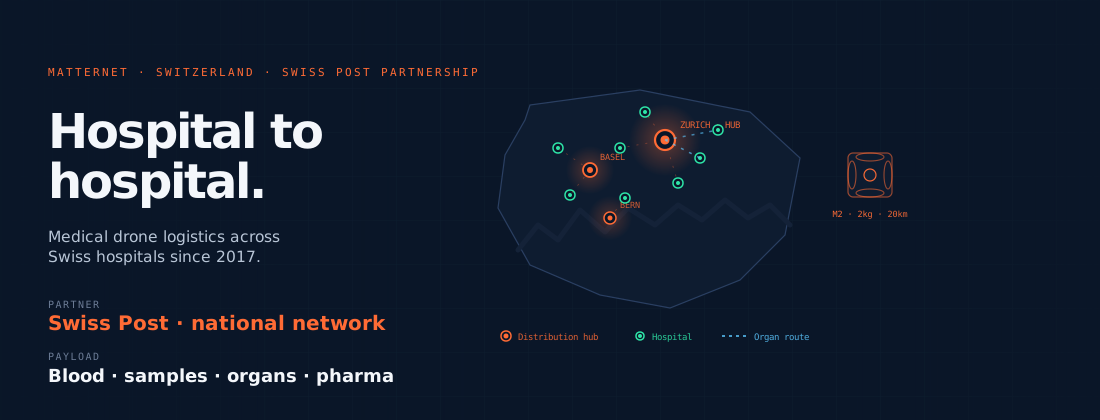
Matternet’s Swiss operations are conducted in partnership with Swiss Post, the country’s national postal operator. The partnership, announced in 2017 and expanded in subsequent years, uses Matternet’s M2 aircraft and software platform to carry medical samples, laboratory results, blood products, and small pharmaceutical items between hospitals and clinics across the country.
Swiss Post provides the logistics and customer relationship infrastructure — the integration with hospital procurement systems, the delivery coordination, the customer-facing elements of the service. Matternet provides the aircraft, the flight management software, and the operational expertise. The division of responsibilities reflects a model that Matternet has described publicly as its preferred commercial approach: partnering with established logistics operators who have existing customer relationships and regulatory standing, rather than building those relationships independently.
The Swiss Federal Office of Civil Aviation, FOCA, regulates drone operations in Switzerland, which is not an EU member state but has aligned its aviation regulatory framework closely with EASA standards. FOCA has been engaged with Matternet’s Swiss operations since their inception and has progressively expanded the authorisations covering the network as the operational record has developed.
The aircraft
Matternet’s M2 is a multirotor delivery aircraft designed specifically for the medical logistics use case. It is publicly documented as capable of carrying payloads of up to two kilograms over distances of up to twenty kilometres on a single charge. The aircraft is fully electric and operates autonomously, with the flight plan uploaded before each mission and the aircraft flying the route without real-time piloting input, subject to monitoring from a ground operator.
The M2’s payload specification — two kilograms — reflects the weight characteristics of the medical payloads it is designed to carry. Blood products, laboratory samples, small pharmaceutical items, and biopsy specimens are all within this range. The constraint means that the aircraft is not suited to larger medical items or equipment, but it is well-matched to the high-frequency, small-payload logistics flows that dominate hospital supply chains.
What the network covers
Matternet’s Swiss network connects hospital laboratories, blood banks, pharmacy fulfilment centres and clinical facilities across multiple cantons. Publicly documented routes include connections between facilities in the Zurich area — including the Kantonsspital Aarau — and routes serving facilities in the Basel and Bern regions. The network has expanded progressively since 2017 as additional facilities and routes have been authorised by FOCA.
The operational model is point-to-point between fixed facility endpoints rather than a hub-and-spoke delivery system serving variable addresses. This distinction is important for both regulatory and operational reasons. Fixed-endpoint operations involve a defined, known flight path between two certified landing locations; variable-address delivery requires a much more complex authorisation framework and places different demands on the aircraft’s navigation and landing capabilities.
Organ transport
Among the most publicly noted applications of Matternet’s Swiss network has been the transport of donor organs. Drone transport of donor organs for transplantation requires authorisation beyond that covering routine medical samples, given the nature of the payload and the time-critical characteristics of organ transport. Matternet has received the necessary authorisations in Switzerland and has publicly reported completing organ transport missions — a milestone that has attracted significant coverage given the clinical stakes involved and the potential for drones to reduce the time between organ availability and transplantation.
The significance of the Swiss model
What makes Matternet’s Swiss operation significant for the broader drone delivery industry is less the technology involved — the M2 is a capable but not exceptional aircraft by current standards — and more the operational model and the regulatory relationship that has been built around it.
The partnership with Swiss Post gave Matternet access to an established logistics operator’s infrastructure, customer relationships, and regulatory standing. The focus on a specific, well-defined use case — medical logistics between fixed hospital facilities — gave FOCA a clear basis for risk assessment and progressive authorisation expansion. The result is a network that has been operating routinely for several years, generating the kind of sustained operational record that builds regulatory confidence.
That record is the most valuable asset Matternet brings to new market discussions. An operator that can point to years of routine hospital operations, documented by a regulator, has a fundamentally different conversation with a new country’s aviation authority than one presenting a concept and a prototype.